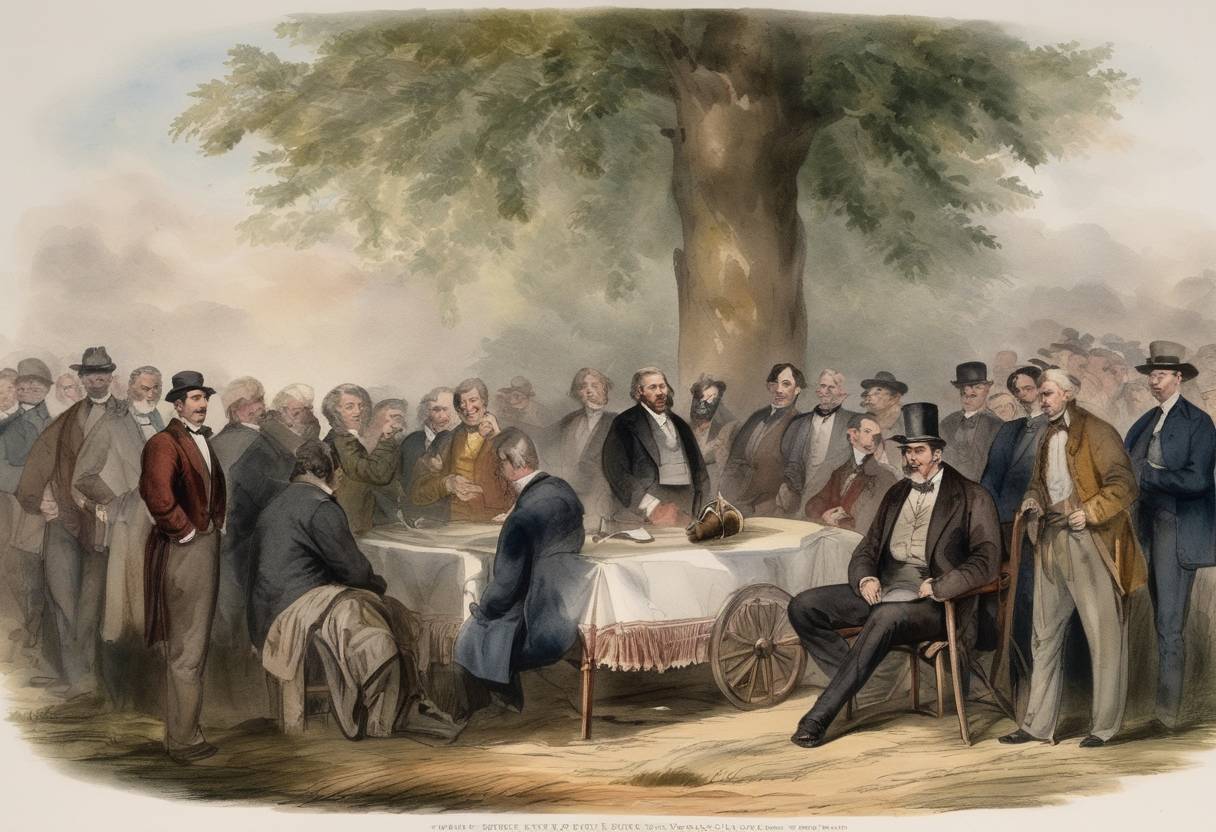
Founding of the Republican Party on March 1, 1854
The Republican Party was officially founded as a political entity on March 1, 1854, in Ripon, Wisconsin. This formative gathering marked the consolidation of a diverse coalition united by a common cause: stopping the expansion of slavery into the American territories. The driving impetus for the creation of the party was the controversial Kansas-Nebraska Act.
Context and Background
In the early 1850s, the issue of slavery’s expansion had become increasingly contentious in American politics. The Missouri Compromise of 1820, which prohibited slavery in new territories above the 36°30’ latitude, was a stabilizing influence. However, the Kansas-Nebraska Act of 1854 threatened this delicate balance by allowing these new territories to determine the legality of slavery through popular sovereignty.
The Kansas-Nebraska Act
Introduced by Senator Stephen A. Douglas, the Kansas-Nebraska Act essentially repealed the Missouri Compromise. The act sparked a vehement reaction in the North, where many saw it as a dangerous concession to pro-slavery interests. It was in this charged atmosphere that the foundational meeting of the Republican Party took place.
The Founding Event
The meeting in Ripon, Wisconsin, convened by anti-slavery activists, abolitionists, and factions from the collapsing Whig Party, served as the initial platform for organizing opposition against the spread of slavery. Under the leadership of individuals like Alvan E. Bovay, the participants laid down the ideological foundations of what would become the Republican Party. It united former Whigs, Free Soilers, anti-slavery Democrats, and abolitionists, all committed to resisting the expansion of slavery.
Significance and Aftermath
The creation of the Republican Party marked a pivotal shift in the American political landscape. By consolidating varied anti-slavery groups, it presented a robust counter to Democratic Party dominance. The Republican Party quickly gained influence and would go on to play a crucial role in American history, spearheading the election of Abraham Lincoln in 1860 and eventually contributing to the end of slavery in the United States.
This moment in Ripon was not just a protest against a legislative act but a significant step toward the political realignments that would define the United States in the following decades.