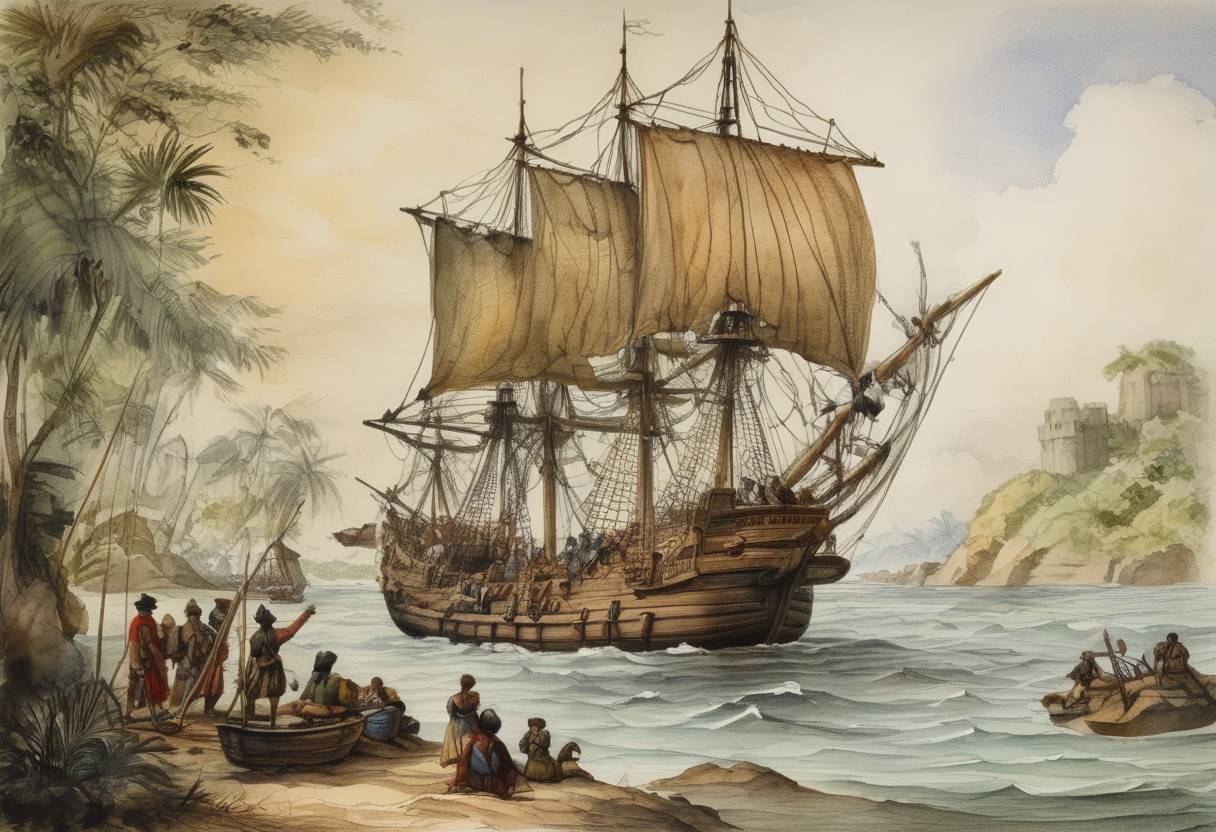
Vasco da Gama’s Expedition Reaches Mozambique - March 2, 1498
On March 2, 1498, the Portuguese explorer Vasco da Gama, leading one of the most significant voyages of the Age of Discovery, reached the island of Mozambique during his quest for a sea route to India. This marked a pivotal moment in the history of European exploration and the beginning of regular engagement between European explorers and East African regions.
Context and Background
Portugal, under the rule of King Manuel I, was eager to establish a direct maritime trade route to India to gain a competitive edge in the lucrative spice trade. This ambition led to Vasco da Gama being chosen to command an expedition along the African coast, ultimately aimed at reaching India.
Da Gama set sail from Lisbon in July 1497 with a fleet of four ships: São Gabriel, São Rafael, Berrio, and a supply ship. Navigating down the Western coast of Africa, the fleet rounded the Cape of Good Hope and ventured into the uncharted waters of the Indian Ocean, making stops along the eastern coast of Africa, including present-day Mozambique.
Arrival and Interaction
Upon arriving at the island of Mozambique, da Gama and his crew encountered a region thronged with traders and merchants from across the Indian Ocean. The island was then a Swahili port city under Muslim control, part of a bustling trade network that included the exchange of gold, ivory, and slaves for textiles, spices, and other goods from the Arabian Peninsula and the Indian subcontinent.
Da Gama initially attempted to present himself as a Muslim to integrate and gain favor within the local trading community. However, the deception was soon uncovered. Despite some initial tensions, Vasco da Gama procured guides from the local inhabitants to help navigate further up the coast towards India.
Significance and Consequences
Vasco da Gama’s arrival in Mozambique was among the early instances of European intervention in East African trade networks, heralding a new era of European influence in the region. The encounter facilitated by the arrival at Mozambique was crucial for obtaining knowledge about local trade winds and navigation charts, which would eventually guide da Gama to Calicut, India, later that year.
This expedition paved the way for the maritime route between Europe and Asia, drastically impacting global trade patterns. It led to the rise of Portuguese influence in the Indian Ocean and the eventual establishment of Portuguese colonies and trading posts across the African and Asian coasts, inaugurating an era of European colonialism.
The contact with Africa’s East Coast also underscored the beginning of a complex history of interactions—marked by commerce, conflict, and cultural exchanges—between European powers and East African societies. These interactions significantly altered the socio-economic dynamics of the region in ensuing centuries.