The First Fatal Airplane Crash: The Death of Lieutenant Thomas Selfridge
1908 · Fort Myer, United States
Lieutenant Thomas Selfridge became the first person to die in an airplane crash, during a demonstration flight piloted by Orville Wright.
October 5, 1905
Wilbur Wright made the first flight longer than 24 miles, flying 24.2 miles in 39 minutes and 23 seconds near Dayton, Ohio, demonstrating the potential of powered flight.
Dayton, United States | Wright Brothers
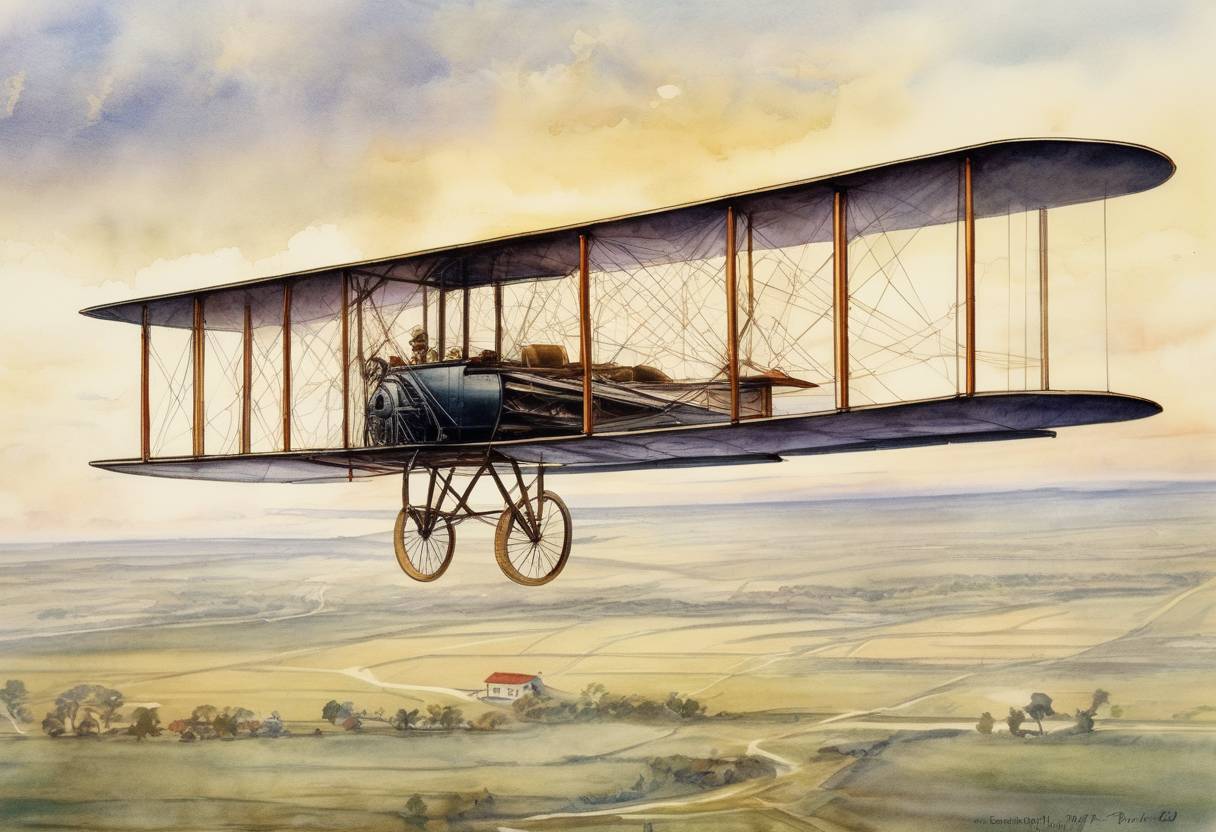
On October 5, 1905, Wilbur Wright achieved a significant milestone in the history of aviation by completing a flight that covered a distance of 24.2 miles in 39 minutes and 23 seconds. This event took place near Dayton, Ohio, and marked a pivotal moment in demonstrating the potential of powered flight.
The Wright brothers, Orville and Wilbur, had been working on the development of powered flight since the late 1890s. Their journey began with extensive research and experimentation with gliders, which laid the groundwork for their later achievements in powered aviation. By 1903, they had successfully conducted the first controlled, sustained flight of a powered, heavier-than-air aircraft at Kitty Hawk, North Carolina.
The aircraft used for the October 5, 1905 flight was the Wright Flyer III, an improved version of their earlier models. This version incorporated several enhancements based on the lessons learned from previous flights, including a more powerful engine, a more robust structure, and improved control mechanisms. These modifications significantly increased the aircraft’s stability and performance.
Wilbur Wright’s flight on October 5 was conducted at Huffman Prairie, a field near Dayton, Ohio, where the Wright brothers had been conducting much of their testing. The flight demonstrated not only the ability to cover a substantial distance but also the potential for sustained and controlled flight. The 24.2-mile journey was a testament to the advancements the Wright brothers had made in aviation technology.
This flight was a crucial step in proving the practicality of powered flight. It showcased the potential for aircraft to travel long distances, paving the way for future developments in aviation. The success of the Wright Flyer III helped to convince skeptics of the viability of powered flight and established the Wright brothers as pioneers in the field.
Following this achievement, the Wright brothers continued to refine their designs and sought to commercialize their inventions. Their work laid the foundation for the modern aviation industry, influencing countless innovations and developments in the years to come.
In summary, Wilbur Wright’s flight on October 5, 1905, was a landmark event in aviation history, demonstrating the feasibility and promise of powered flight and setting the stage for the future of air travel.
Source: en.wikipedia.org