The British North America Act Takes Effect: Creation of the Dominion of Canada
1867 · Ottawa, Canada
The British North America Act takes effect, creating the Dominion of Canada.
June 29, 1864
The Canadian Confederation Conference began in Charlottetown, leading to the formation of Canada.
Charlottetown, Canada | Province of Canada
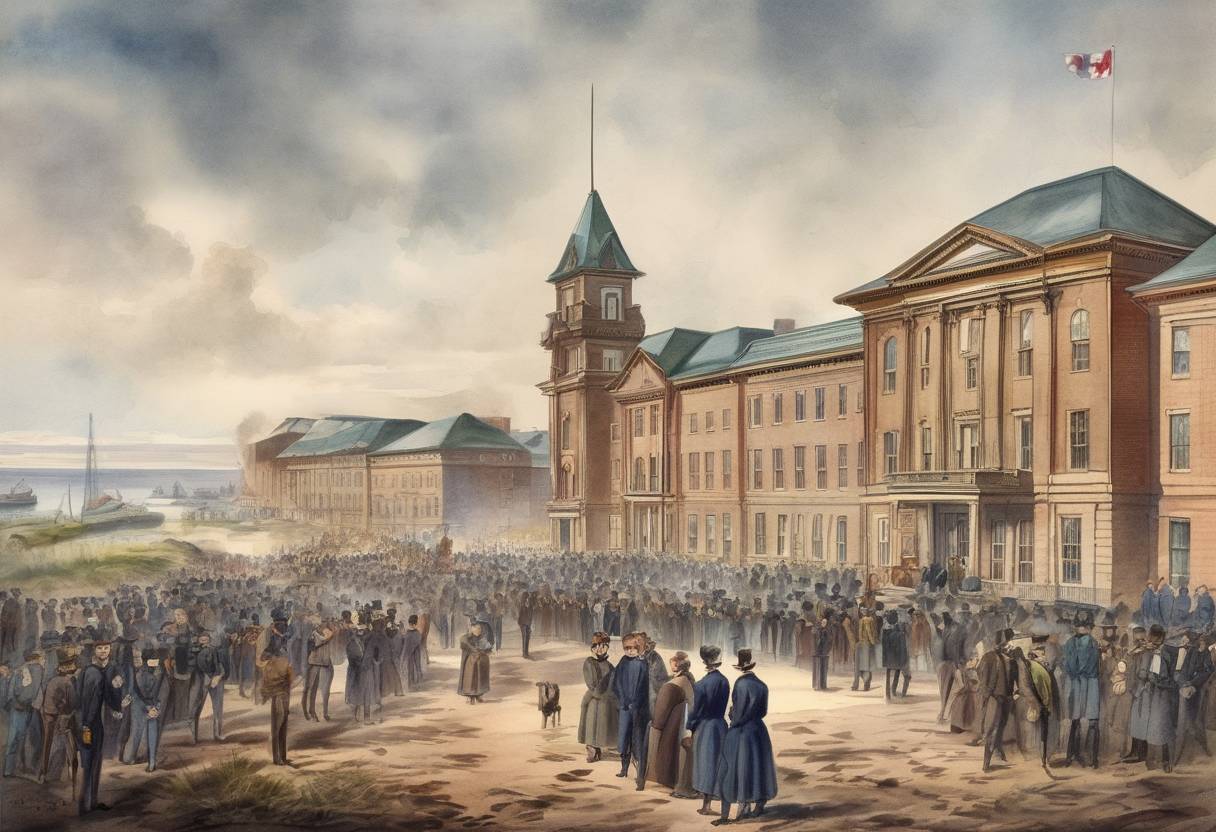
The Charlottetown Conference, which began on September 1, 1864, was a pivotal event in Canadian history, setting the stage for the formation of the Canadian Confederation. Prior to this conference, the provinces of British North America were separate colonies under British rule, each with its own government and interests. The idea of uniting these colonies had been discussed for years, driven by economic, political, and security concerns.
Political Stalemate: The Province of Canada (now Ontario and Quebec) was experiencing political deadlock between English and French-speaking populations. This impasse made governance difficult and highlighted the need for a new political structure.
Maritime Union Proposal: Initially, the Charlottetown Conference was intended to discuss a union among the Maritime Provinces—Nova Scotia, New Brunswick, and Prince Edward Island. However, representatives from the Province of Canada requested to join the discussions to propose a larger federation.
Economic and Security Concerns: The American Civil War (1861-1865) and the threat of American expansionism made the idea of a united defense strategy appealing. Additionally, economic benefits were anticipated from a larger, unified market.
Date and Location: The conference began on September 1, 1864, in Charlottetown, Prince Edward Island.
Delegates: Key figures included John A. Macdonald, George-Étienne Cartier, and George Brown from the Province of Canada, along with representatives from New Brunswick, Nova Scotia, and Prince Edward Island.
Discussions: The delegates discussed the merits of a federal union, where each province would retain control over local matters but cede authority over national issues to a central government. This structure aimed to balance regional interests with the need for a strong national government.
Outcome: The conference concluded with a general agreement on the principles of a federal union. The success of these discussions led to further meetings in Quebec City and London, where the details of the Confederation were hammered out.
Quebec Conference: Following the Charlottetown Conference, the Quebec Conference in October 1864 further refined the terms of the union, resulting in the “72 Resolutions” which laid the groundwork for the British North America Act.
Formation of Canada: The British North America Act was passed by the British Parliament and came into effect on July 1, 1867, officially creating the Dominion of Canada. The original provinces included Ontario, Quebec, New Brunswick, and Nova Scotia.
Legacy: The Charlottetown Conference is celebrated as the birthplace of Canadian Confederation. It marked the beginning of a process that would eventually lead to the inclusion of other provinces and territories, shaping the nation of Canada as it is known today.
The Charlottetown Conference was a crucial step in the creation of a unified Canada, demonstrating the power of negotiation and compromise in addressing complex political challenges.
Source: en.wikipedia.org