Richard I of England Arrives in Acre - June 8, 1191
1191 · Acre, Kingdom of Jerusalem
Richard I of England arrives in Acre, beginning his involvement in the Third Crusade.
September 7, 1191
The Battle of Arsuf took place during the Third Crusade, where Richard I of England defeated Saladin's forces.
Arsuf, Israel | Third Crusade
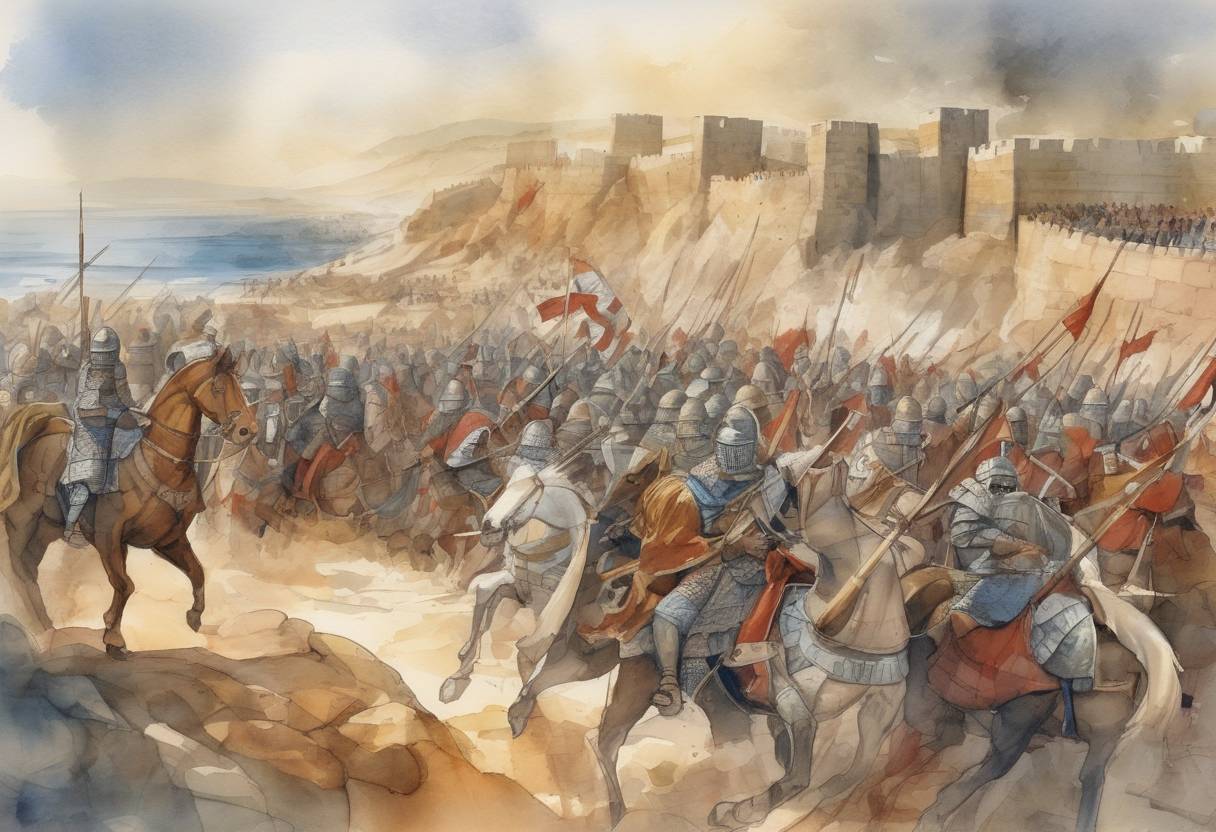
The Battle of Arsuf was a significant military engagement during the Third Crusade, where Richard I of England, also known as Richard the Lionheart, achieved a crucial victory over the forces of Saladin, the Sultan of Egypt and Syria. This battle took place on September 7, 1191, near the coastal town of Arsuf, north of Jaffa, in present-day Israel.
The Third Crusade (1189–1192) was launched in response to the capture of Jerusalem by Saladin in 1187. Richard I, alongside other European monarchs like Philip II of France, embarked on this crusade to reclaim the Holy Land for Christendom. After capturing the city of Acre in July 1191, Richard’s forces began marching south along the Mediterranean coast towards Jaffa, a strategic port city needed for a subsequent assault on Jerusalem.
Forces Involved: Richard’s army consisted of approximately 10,000 men, including knights, infantry, and archers. Saladin’s forces were larger, estimated at around 20,000, comprising mainly cavalry and archers.
Tactics and Strategy: Richard’s forces marched in a disciplined formation, with infantry and crossbowmen protecting the flanks and rear, while the knights were kept in reserve. Saladin’s strategy involved harassing the Crusaders with hit-and-run tactics, aiming to break their formation.
Key Events: On the morning of September 7, as Richard’s army approached Arsuf, Saladin launched a full-scale assault. Despite the relentless attacks, Richard maintained his troops’ discipline. The turning point came when Richard ordered a counter-charge by his knights, which decisively broke through Saladin’s lines, causing a rout.
Immediate Consequences: The victory at Arsuf bolstered the morale of the Crusader forces and secured the coastal route to Jaffa. It demonstrated Richard’s military prowess and his ability to lead and inspire his troops under pressure.
Broader Impact: Although the battle was a tactical victory for the Crusaders, it did not lead to the immediate recapture of Jerusalem. However, it established Richard as a formidable opponent and set the stage for further negotiations and military engagements with Saladin.
Legacy: The Battle of Arsuf is often remembered for Richard’s leadership and the disciplined execution of medieval warfare tactics. It remains a notable example of the challenges and complexities of the Crusades, highlighting the interplay of military strategy, religious fervor, and political ambition.
In conclusion, the Battle of Arsuf was a pivotal moment in the Third Crusade, showcasing the military acumen of Richard the Lionheart and marking a significant, albeit temporary, shift in the balance of power in the Crusader states.
Source: en.wikipedia.org