Cyprus Independence Agreement - February 19, 1959
1959 · London, United Kingdom
The United Kingdom granted Cyprus independence, ending British colonial rule.
December 6, 1921
The Anglo-Irish Treaty was signed, ending the Irish War of Independence and establishing the Irish Free State as a self-governing dominion within the British Empire.
London, United Kingdom | British Government
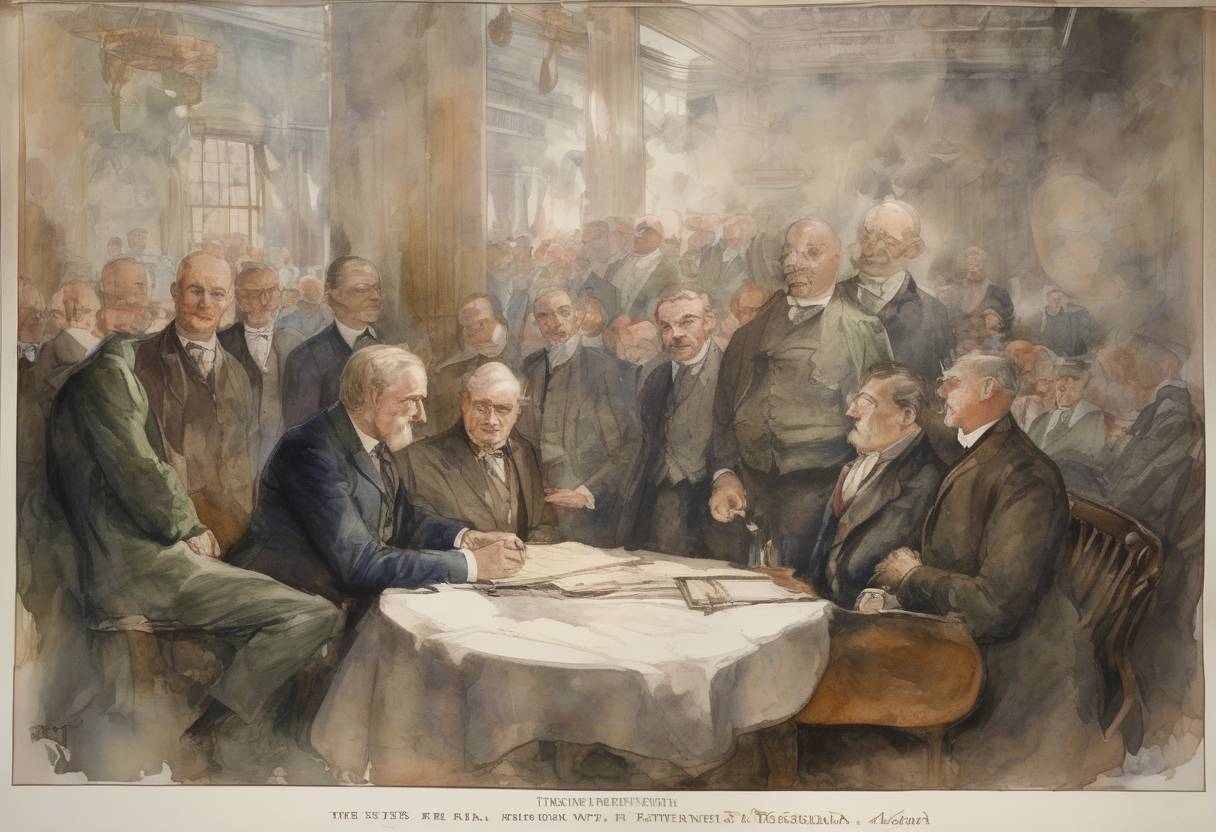
The signing of the Anglo-Irish Treaty on December 6, 1921, marked a pivotal moment in Irish history, bringing an end to the Irish War of Independence. This conflict, which lasted from 1919 to 1921, was a guerrilla war between the Irish Republican Army (IRA) and British forces. The war was rooted in Ireland’s long-standing struggle for independence from British rule, which intensified following the 1916 Easter Rising and the subsequent rise of Sinn Féin, a political party advocating for Irish independence.
Negotiations took place in London between representatives of the British government and the Irish delegation. The British delegation was led by Prime Minister David Lloyd George, while the Irish delegation included key figures such as Arthur Griffith and Michael Collins. The talks were complex and fraught with tension, as both sides had to navigate contentious issues such as the status of Northern Ireland and the nature of Irish sovereignty.
The Anglo-Irish Treaty established the Irish Free State as a self-governing dominion within the British Empire, similar to Canada or Australia. Key provisions included:
The signing of the treaty was met with mixed reactions in Ireland. It was seen as a compromise that fell short of full independence, leading to a split within the Irish nationalist movement:
The Anglo-Irish Treaty was a landmark in the history of Ireland and the British Empire. It marked the beginning of the end of British rule in most of Ireland and set the stage for the eventual establishment of a fully independent Irish republic. The treaty’s legacy is complex, as it both resolved and sowed new conflicts, shaping the political landscape of Ireland for decades to come.
Source: en.wikipedia.org