UNIVAC I: The World's First Commercial Computer
1951 · Philadelphia, United States
UNIVAC I, the world's first commercial computer, is unveiled in Philadelphia.
February 14, 1946
The Electronic Numerical Integrator and Computer (ENIAC), the first general-purpose electronic digital computer, was formally dedicated at the University of Pennsylvania.
Philadelphia, United States | University of Pennsylvania
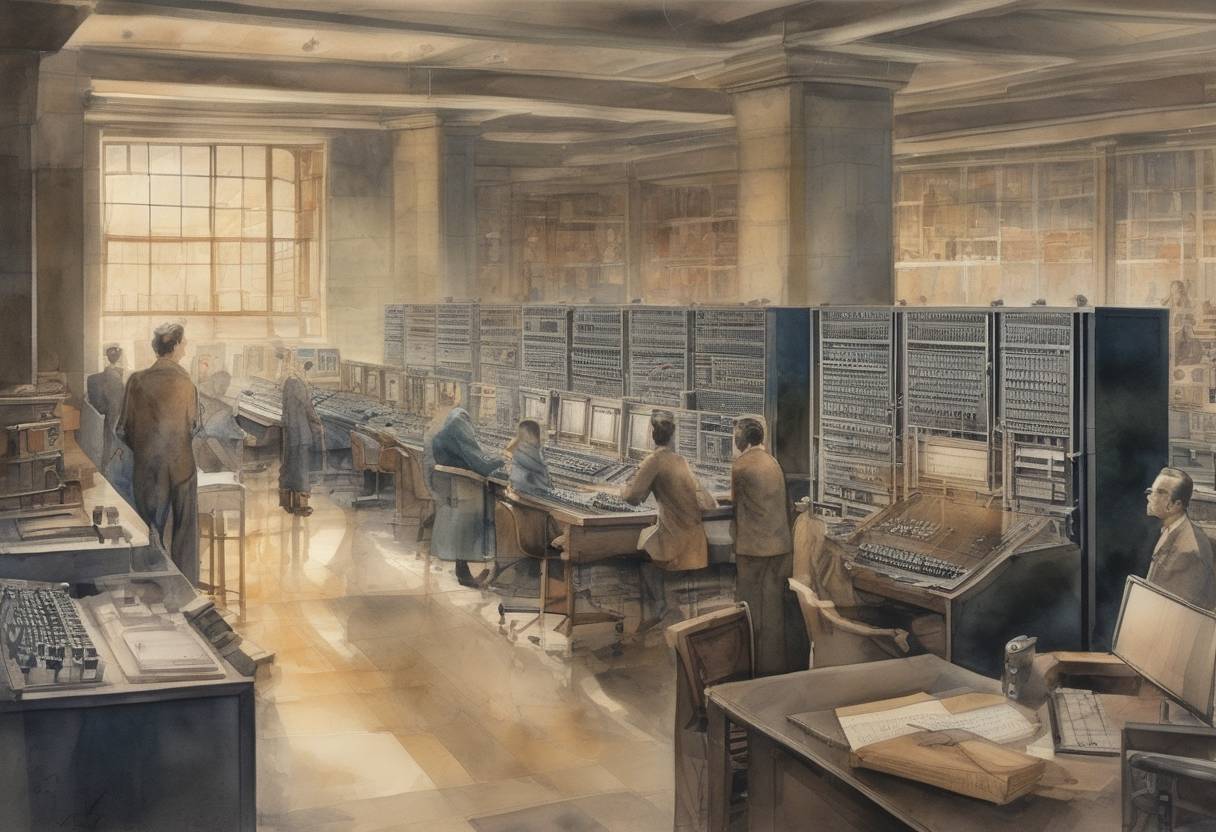
On February 14, 1946, the Electronic Numerical Integrator and Computer (ENIAC) was formally dedicated at the University of Pennsylvania. This event marked a significant milestone in the history of computing, as ENIAC is widely regarded as the first general-purpose electronic digital computer.
The development of ENIAC was initiated during World War II, driven by the need for rapid calculations to improve artillery accuracy. The project was funded by the United States Army and spearheaded by John W. Mauchly and J. Presper Eckert, two pioneering engineers at the University of Pennsylvania’s Moore School of Electrical Engineering.
The dedication ceremony on February 14, 1946, was a momentous occasion attended by military officials, scientists, and the press. Demonstrations showcased ENIAC’s capabilities, highlighting its potential to revolutionize scientific and military calculations.
Following its dedication, ENIAC was used extensively by the U.S. Army for ballistic calculations and other scientific applications until it was decommissioned in 1955. The machine’s legacy endures as a foundational achievement in the history of computing, symbolizing the transition from mechanical to electronic computation.
In summary, the dedication of ENIAC on February 14, 1946, was a pivotal event that heralded the dawn of the computer age, setting the stage for the technological advancements that would shape the modern world.
Source: en.wikipedia.org