Kublai Khan Becomes Ruler of the Mongol Empire
1260 · Karakorum, Mongol Empire
Kublai Khan becomes ruler of the Mongol Empire.
August 18, 1227
Genghis Khan, the founder and first Great Khan of the Mongol Empire, died. His death marked the beginning of the division of his empire among his descendants, leading to the establishment of several khanates.
unknown, Mongol Empire | Mongol Empire
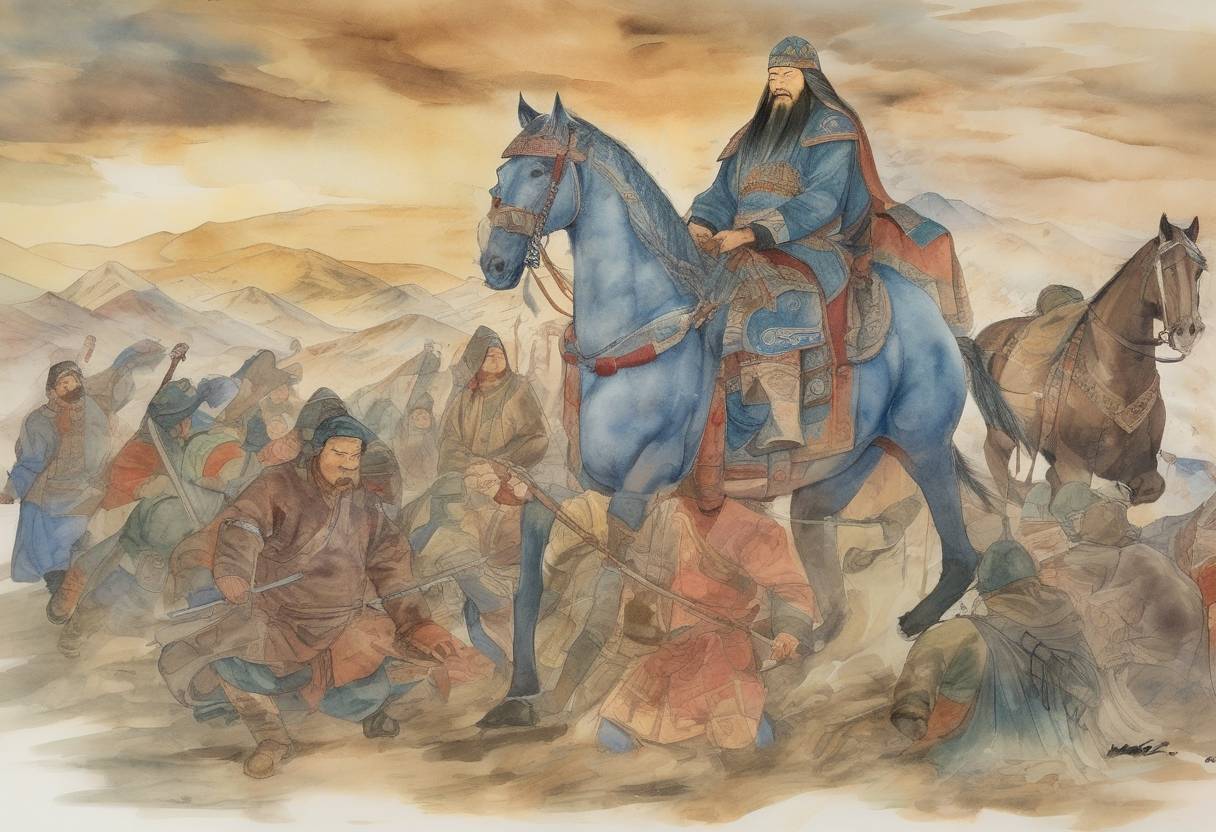
Genghis Khan, born Temüjin, was the founder and first Great Khan of the Mongol Empire, which became the largest contiguous empire in history after his death. His leadership and military strategies were instrumental in uniting the Mongol tribes and expanding their territories across Asia and into Europe. Genghis Khan’s death on August 18, 1227, marked a significant turning point in the history of the Mongol Empire.
By the time of his death, Genghis Khan had established a vast empire that stretched from the Pacific Ocean to the Caspian Sea. His campaigns were characterized by their speed, mobility, and innovative military tactics. In 1227, Genghis Khan was engaged in a campaign against the Western Xia, a kingdom in northwestern China that had defied Mongol authority.
The exact circumstances of Genghis Khan’s death remain somewhat shrouded in mystery, with various historical accounts offering differing explanations. Some suggest he died from injuries sustained during a fall from a horse, while others propose he succumbed to illness. Regardless of the cause, his death occurred during the siege of the Western Xia capital, Yinchuan.
Genghis Khan’s death led to the division of his empire among his sons and grandsons, in accordance with Mongol tradition. This division resulted in the establishment of several khanates, each ruled by a different branch of his family. The most notable of these were:
The division of the Mongol Empire did not immediately lead to its decline; rather, it allowed for the continued expansion and consolidation of Mongol power across Eurasia. The khanates maintained trade routes, such as the Silk Road, and facilitated cultural and technological exchanges between East and West. However, over time, internal conflicts and the challenges of governing such vast territories contributed to the fragmentation and eventual decline of Mongol dominance.
Genghis Khan’s legacy is complex, marked by both his role as a unifier and conqueror. His death on August 18, 1227, set the stage for the next phase of Mongol history, influencing the political and cultural landscapes of Asia and Europe for centuries to come.
Source: en.wikipedia.org