Alan Shepard: First American in Space
1961 · Cape Canaveral, United States
Alan Shepard becomes the first American in space aboard the Freedom 7 spacecraft.
January 31, 1961
Ham the Chimp travels into outer space aboard Mercury-Redstone 2, becoming the first hominid launched into space.
Cape Canaveral, United States | NASA
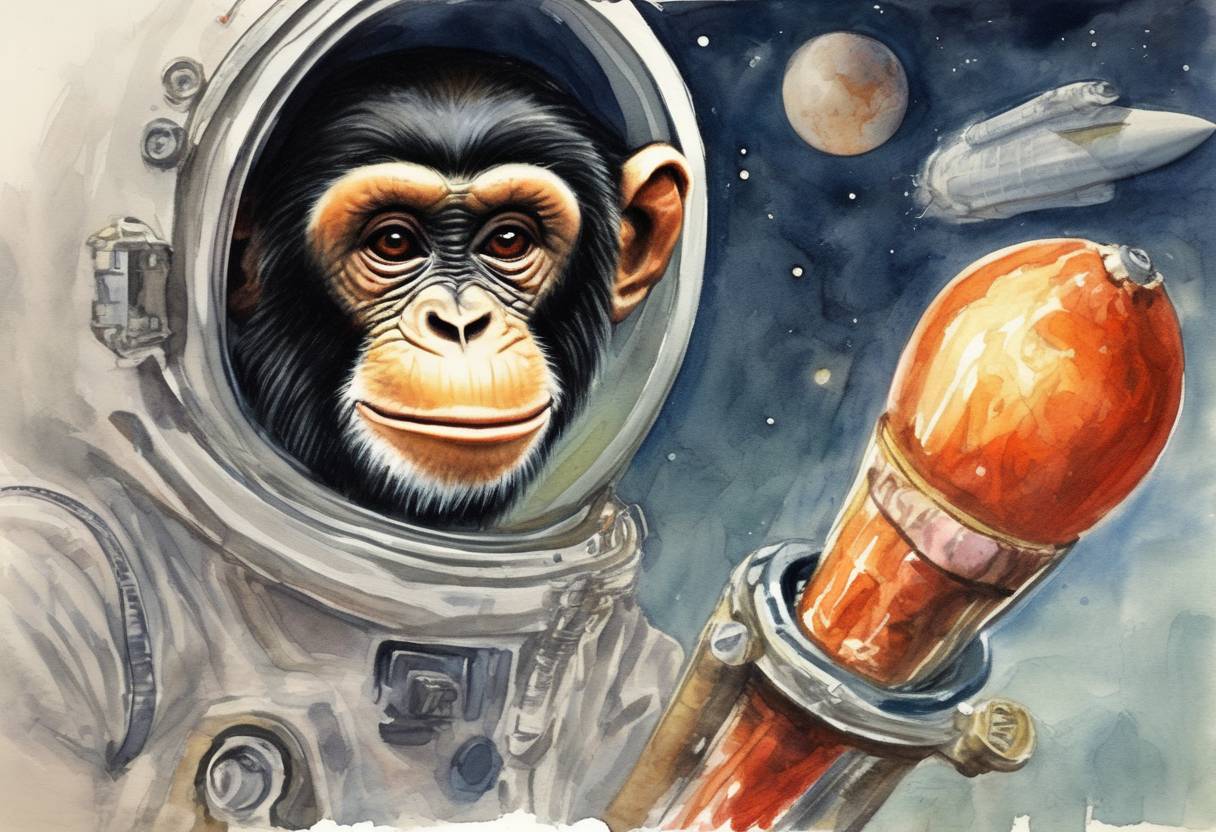
On January 31, 1961, a significant milestone in the history of space exploration was achieved when Ham the Chimp became the first hominid to travel into outer space. This event was part of NASA’s Project Mercury, which aimed to send humans into space and ensure their safe return to Earth.
Project Mercury: Initiated by NASA in 1958, Project Mercury was the United States’ first human spaceflight program. Its objectives included orbiting a manned spacecraft around Earth, investigating human capabilities in space, and recovering both the astronaut and spacecraft safely.
Selection of Ham: Ham, a chimpanzee born in Cameroon and brought to the United States, was chosen for this mission due to his close genetic relationship to humans. He was trained to perform tasks in response to electric lights and sounds, which would test his ability to function in space.
Launch Vehicle: The mission utilized the Mercury-Redstone 2 rocket, a modified version of the Redstone ballistic missile, designed to carry a Mercury capsule.
Launch Details: The launch took place at Cape Canaveral, Florida. Ham was secured in a specially designed biopack within the Mercury capsule.
Flight Duration and Path: The flight lasted approximately 16 minutes and 39 seconds, reaching an altitude of 157 miles and a speed of 5,857 miles per hour. Ham experienced about 6.6 minutes of weightlessness during the suborbital flight.
Task Performance: During the flight, Ham successfully performed the tasks he had been trained for, demonstrating that tasks could be completed in a weightless environment.
Capsule Re-entry and Recovery: The Mercury capsule splashed down in the Atlantic Ocean, about 130 miles from the launch site. Ham was safely recovered by a rescue ship, the USS Donner, and was found to be in good health.
Impact on Human Spaceflight: Ham’s successful mission provided NASA with crucial data on the effects of space travel on living organisms, paving the way for human spaceflights. It demonstrated that humans could perform tasks in space, a critical factor for future missions.
Legacy: Ham’s flight was a precursor to Alan Shepard’s historic flight on May 5, 1961, when he became the first American astronaut to travel into space.
Ham’s Later Life: After the mission, Ham lived at the National Zoo in Washington, D.C., and later at a zoo in North Carolina, where he lived until his death in 1983.
Ham the Chimp’s journey into space marked a pivotal moment in the space race, showcasing the potential for human space exploration and contributing to the advancements that would eventually lead to landing a man on the Moon.
Source: en.wikipedia.org