Establishment of Cebu as the First Spanish Settlement in the Philippines
1565 · Cebu, Philippines
Cebu was established as the first Spanish settlement in the Philippines by Miguel López de Legazpi.
April 27, 1521
The Battle of Mactan occurred, where Filipino forces led by Lapu-Lapu defeated Spanish forces led by Ferdinand Magellan, resulting in Magellan's death.
Mactan, Philippines | Spanish expedition
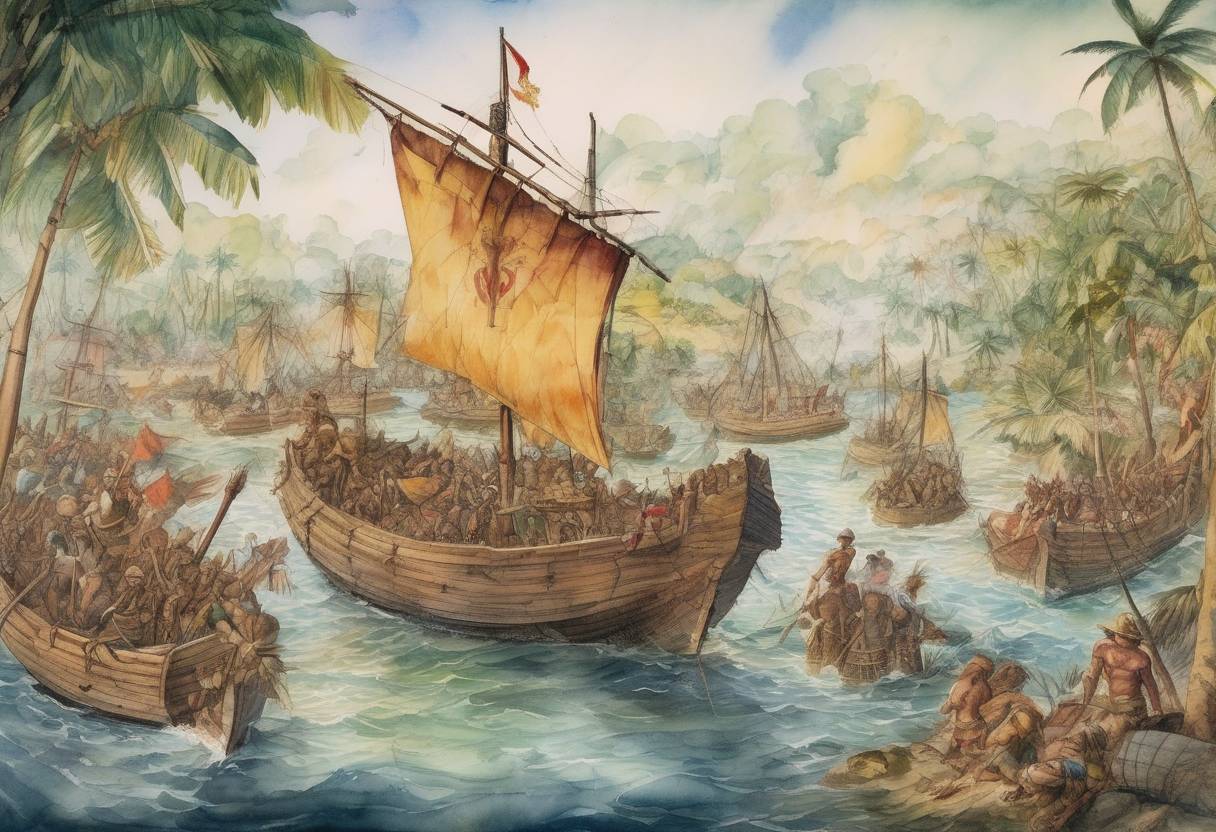
The Battle of Mactan was a significant historical event that took place on April 27, 1521, in the Philippines. This battle marked a pivotal moment in the early interactions between European explorers and indigenous peoples in Southeast Asia.
In the early 16th century, the Age of Exploration was in full swing, with European powers seeking new trade routes and territories. Ferdinand Magellan, a Portuguese explorer sailing under the Spanish flag, embarked on an expedition to find a westward route to the Spice Islands (modern-day Maluku Islands in Indonesia). Magellan’s fleet, known as the Armada de Molucca, reached the Philippines in March 1521.
Upon arrival, Magellan established friendly relations with some local leaders, including Rajah Humabon of Cebu. Humabon converted to Christianity, and in return, he pledged allegiance to the Spanish crown. However, not all local leaders were receptive to Spanish influence.
Lapu-Lapu, a chieftain of Mactan Island, resisted Spanish demands for submission and conversion to Christianity. Magellan, confident in his superior weaponry and eager to demonstrate Spanish power, decided to confront Lapu-Lapu.
On the morning of April 27, 1521, Magellan led a force of approximately 60 men, including Spanish soldiers and converted natives, to Mactan Island. Due to the shallow waters surrounding the island, Magellan’s ships could not approach the shore, forcing his men to wade through the water to reach the beach.
Lapu-Lapu and his warriors, numbering around 1,500, awaited the Spanish on the shore. The battle that ensued was fierce and chaotic. Despite their advanced weaponry, the Spanish were overwhelmed by the sheer number of Lapu-Lapu’s forces and their knowledge of the terrain.
Magellan was struck by a bamboo spear and later killed in the skirmish. His death marked a significant setback for the Spanish expedition.
The Battle of Mactan was a crucial moment in Philippine history, symbolizing resistance against foreign domination. Lapu-Lapu became a national hero and a symbol of Filipino bravery and independence.
For the Spanish, the loss of Magellan was a significant blow. The remaining members of his expedition eventually completed the first circumnavigation of the globe, led by Juan Sebastián Elcano, but the encounter at Mactan highlighted the challenges of colonial expansion.
The battle is remembered as an early instance of indigenous resistance to European colonization, and it remains a celebrated event in the Philippines, commemorated annually as “Lapu-Lapu Day.”
In summary, the Battle of Mactan was not only a clash of arms but also a clash of cultures and ideologies, with lasting implications for the history of the Philippines and European colonial ambitions in Asia.
Source: en.wikipedia.org