Abraham Lincoln's Second Inauguration: March 4, 1865
1865 · Washington, D.C., United States
Abraham Lincoln was inaugurated for his second term as President of the United States.
March 4, 1861
Abraham Lincoln was inaugurated as the 16th President of the United States.
Washington, D.C., United States | United States Government
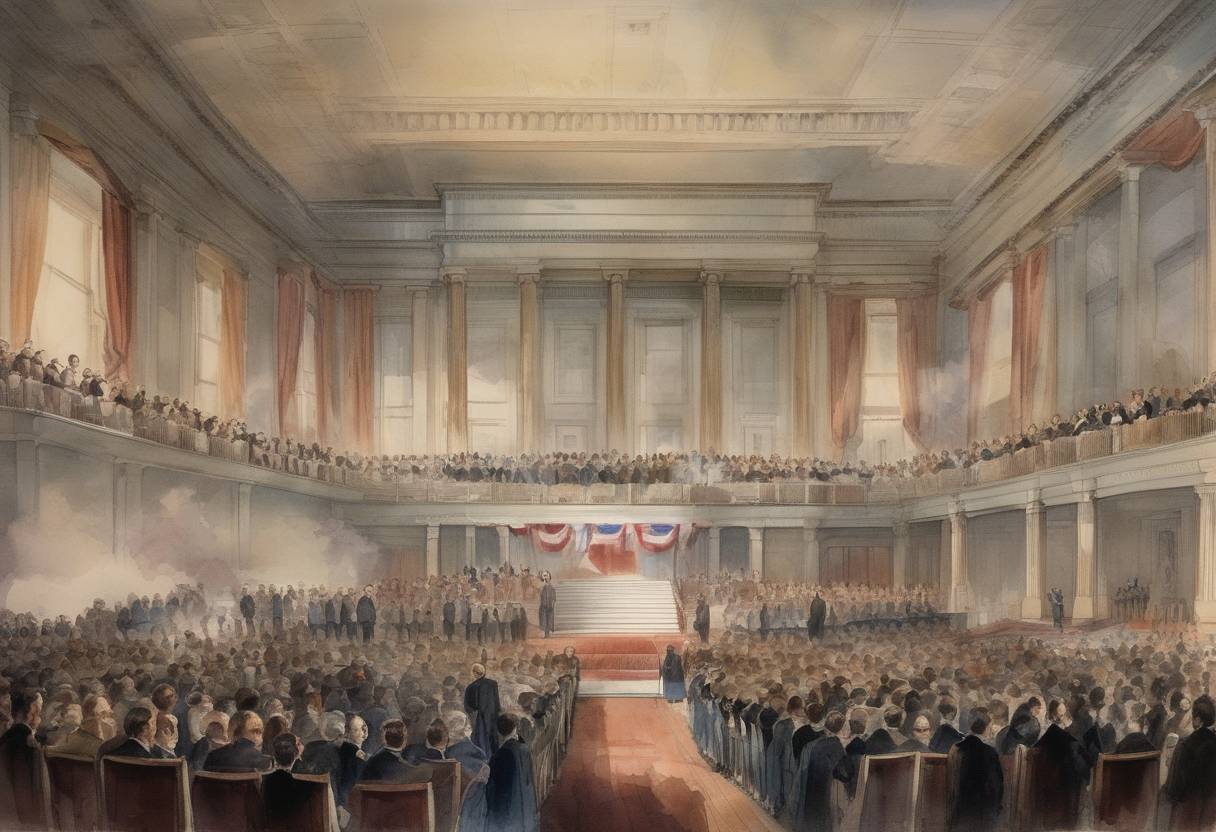
On March 4, 1861, Abraham Lincoln was inaugurated as the 16th President of the United States, a pivotal moment in American history. This event marked the beginning of Lincoln’s leadership during one of the nation’s most challenging periods, as the country stood on the brink of civil war.
Election of 1860: Lincoln’s election in November 1860 was a significant turning point. He ran as the Republican candidate, opposing the expansion of slavery into the territories. His victory was seen as a threat by Southern states, leading to heightened tensions.
Secession Crisis: By the time of Lincoln’s inauguration, seven Southern states—South Carolina, Mississippi, Florida, Alabama, Georgia, Louisiana, and Texas—had seceded from the Union, forming the Confederate States of America. This secession was a direct response to Lincoln’s election and his anti-slavery platform.
Location: The inauguration took place at the East Portico of the United States Capitol in Washington, D.C.
Security Concerns: Given the volatile political climate, security was a significant concern. There were fears of assassination attempts or disruptions by Confederate sympathizers. As a result, heightened security measures were in place.
Lincoln’s Inaugural Address: In his address, Lincoln focused on the themes of unity and the preservation of the Union. He emphasized that he had no intention to interfere with slavery where it existed but firmly stated that the Union was perpetual and secession was illegal. His famous closing appeal was for reconciliation, urging Americans to heed “the better angels of our nature.”
Union and Constitution: Lincoln reiterated his commitment to uphold the Constitution and maintain the Union, asserting that the Union was older than the Constitution itself.
Appeal for Peace: He appealed to the seceded states to return to the Union peacefully, expressing his hope to avoid conflict.
Firm Stance on Secession: Lincoln declared that acts of violence against the United States were insurrectionary or revolutionary, depending on the outcome, and he would fulfill his duty to “hold, occupy, and possess the property and places belonging to the government.”
Civil War Onset: Despite Lincoln’s appeals for peace, the Confederate attack on Fort Sumter in April 1861, just over a month after his inauguration, marked the beginning of the Civil War.
Leadership in Crisis: Lincoln’s presidency would be defined by his leadership during the Civil War, his efforts to preserve the Union, and his role in the abolition of slavery.
Legacy: Lincoln’s inaugural address is remembered for its eloquence and its call for national unity at a time of deep division. His presidency set the stage for significant social and political changes in the United States.
Abraham Lincoln’s inauguration was not just a ceremonial transition of power; it was a defining moment that set the course for the nation’s future amidst unprecedented challenges.
Source: en.wikipedia.org