Napoleon Bonaparte's Surrender on July 15, 1815
1815 · Rochefort, France
Napoleon Bonaparte surrendered to Captain Frederick Maitland of HMS Bellerophon, marking the end of the Napoleonic Wars.
October 21, 1805
The Battle of Trafalgar takes place, a naval engagement fought by the British Royal Navy against the combined fleets of France and Spain during the Napoleonic Wars, resulting in a decisive British victory.
Cape Trafalgar, Spain | British Royal Navy
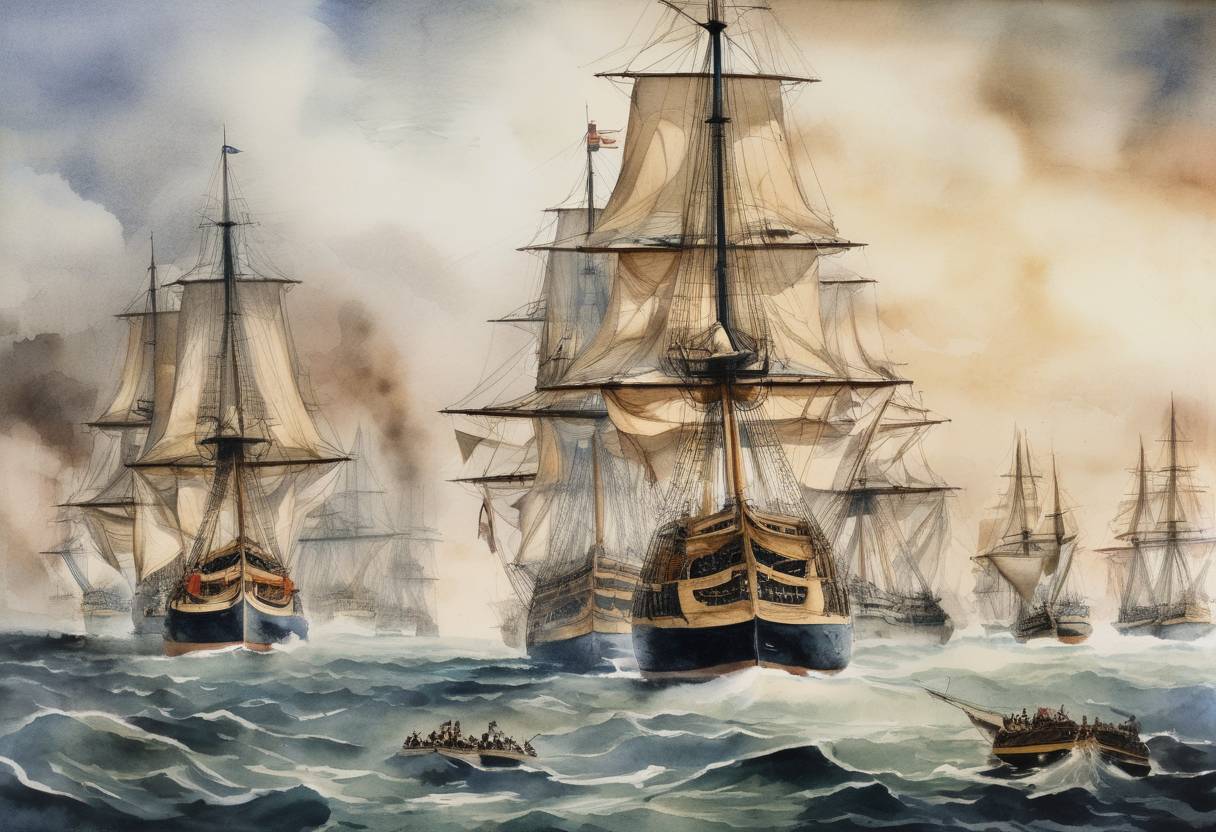
The Battle of Trafalgar, fought on October 21, 1805, stands as one of the most significant naval engagements in history. It was a pivotal moment during the Napoleonic Wars, where the British Royal Navy, under the command of Vice-Admiral Horatio Nelson, faced the combined fleets of France and Spain.
The Napoleonic Wars (1803-1815) were a series of conflicts involving Napoleon Bonaparte’s French Empire and various European coalitions. By 1805, Napoleon sought to invade Britain, and to do so, he needed to ensure control of the English Channel. This required neutralizing the British naval threat.
The French and Spanish fleets, commanded by Admiral Pierre-Charles Villeneuve, were tasked with breaking the British blockade and securing naval dominance. However, Villeneuve’s fleet was pursued by Nelson, who was determined to prevent any threat to British shores.
The battle took place off the coast of Cape Trafalgar, near the southwest coast of Spain. Nelson’s fleet consisted of 27 ships of the line, while the Franco-Spanish fleet had 33. Despite being outnumbered, Nelson employed innovative tactics.
Nelson’s strategy deviated from the traditional naval tactics of parallel lines. Instead, he divided his fleet into two columns, intending to break through the enemy line perpendicularly. This approach aimed to disrupt the cohesion of the Franco-Spanish fleet, allowing the British to engage in close-quarters combat, where their superior training and gunnery could prevail.
The Battle of Trafalgar ended in a decisive British victory. The Franco-Spanish fleet lost 22 ships, while the British did not lose a single vessel. This victory ensured British naval supremacy for the remainder of the Napoleonic Wars and effectively ended Napoleon’s plans to invade Britain.
The Battle of Trafalgar remains a testament to strategic innovation and the importance of naval power in shaping global history.
Source: en.wikipedia.org