1649 · London, England
King Charles I of England went on trial for treason and other high crimes against the realm. This trial eventually led to his execution.
January 3, 1642
King Charles I of England attempts to arrest members of the Long Parliament who were in opposition to his policies, an event that contributes to the tensions leading to the English Civil War.
London, England | English monarchy
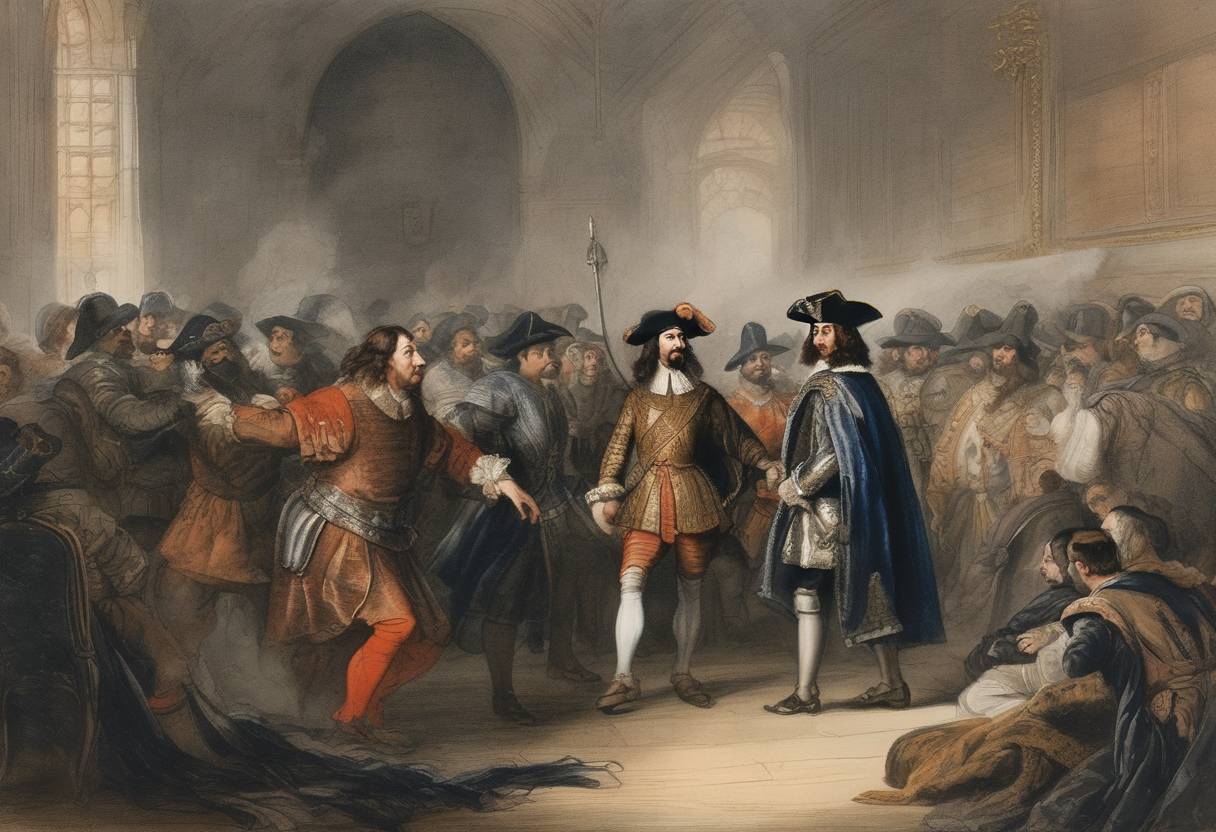
On January 3, 1642, King Charles I of England made a decisive and controversial move that significantly heightened tensions between the monarchy and Parliament, contributing to the onset of the English Civil War. This event, known as the attempted arrest of five members of the Long Parliament, was a direct confrontation with parliamentary privilege and an assertion of royal authority.
The relationship between Charles I and Parliament had been strained due to a series of disputes over royal prerogative and issues such as taxation, religious reforms, and governance. Charles I’s use of personal rule from 1629 to 1640, during which he governed without calling Parliament, had also created deep resentment. When the Long Parliament convened in 1640, it sought to address grievances and curb the king’s authority.
The immediate cause of the attempted arrests lay in the king’s growing frustration with Parliament’s resistance. Charles I, believing that certain members were in conspiracy with the Scots and threatening his authority, issued accusations of treason against five members of the House of Commons: John Pym, John Hampden, Denzil Holles, Sir Arthur Haselrig, and William Strode, as well as one peer, Lord Mandeville (later known as the Earl of Manchester).
On January 3, 1642, Charles issued a warrant for their arrest. His unprecedented action was seen as a direct attack on the institution of Parliament and its rights, especially since parliamentary privilege traditionally protected its members from arrest while attending sessions.
The move was politically disastrous for Charles. Upon learning of the king’s intentions, the five members fled and took refuge in the City of London, whose populace was largely supportive of parliamentary causes. On January 4, Charles personally entered the House of Commons with armed guards to seize the accused members but found them absent. Speaker William Lenthall, when pressed by the king, famously replied, “May it please Your Majesty, I have neither eyes to see nor tongue to speak in this place but as the House is pleased to direct me,” highlighting the breach of parliamentary privilege.
The botched arrest attempt alienated many of the king’s potential supporters and galvanized opposition against him. It intensified distrust and enmity between the monarch and Parliament, polarizing factions and setting the scene for the outbreak of the English Civil War in August 1642.
This incident is considered a pivotal moment leading up to the English Civil War. It underscored the irreconcilable differences between the monarchy and Parliament and was a clear signal of the lengths to which Charles was willing to go to assert his authority. It energized the Parliamentary party, whose subsequent conflict with the royalists ultimately led to a series of wars that would reshape the English political landscape and lead to a temporary overthrow of the monarchy.
Source: www.britannica.com