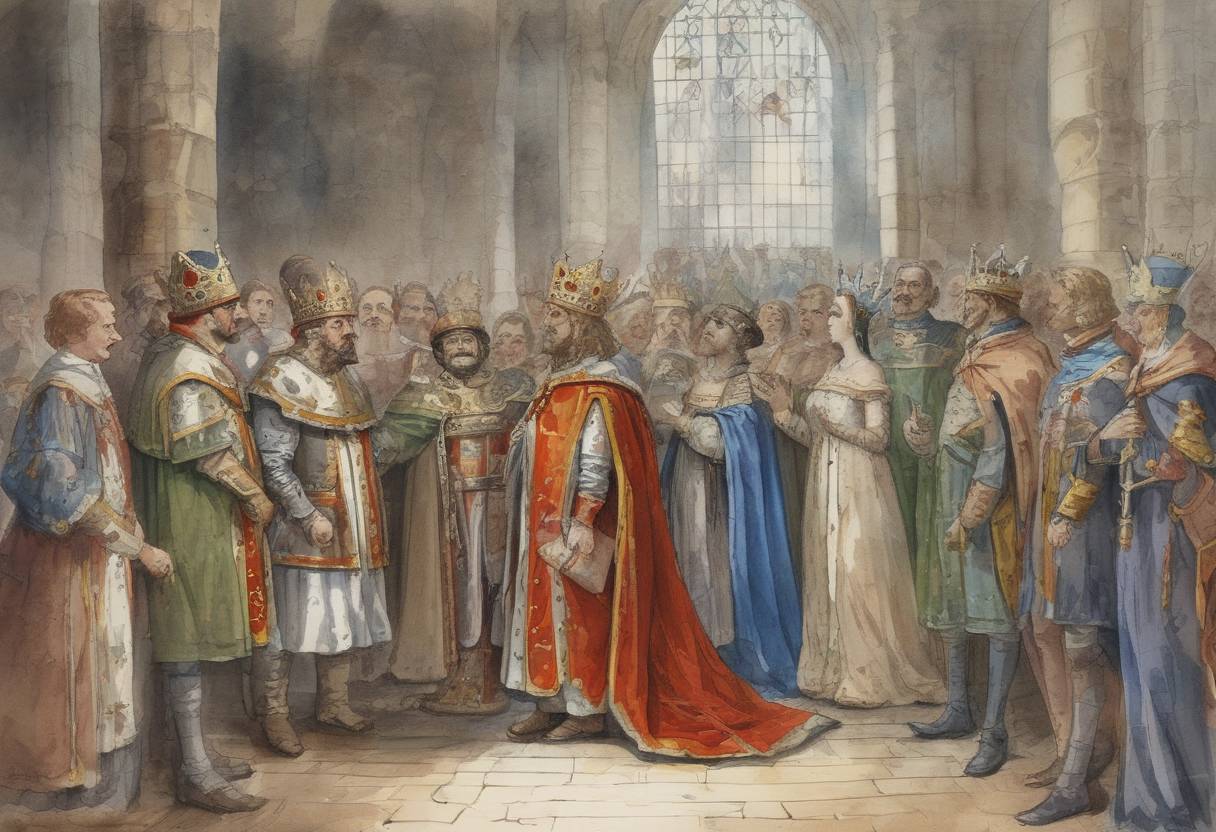
On February 21, 919, Henry the Fowler was elected King of East Francia, a pivotal moment that marked the beginning of the Ottonian dynasty. This event played a crucial role in shaping the medieval history of Germany and the Holy Roman Empire.
Background
- East Francia: After the Treaty of Verdun in 843, the Carolingian Empire was divided into three kingdoms. East Francia, which roughly corresponds to modern-day Germany, was one of these kingdoms.
- Carolingian Decline: By the early 10th century, the Carolingian dynasty’s power was waning, leading to political fragmentation and vulnerability to external threats such as Viking, Magyar, and Slavic invasions.
Henry the Fowler
- Early Life: Henry was born around 876, the son of Duke Otto I of Saxony. He became Duke of Saxony in 912, succeeding his father.
- Reputation: Known for his military prowess and administrative skills, Henry was a respected leader among the Germanic tribes.
Election as King
- Vacant Throne: The death of King Conrad I in 918 left the throne of East Francia vacant. Conrad, recognizing Henry’s capabilities, had recommended him as his successor.
- Election: On February 21, 919, Henry was elected king by the German dukes at Fritzlar. This election was significant as it was one of the first instances of a king being chosen by a council of nobles rather than through hereditary succession.
Significance of Henry’s Reign
- Consolidation of Power: Henry worked to consolidate his power by negotiating with other dukes, thus strengthening the unity of the kingdom.
- Defense and Expansion: He fortified the eastern borders against Magyar invasions and expanded influence over Slavic territories.
- Foundation of the Ottonian Dynasty: Henry’s reign laid the groundwork for the Ottonian dynasty, which would continue with his son, Otto I, who was crowned Holy Roman Emperor in 962.
Legacy
- Ottonian Renaissance: The dynasty is credited with a cultural and political renaissance in Germany, fostering the growth of art, architecture, and learning.
- Holy Roman Empire: The Ottonian dynasty’s efforts in consolidating power and expanding influence contributed significantly to the formation of the Holy Roman Empire.
Henry the Fowler’s election as king was a turning point that not only stabilized East Francia but also set the stage for the emergence of a powerful and culturally rich medieval European empire.