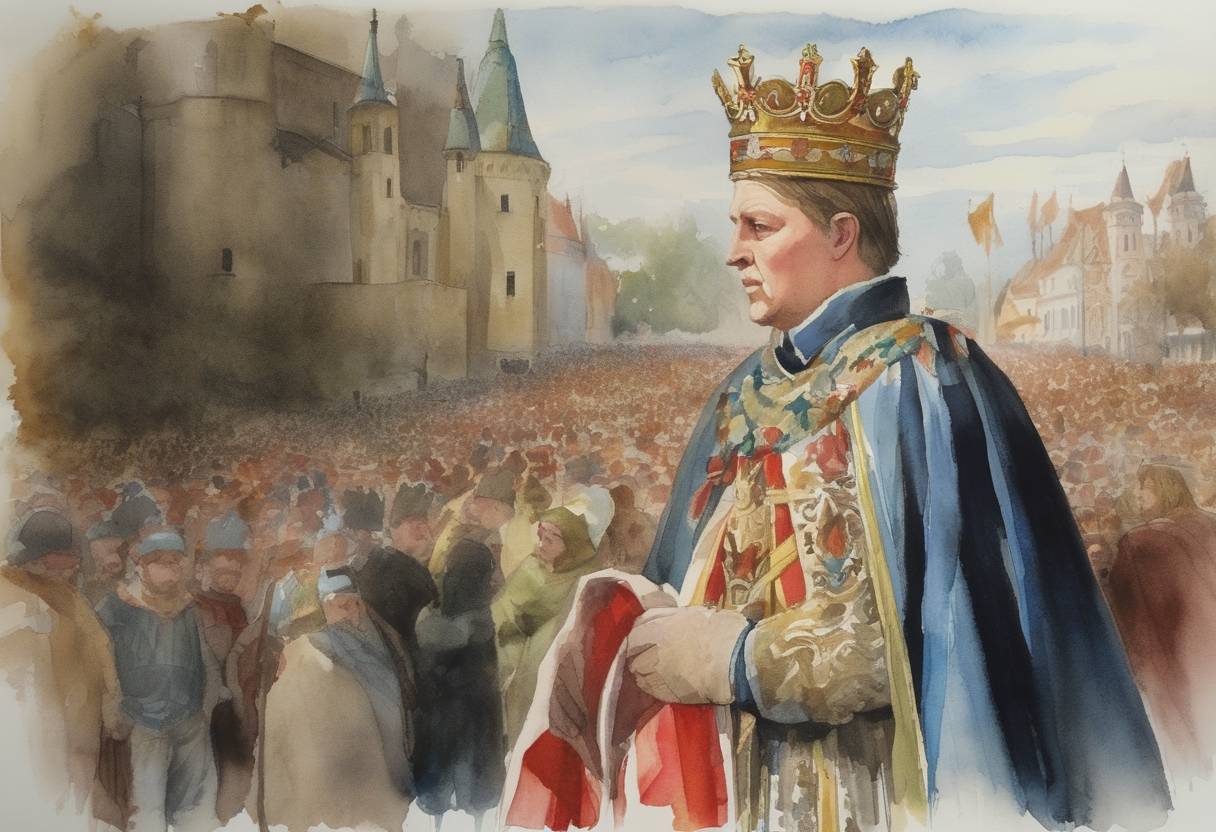
Coronation of Mindaugas as King of Lithuania
On July 6, 1253, a pivotal event in the history of Lithuania took place: Mindaugas, the Grand Duke of Lithuania, was crowned as the first and only official King of Lithuania. This event marked a significant development in Lithuanian statehood and its entry onto the European political stage.
Background
The period leading up to Mindaugas’s coronation was marked by internal power struggles and external threats. The Grand Duchy of Lithuania, during the early 13th century, was a nascent state comprised of various Baltic tribes resisting Christianization and the territorial ambitions of neighboring powers such as the Teutonic Knights and Livonian Order.
Mindaugas, who rose to prominence amid this backdrop, initially focused on consolidating his rule over local chieftains and expanding his territory through alliances and military campaigns. As he worked to strengthen his power, Mindaugas recognized the importance of gaining acceptance from the regional European powers and the Catholic Church, which were increasingly influential in Baltic affairs.
The Crowning
The culmination of Mindaugas’s strategic efforts was realized on July 6, 1253, when he was crowned King of Lithuania. His coronation took place after he had undergone baptism, which was a crucial precondition for securing Papal support and recognition. By converting to Christianity, Mindaugas sought to ensure peace with the Teutonic Knights and Livonian Order, mitigate the threat posed by these crusading orders, and obtain legitimacy from the Papacy.
Pope Innocent IV’s support was vital to the ceremony, granting Mindaugas the title and endorsing his reign as the legitimate ruler of a Christian monarchy. The ecclesiastical blessing also symbolically integrated Lithuania into the Christian world, which was a diplomatic victory for Mindaugas.
Historical Significance
Mindaugas’s coronation was significant for several reasons:
Formation of Lithuanian Monarchy: It marked the establishment of the Kingdom of Lithuania, although the kingdom’s existence was short-lived.
Diplomatic Success: The event illustrated the successful use of diplomacy and religion to secure power and deter external aggression.
Christianization: The coronation represented a critical juncture in the Christianization of Lithuania, albeit interrupted after Mindaugas’s death.
Legacy: Mindaugas laid the groundwork for the eventual expansion and consolidation of the Lithuanian state, which would later become one of medieval Europe’s most powerful entities during the Grand Duchy’s height in the 14th and 15th centuries.
Aftermath
Mindaugas’s reign as king ended in 1263 when he was assassinated, leading to the regression of Lithuania into paganism and a temporary collapse of the Christian kingdom he had established. Despite this, Mindaugas is celebrated in Lithuania as a visionary ruler whose efforts contributed to the long-term success of the Lithuanian state.
In contemporary Lithuania, July 6 is observed as a national holiday known as Statehood Day, commemorating the coronation of Mindaugas and the establishment of the Lithuanian state.