Francis Drake's Expedition in St. Augustine - June 6, 1586
1586 · St. Augustine, present-day USA
Francis Drake's expedition lands in St. Augustine in present-day Florida, claiming it for England.
July 28, 1579
Francis Drake, the English explorer, completed his journey through the Pacific Ocean after departing from North America on his circumnavigation of the globe. This journey would ultimately contribute to England's global exploration and colonial endeavors.
Circumnavigation underway, United Kingdom | English Crown
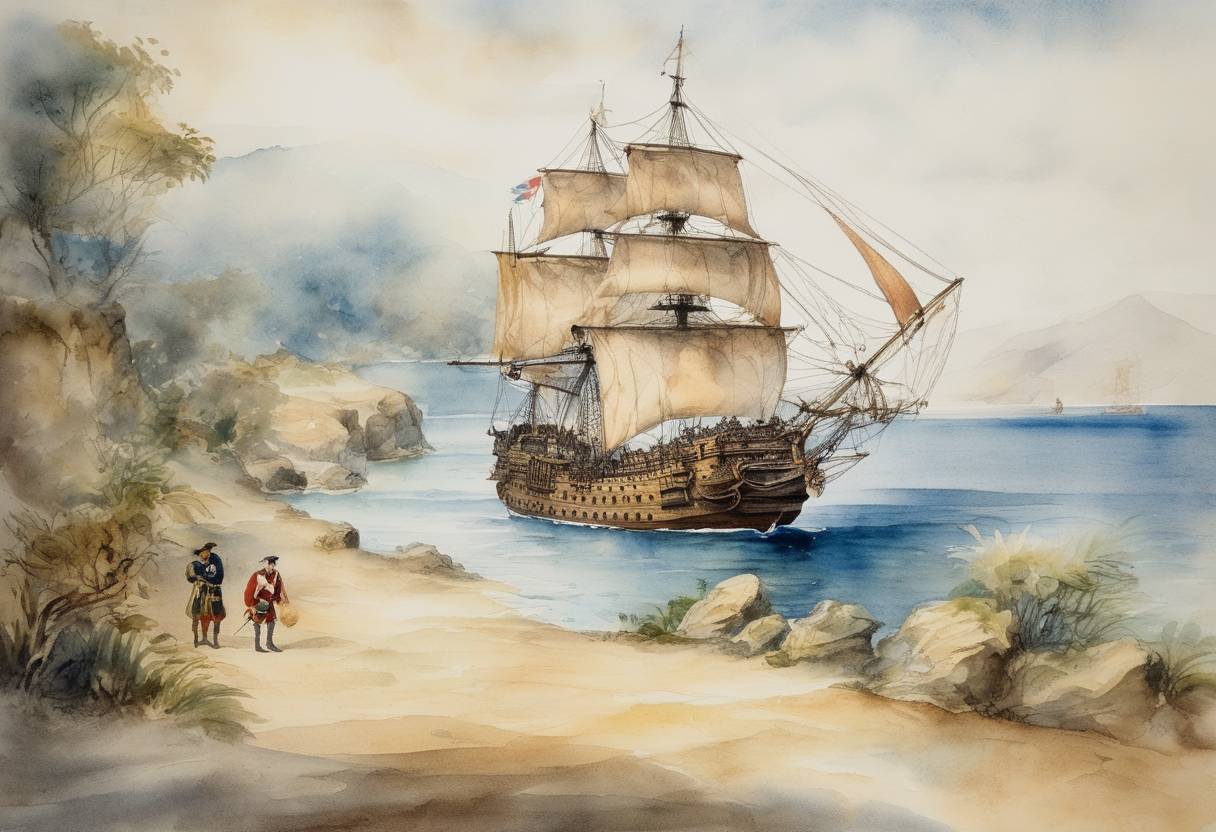
On July 28, 1579, the English explorer Francis Drake, aboard his ship the Golden Hind, concluded his journey through the Pacific Ocean after departing from the western coast of North America. This leg of his voyage was a significant part of his pioneering circumnavigation of the globe, which bolstered England’s aspirations for global exploration and colonial expansion.
Francis Drake’s circumnavigation began in December 1577, under the commission of Queen Elizabeth I. The expedition’s initial objective was to raid Spanish holdings along the Pacific coast of the Americas as part of England’s larger conflict with Spain. Notably, the venture was both a pursuit of wealth and an opportunity to undermine Spanish dominance in the region.
First Engagements: After departing from Plymouth in late 1577, Drake sailed across the Atlantic and began his raids along the South American coast, capturing valuable Spanish treasures.
Navigating the Straits: Drake then maneuvered through the perilous Magellan Strait in the southern tip of South America in 1578 to enter the Pacific Ocean, marking a critical point in his journey.
Repairs and Exploration: In June 1579, Drake temporarily landed on the western coast of what is now California—an area he called “Nova Albion”—to repair his ship and interact with local tribes. This marked one of the earliest European encounters with the western shores of North America.
Having resupplied and repaired his vessel, Drake embarked upon the trans-Pacific crossing. By July 28, 1579, he was navigating the vast Pacific Ocean toward the Moluccas (present-day Maluku Islands, Indonesia), continuing his path of exploration and avoiding confrontation with Spanish forces.
Completion of Circumnavigation: Drake ultimately completed his circunnavigation in September 1580, returning to England with substantial wealth. He was hailed as a hero and famously knighted by Queen Elizabeth I aboard the Golden Hind.
Impact on English Exploration: Drake’s successful voyage demonstrated the feasibility of global circumnavigation and opened up new maritime routes and opportunities for English commerce and exploration.
Foundation for English Colonial Ambitions: His journey laid the groundwork for England’s subsequent imperial aspirations, emphasizing naval prowess and exploration as key components of national policy.
Francis Drake’s ventures not only enriched England economically and geopolitically but also challenged Spanish supremacy and marked a turning point in the age of exploration. His circumnavigation remains a seminal moment in maritime history, symbolizing the era’s spirit of adventure and the beginnings of European global dominance.
Source: en.wikipedia.org