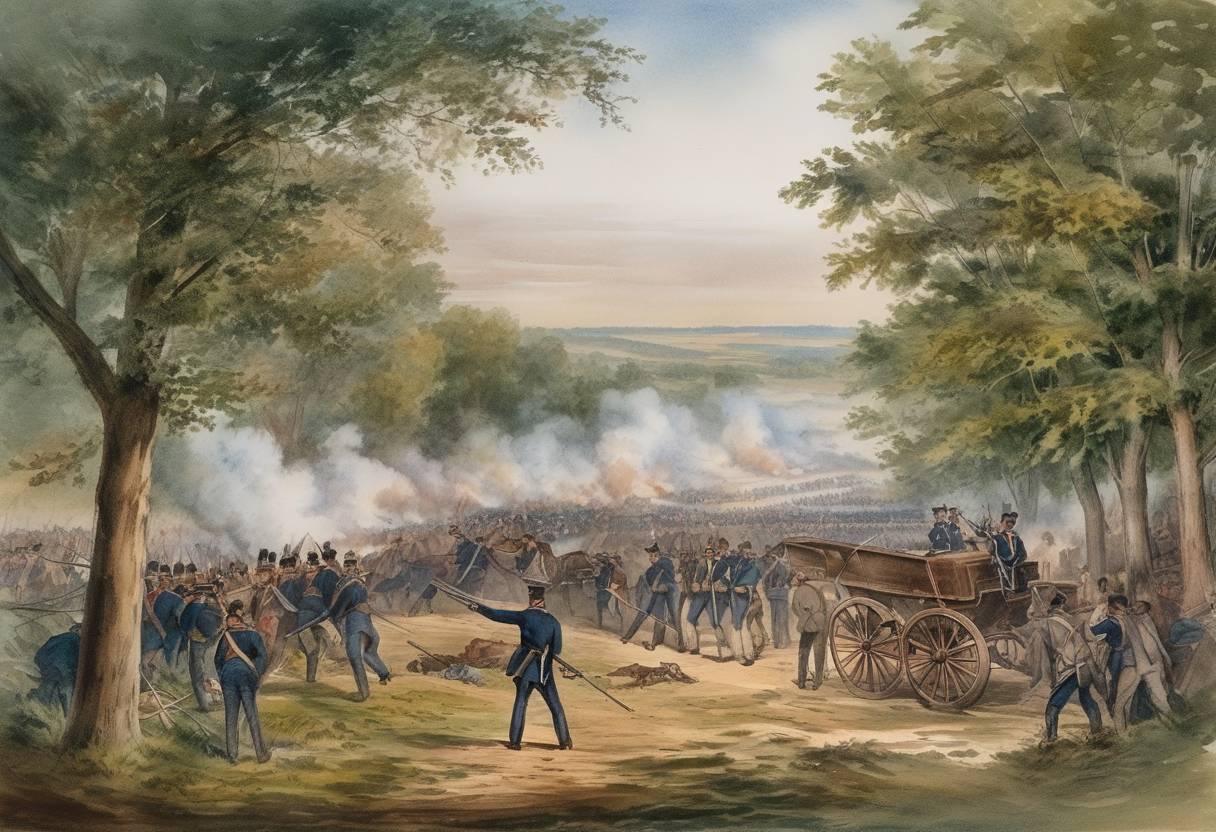
Battle of Westport - October 23, 1864
The Battle of Westport, fought on October 23, 1864, stands as a pivotal engagement during the American Civil War and is considered the largest battle west of the Mississippi River. It marked a decisive Union victory over the Confederate forces in what is now Kansas City, Missouri.
Context
The battle was part of Confederate Major General Sterling Price’s Missouri Expedition, a campaign aimed at diverting Union troops from the eastern theatres and encouraging Southern sympathizers in the region. Price’s goals included capturing Missouri for the Confederacy and disrupting Union operations during the 1864 elections.
Prelude to Battle
In September 1864, Price launched his raid into Missouri with a force of approximately 12,000 troops, hoping to capture St. Louis and Jefferson City. After being repelled at both, Price turned westward toward Kansas City, pursued by Union forces under the command of Major General Samuel R. Curtis and Major General Alfred Pleasonton.
The Battle
On October 23, 1864, Curtis, commanding the Army of the Border, and Pleasonton, leading the Provisional Cavalry Division, coordinated their forces against Price’s Confederate army near Westport. The battle unfolded along today’s Brush Creek in Kansas City.
Curtis deployed around 15,000 Union troops, significantly outnumbering Price’s diminished force, reduced after skirmish losses and desertions. The Union troops launched a series of assaults to push back the Confederates from their fortified positions.
Outcome and Aftermath
By the end of the day, Price’s forces were in full retreat southward with Union forces in pursuit. The Confederate defeat at Westport effectively ended Price’s invasion of Missouri. The Union’s ability to maintain control of Missouri provided a significant morale boost and secured the state’s loyalty to the Union cause.
The battle demonstrated the effectiveness of combined arms tactics and solidified the strategic importance of maintaining Union control west of the Mississippi River.
Significance
The Battle of Westport, often called the “Gettysburg of the West,” was a turning point in the Trans-Mississippi Theater of the Civil War. It was instrumental in ensuring the security of the Western states and territories for the Union and marked the conclusion of significant Confederate operations in the region.