The Death of King Macbeth of Scotland
1057 · Lumphanan, Scotland
King Macbeth of Scotland was killed at the Battle of Lumphanan by the forces of Máel Coluim mac Donnchada (Malcolm III).
July 27, 1054
Siward, Earl of Northumbria, invades Scotland and defeats Macbeth, King of Scotland, at the Battle of Dunsinane.
Dunsinane, Scotland | Earl of Northumbria
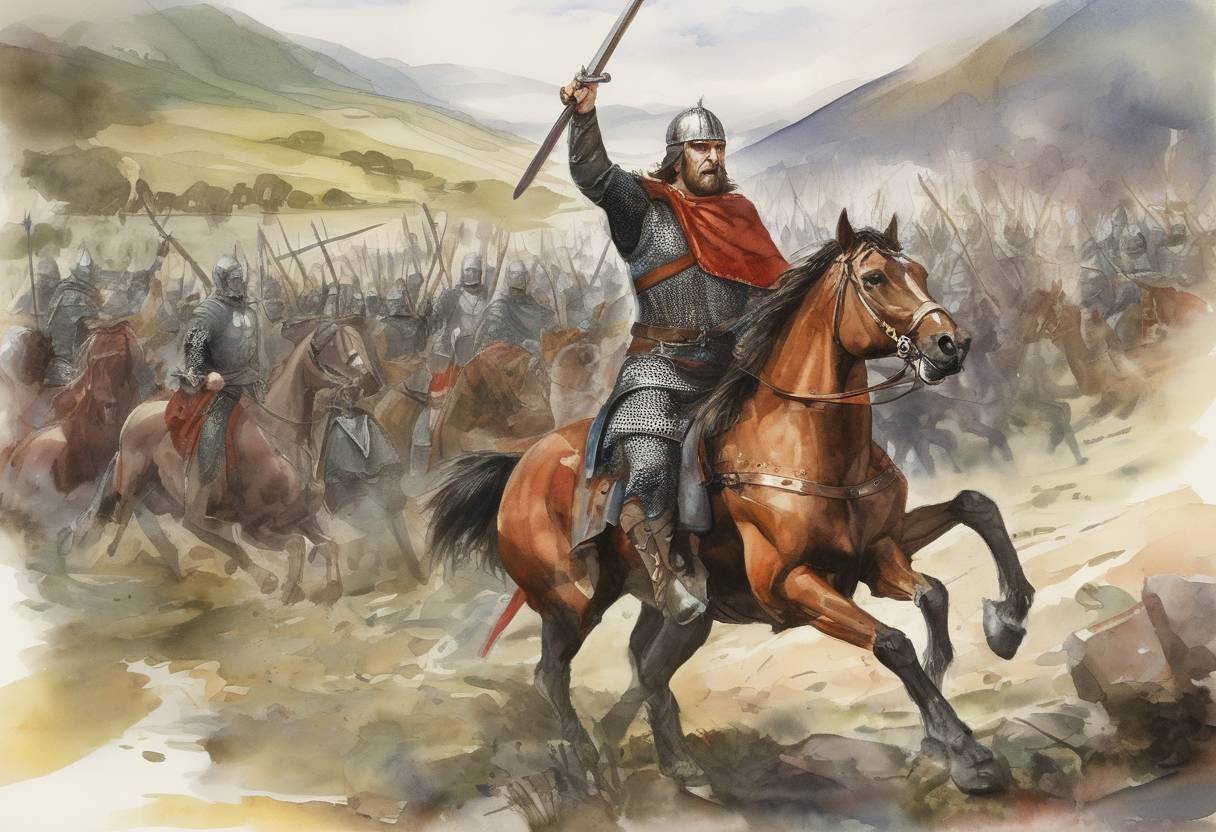
On July 27, 1054, a significant military engagement took place known as the Battle of Dunsinane, where Siward, the Earl of Northumbria, led an invasion into Scotland and defeated Macbeth, the King of Scotland. This battle is a notable event in the complex history of Anglo-Scottish relations during the 11th century.
Siward was a powerful Anglo-Scandinavian nobleman who held the earldom of Northumbria, a region that was strategically important due to its proximity to Scotland. His influence extended beyond Northumbria, and he was a key figure in the politics of England under King Edward the Confessor.
Macbeth became King of Scotland in 1040 after defeating and killing the previous king, Duncan I, in battle. His reign, which lasted until 1057, was marked by efforts to consolidate power and maintain stability in a kingdom often fraught with internal strife and external threats.
The conflict between Siward and Macbeth was partly fueled by dynastic disputes. Malcolm Canmore, the son of the slain King Duncan I, sought to reclaim the Scottish throne. Siward’s invasion was likely motivated by a combination of political alliances and the desire to support Malcolm’s claim, which aligned with the interests of the English crown.
The battle took place near Dunsinane Hill, located in present-day Perthshire, Scotland. Siward’s forces, comprising a mix of English and Scandinavian troops, engaged Macbeth’s army in a fierce confrontation. Despite Macbeth’s efforts to defend his position, Siward’s forces emerged victorious.
The defeat at Dunsinane did not immediately end Macbeth’s reign, but it significantly weakened his position. Macbeth continued to rule for a few more years until he was eventually killed in 1057, and Malcolm Canmore ascended to the Scottish throne as Malcolm III.
The Battle of Dunsinane remains a pivotal moment in the medieval history of the British Isles, illustrating the complex interplay of power, politics, and warfare that shaped the region’s history.
Source: en.wikipedia.org