Comet Hale-Bopp's Closest Approach to Earth
1997 · Global, Earth
The Comet Hale-Bopp made its closest approach to Earth, a notable astronomical event observed by millions.
March 8, 1618
Johannes Kepler discovered the third law of planetary motion, which states that the square of the orbital period of a planet is proportional to the cube of the semi-major axis of its orbit.
Linz, Austria | None
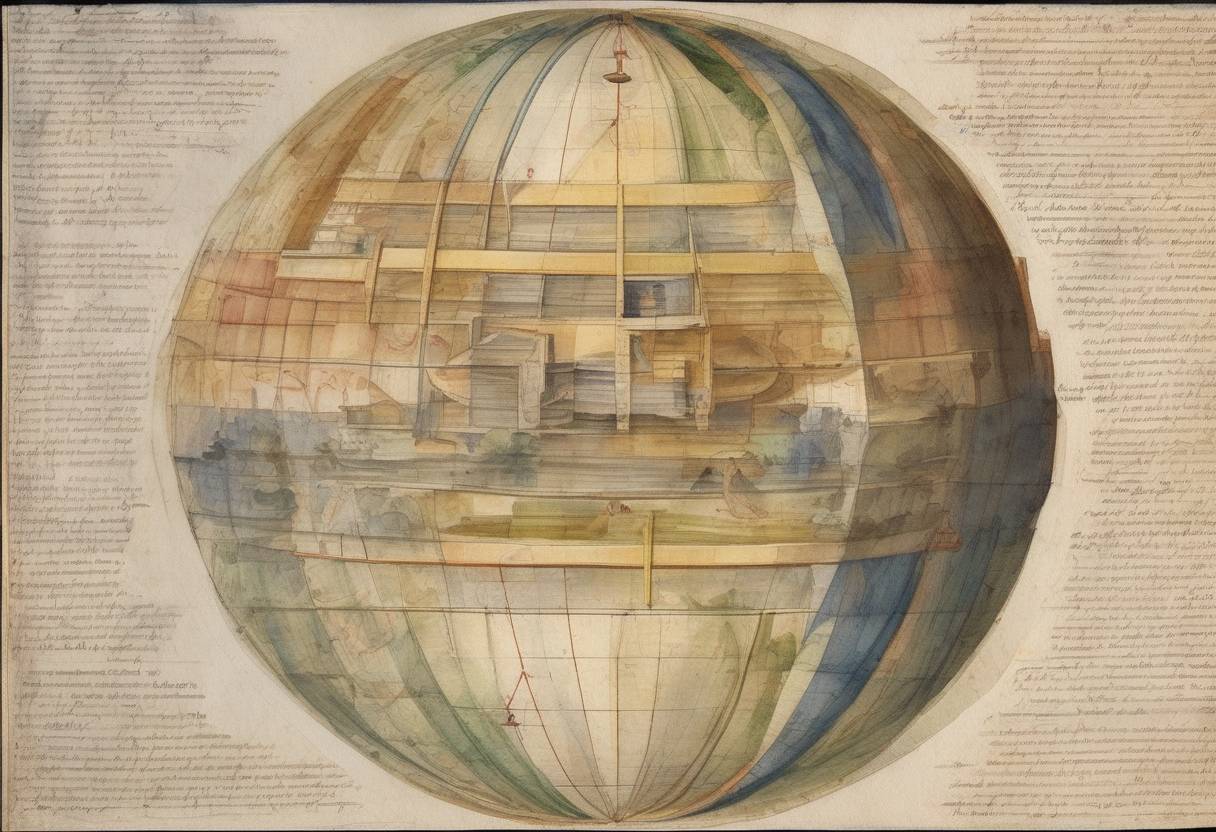
On March 8, 1618, the renowned German mathematician and astronomer Johannes Kepler formulated his third law of planetary motion, a pivotal moment in the history of astronomy. This law states that the square of the orbital period of a planet is proportional to the cube of the semi-major axis of its orbit. This discovery was a significant advancement in understanding the mechanics of our solar system and laid the groundwork for future astronomical studies.
Johannes Kepler was a key figure in the scientific revolution of the 17th century. His work was instrumental in moving away from the geocentric models of the universe, which placed Earth at the center, to a heliocentric model, where planets orbit the Sun. Kepler’s laws of planetary motion were derived from meticulous observations made by the Danish astronomer Tycho Brahe, whose data Kepler inherited after Brahe’s death in 1601.
Before arriving at his third law, Kepler had already formulated two other laws of planetary motion:
Kepler’s First Law (1609): Also known as the Law of Ellipses, it states that planets move in elliptical orbits with the Sun at one focus.
Kepler’s Second Law (1609): Known as the Law of Equal Areas, it asserts that a line segment joining a planet and the Sun sweeps out equal areas during equal intervals of time.
Kepler’s Third Law, often referred to as the Law of Harmonies, was discovered as he continued to analyze the orbital data of planets, particularly focusing on the relationship between their orbital periods and distances from the Sun. The law can be mathematically expressed as:
[ T^2 \propto a^3 ]
Where:
This law implies that the ratio of the square of the period of any two planets is equal to the ratio of the cubes of their semi-major axes. This discovery was crucial because it provided a clear mathematical relationship that described the motion of planets around the Sun, reinforcing the heliocentric model.
Kepler’s Third Law was a monumental step in celestial mechanics and had profound implications for future scientific endeavors:
Newton’s Law of Universal Gravitation: Kepler’s laws, particularly the third, were instrumental in Isaac Newton’s formulation of the law of universal gravitation. Newton demonstrated that Kepler’s laws could be derived from his own laws of motion and gravitation, thus providing a theoretical foundation for Kepler’s empirical findings.
Advancement of Astronomy: Kepler’s work marked a shift from descriptive to predictive astronomy, allowing for more accurate predictions of planetary positions and movements.
Influence on Future Scientists: Kepler’s laws influenced many scientists and mathematicians, including Galileo Galilei and Edmond Halley, and continue to be fundamental in the study of celestial mechanics.
In conclusion, Johannes Kepler’s discovery of the third law of planetary motion on March 8, 1618, was a cornerstone in the development of modern astronomy, bridging the gap between observational data and theoretical physics, and paving the way for the scientific advancements that followed.
Source: en.wikipedia.org