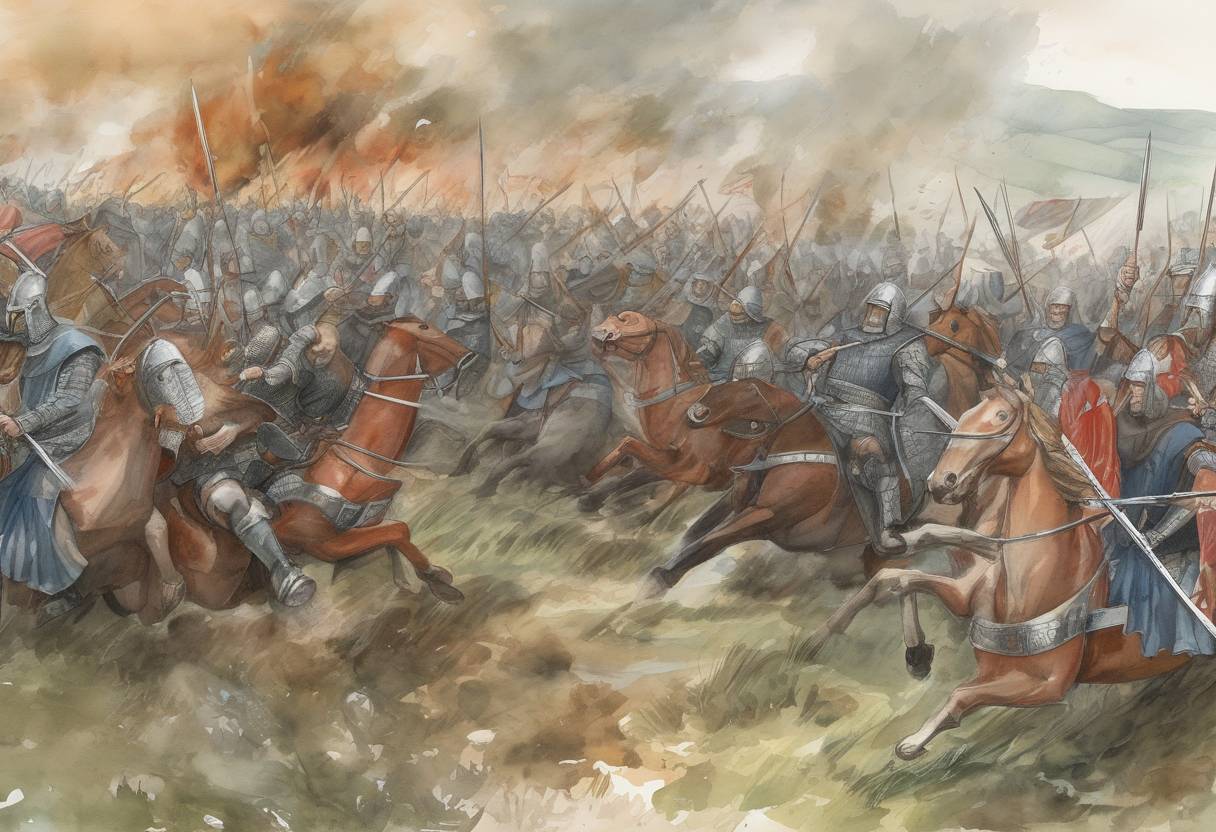
The Battle of Maserfield: August 5, 642
The Battle of Maserfield, fought on August 5, 642, was a significant conflict in early medieval Britain. It marked a pivotal moment in the power dynamics of the Anglo-Saxon kingdoms, particularly affecting the fortunes of Northumbria and Mercia.
Context and Background
Northumbria’s Rise: Prior to the battle, Northumbria had emerged as a dominant power under King Oswald. He had successfully unified the kingdoms of Bernicia and Deira and was recognized as a Bretwalda, a term used for a king who held overlordship over other Anglo-Saxon kingdoms.
Mercian Ambitions: Penda of Mercia, a formidable and ambitious ruler, sought to expand his influence. Mercia, located in the central part of what is now England, was a rising power under Penda’s leadership.
Religious Tensions: The period was marked by religious transformation, with Christianity spreading across the Anglo-Saxon kingdoms. Oswald was a devout Christian, while Penda remained a staunch pagan, adding a religious dimension to their rivalry.
The Battle
Location: The exact location of Maserfield is debated, but it is generally believed to be near present-day Oswestry in Shropshire, England.
Forces and Strategy: The battle saw the forces of Northumbria, led by King Oswald, clash with those of Mercia, commanded by Penda. Details about the size of the armies and specific tactics are scarce, typical of early medieval battles.
Outcome: The battle resulted in a decisive victory for Penda. King Oswald was killed in the fighting, a significant blow to Northumbrian power and influence.
Aftermath and Significance
Oswald’s Legacy: Following his death, Oswald was venerated as a martyr and saint, particularly in Northumbria and other Christian communities. His death was seen as a sacrifice for his faith and kingdom.
Power Shift: The defeat weakened Northumbria temporarily, leading to internal strife and a shift in the balance of power. Penda’s victory solidified Mercia’s position as a dominant force in the region.
Continued Conflict: The battle did not end hostilities between the two kingdoms. Penda continued to exert pressure on Northumbria and other neighboring territories, maintaining his influence until his own death in 655.
Broader Historical Impact
The Battle of Maserfield exemplifies the turbulent nature of early medieval Britain, characterized by shifting alliances, religious transformations, and the constant struggle for dominance among the Anglo-Saxon kingdoms. It highlights the complex interplay of politics and religion during this formative period in British history.