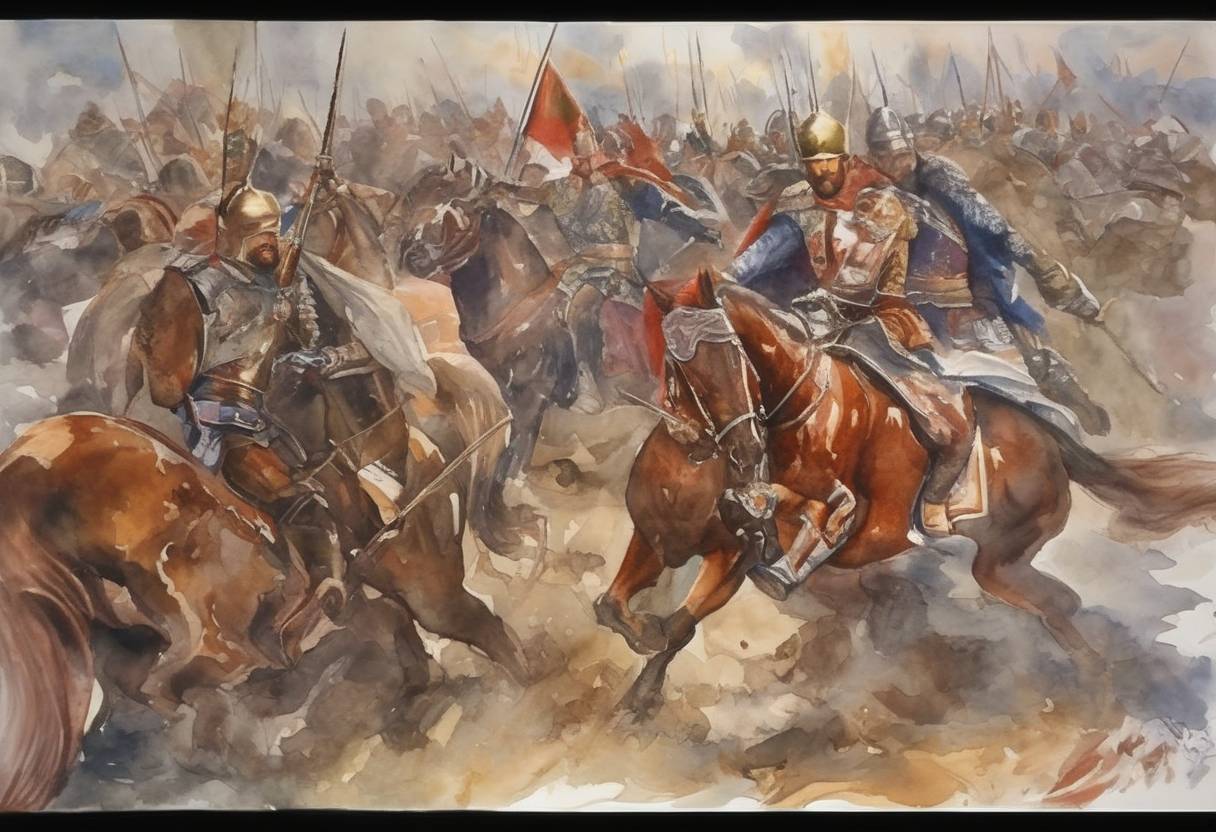
The Battle of Anchialus: August 20, 917
Context and Background
The Battle of Anchialus, fought on August 20, 917, was a pivotal conflict between the Bulgarian Empire and the Byzantine Empire. This battle was part of the larger Byzantine-Bulgarian Wars, a series of conflicts that spanned several centuries as both empires vied for dominance in the Balkans.
The Bulgarian Empire under Tsar Simeon I
- Tsar Simeon I: Known as Simeon the Great, he reigned from 893 to 927 and was one of Bulgaria’s most powerful and influential rulers. Under his leadership, Bulgaria reached its territorial zenith and cultural peak.
- Ambitions: Simeon sought to expand Bulgarian influence and aimed to establish Bulgaria as the preeminent power in the Balkans, challenging Byzantine supremacy.
The Byzantine Empire
- Byzantine Leadership: At the time, the Byzantine Empire was under the regency of Empress Zoe Karbonopsina for her son, Emperor Constantine VII. The empire faced internal strife and external threats, including the rise of the Bulgarian Empire.
- Strategic Importance: The Byzantines aimed to curb Bulgarian expansion and maintain their influence over the Balkan territories.
The Battle
Location
- Anchialus: The battle took place near the town of Anchialus, present-day Pomorie in Bulgaria, located on the western coast of the Black Sea. This location was strategically significant for controlling the region.
Forces Involved
- Bulgarian Army: Commanded by Tsar Simeon I, the Bulgarian forces were well-prepared and motivated, benefiting from Simeon’s strategic acumen and leadership.
- Byzantine Army: Led by Leo Phokas the Elder, the Byzantine forces were substantial but suffered from logistical challenges and internal discord.
The Conflict
- Tactics and Strategy: Simeon employed effective military tactics, including the use of a feigned retreat to lure the Byzantine forces into a vulnerable position.
- Outcome: The battle resulted in a decisive Bulgarian victory. The Byzantine army was routed, suffering heavy casualties, and the defeat significantly weakened Byzantine influence in the region.
Aftermath and Significance
- Bulgarian Dominance: The victory at Anchialus solidified Bulgarian power in the Balkans, allowing Simeon to further his ambitions of creating a Bulgarian Empire that rivaled Byzantium.
- Byzantine Setbacks: The defeat forced the Byzantines to acknowledge Bulgarian supremacy in the region temporarily and led to a period of instability within the empire.
- Long-term Impact: The battle was a critical moment in the medieval history of the Balkans, shaping the geopolitical landscape and influencing future Byzantine-Bulgarian relations.
The Battle of Anchialus exemplifies the intense rivalry between the Bulgarian and Byzantine empires during the early medieval period and underscores the strategic and military prowess of Tsar Simeon I.