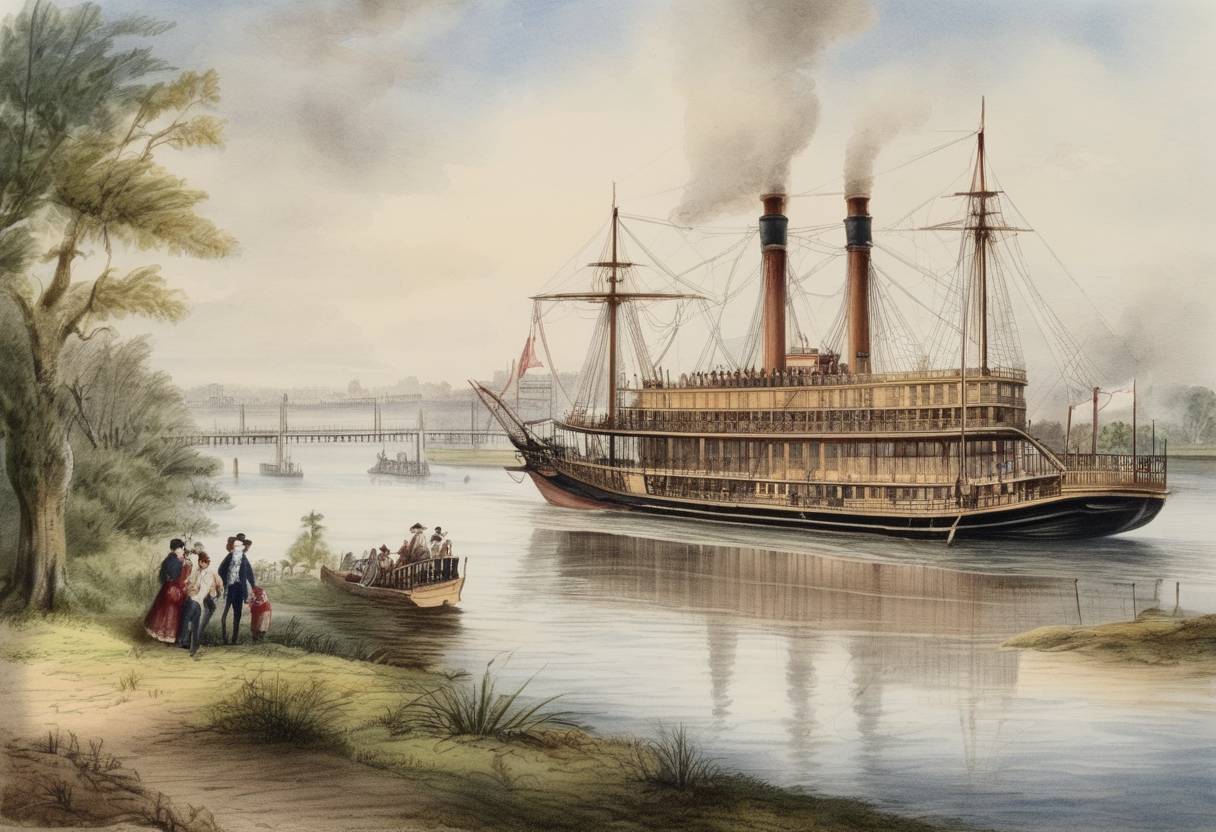
The Arrival of the First Steamboat in New Orleans - October 11, 1811
On October 11, 1811, the steamboat New Orleans, often recognized as the first steamboat to sail on the Mississippi River, arrived in New Orleans, marking a significant milestone in the history of American transportation and commerce. This event heralded the dawn of a new era of navigation on America’s inland waterways, dramatically altering the economic landscape of the United States by opening up major commercial routes along the river.
Background
Prior to the introduction of steamboats, transportation on the Mississippi and its tributaries was limited to keelboats, flatboats, and other vessels reliant on either human or wind power. These modes of transport were slow and labor-intensive, restricting the scale and efficiency of trade.
The New Orleans was a side-wheel steamboat constructed in Pittsburgh, Pennsylvania. It was designed by engineer Robert Fulton, who is credited with developing the first successful commercial steamboat in America, and funded by Robert R. Livingston, the U.S. minister to France who had facilitated the Louisiana Purchase. Livingston and Fulton aimed to demonstrate the feasibility and commercial potential of steam-powered travel on Western rivers.
The Journey
The New Orleans embarked on its maiden voyage from Pittsburgh in September 1811. Under the command of Captain Nicholas Roosevelt, a relation of the more famous Theodore and Franklin, the vessel navigated the challenging waters of the Ohio and Mississippi Rivers. The journey itself was fraught with difficulties, including navigating through narrow river passages, dealing with unpredictable water levels, and the dynamic autumn weather conditions.
However, the boat’s successful arrival in New Orleans after its nearly 2,000-mile journey proved the viability of steamboat navigation, despite skepticism and technical challenges. This achievement demonstrated that steamboats could effectively link burgeoning western settlements with vital ports, facilitating trade and travel.
Significance and Impact
The arrival of the New Orleans in New Orleans ushered in a new era for commerce on the Mississippi River. Steamboats significantly reduced travel time and increased the volume of goods that could be transported. This innovation allowed for the rapid expansion of marketplaces, promoting economic growth in the region and aiding the expansion westward. The river, now teeming with steamboats, became a bustling artery of commerce and communication.
This technological advancement also played a critical role in shaping the economic and cultural development of the United States, contributing to the prosperity of cities along the river and establishing New Orleans as a key commercial hub in the early 19th century.
The success of the New Orleans serves as a pivotal point in American transportation history, illustrating the transformative power of engineering and innovation in shaping economies and societies.