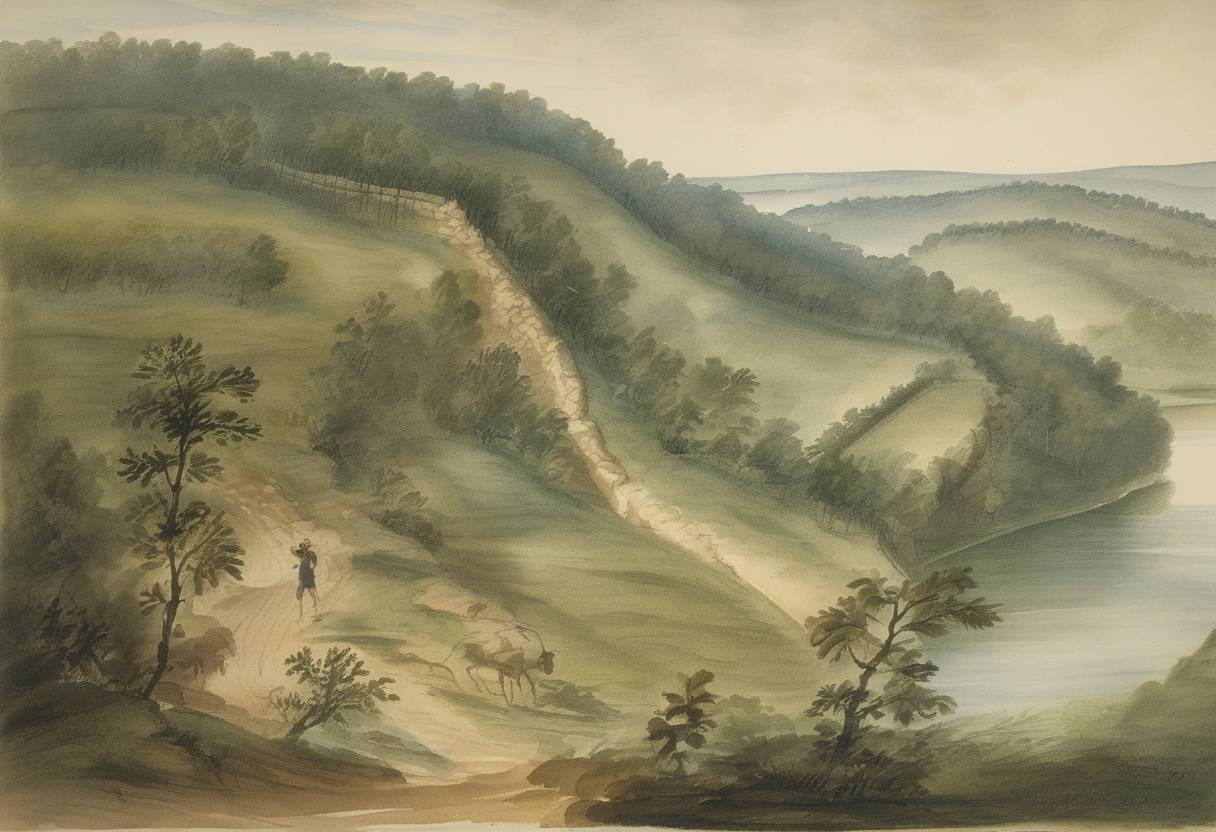
Completion of the Mason-Dixon Line Survey on October 18, 1767
On October 18, 1767, the survey of the Mason-Dixon Line was officially completed by English astronomers and surveyors Charles Mason and Jeremiah Dixon. This significant accomplishment came as a resolution to a contentious border dispute between the British colonies of Maryland and Pennsylvania.
Context and Background
The need for a precise boundary arose due to conflicting land grants given by British monarchs to the proprietors of Maryland (Cecil Calvert, 2nd Baron Baltimore) and Pennsylvania (William Penn). Both colonies claimed overlapping territory, which led to confusion and frequent conflicts among settlers in the mid-18th century. The dispute was particularly focused on defining the northern boundary of Maryland.
The Survey
Commissioned in 1763, the task of demarcating the boundary was entrusted to Mason and Dixon. Their work methodically plotted a line following the latitude of 39 degrees and 43 minutes north, extending from the Delaware River westward to what is now the southwestern corner of Pennsylvania. The process required sophisticated techniques of the time, using astronomical observations and careful triangulation, as well as overcoming challenging terrain and the reluctance of local populations.
Outcome and Aftermath
The completion of the Mason-Dixon Line in 1767 succeeded in settling the border dispute between Maryland and Pennsylvania. However, its historical significance would grow beyond its original purpose. By the early 19th century, the line gained symbolic importance as a cultural and ideological divide between the Northern free states and Southern slave states before and during the American Civil War. It became entrenched in American cultural memory as a marker of regional division in the United States.
Broader Historical Significance
While initially a practical solution to a boundary issue, the Mason-Dixon Line’s later associations with the divisive aspects of American history underscore its enduring legacy. It remains a poignant reminder of the regional and social tensions that have shaped American history, acting as a geographical and cultural demarcation point with profound implications beyond its colonial origins.