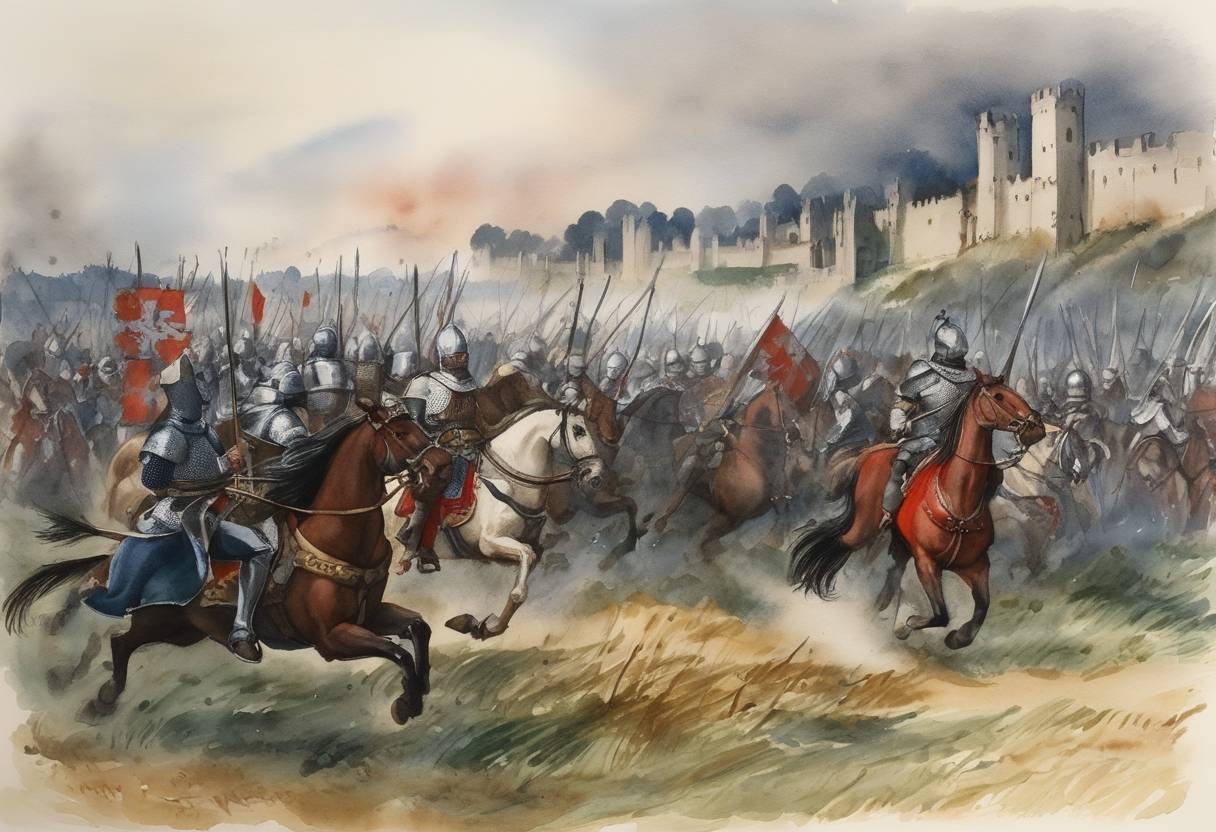
The Battle of Poitiers - September 19, 1356
The Battle of Poitiers, a crucial conflict within the larger context of the Hundred Years’ War, occurred on September 19, 1356. This battle was marked by a significant victory for the English forces under the command of Edward, the Black Prince—son of King Edward III of England—and resulted in the capture of King John II of France. This engagement is notable for its strategic brilliance and substantial impact on the war’s trajectory.
Prelude to Battle
The Hundred Years’ War, which spanned from 1337 to 1453, was primarily a series of conflicts between the Kingdom of England and the Kingdom of France over territorial disputes and claims to the French throne. By the mid-14th century, the English, led by Edward the Black Prince, were implementing a strategy known as chevauchée, involving raiding expeditions intended to destabilize and economically weaken the French adversaries.
In the summer of 1356, the Black Prince conducted a large-scale raid from the English-controlled area of Gascony northward into central France. The goal was to harass French territories, gather supplies, and exploit any opportunity to draw French forces into battle.
The Battle
As King John II learned of the English raid, he mustered a formidable army to intercept Edward’s forces. The English, realizing the French army’s proximity and numerical superiority—approximately 20,000 French soldiers against 6,000 English—chose a defensive position near Poitiers.
On the morning of September 19, the French attacked in a series of frontal assaults. The English benefited from a tactically advantageous site, using natural terrain features and dispersing their archers to disrupt the French cavalry and infantry with volleys of arrows.
A key tactical maneuver by Edward involved a feigned withdrawal, reminiscent of previous English victories at Crécy in 1346. This tactic lured the French into a premature charge across rough terrain, which resulted in disorganized formations vulnerable to English counterattacks.
Outcome and Significance
The English victory at Poitiers was decisive. French King John II was captured, alongside many key nobles. This event severely undermined French morale and destabilized the political landscape of France, setting the stage for the Treaty of Brétigny in 1360, which temporarily favored English territorial claims.
The capture of the French king had dramatic ramifications, leading to a significant ransom demand, which further strained France’s finances and contributed to internal dissent and instability.
Historical Impact
The implications of the Battle of Poitiers were far-reaching. It epitomized the effectiveness of English military tactics, particularly the use of the longbow and defensive positioning, and highlighted the weaknesses of heavily armored cavalry in the face of coordinated infantry and defilade tactics.
Furthermore, the battle exemplified the shifting nature of medieval warfare and the growing importance of strategic acumen over sheer numbers. It was a critical turning point in the Hundred Years’ War, influencing future engagements and diplomatic arrangements.
The battle remains a testament to the tactical genius of Edward the Black Prince and the enduring struggle between two European powerhouses during one of history’s most protracted conflicts.