Battle of Princeton: January 3, 1777
1777 · Princeton, United States
American Revolutionary War: American forces under General George Washington defeated British forces at the Battle of Princeton.
December 25, 1776
George Washington crossed the Delaware River, leading to a surprise attack against Hessian forces in Trenton, New Jersey, during the American Revolutionary War.
Trenton, United States | Continental Army
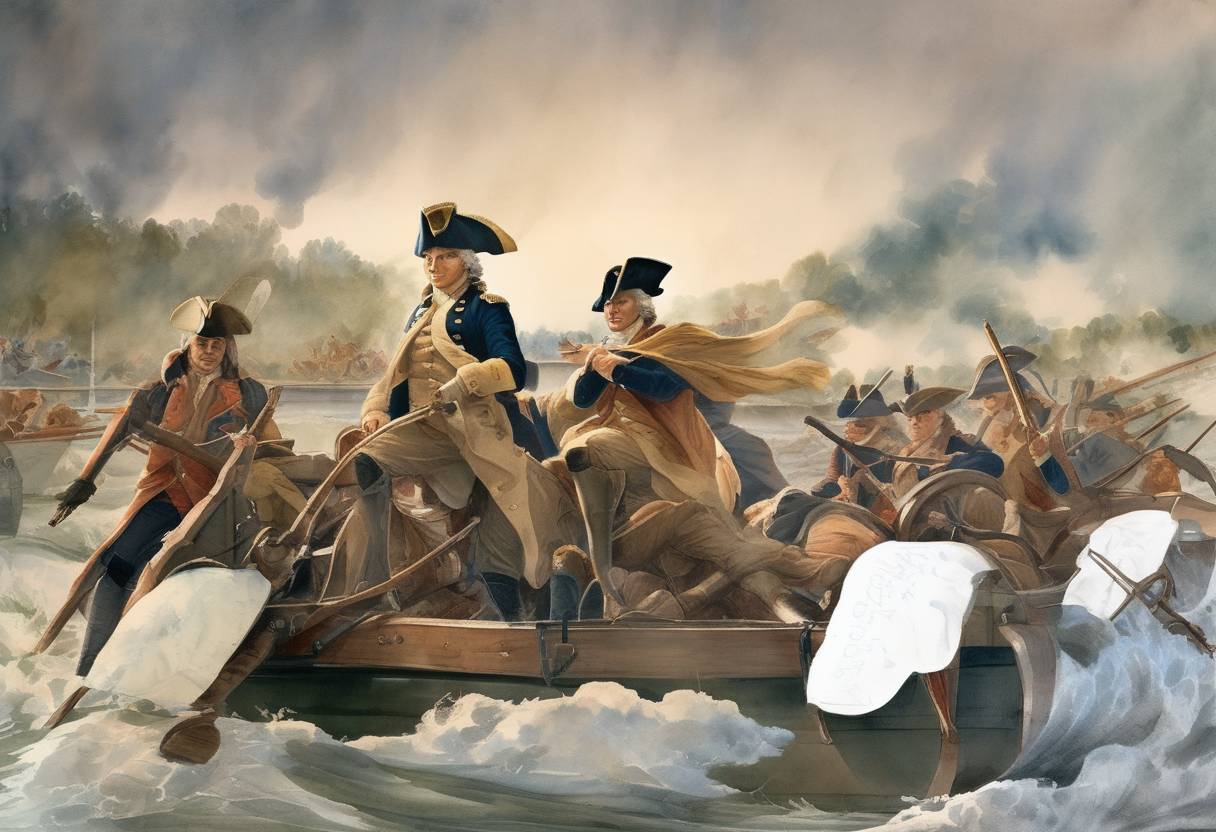
On the night of December 25, 1776, General George Washington led a daring and pivotal operation during the American Revolutionary War: the crossing of the Delaware River. This bold maneuver set the stage for a surprise attack against Hessian forces stationed in Trenton, New Jersey, and marked a turning point in the struggle for American independence.
By late 1776, the American Revolutionary War was not favoring the Continental Army. After a series of defeats in New York and New Jersey, morale was low, and enlistments were dwindling. Washington’s forces had retreated across New Jersey and were camped on the Pennsylvania side of the Delaware River. The British, confident in their position, had established winter quarters, leaving Hessian mercenaries to hold Trenton.
Washington recognized the need for a bold action to revive the revolutionary cause. He planned a surprise attack on the Hessian garrison in Trenton, hoping to catch them off guard after Christmas celebrations.
On the evening of December 25, 1776, Washington’s plan was set into motion. Despite harsh winter conditions, including ice-choked waters and a nor’easter bringing snow and sleet, Washington led approximately 2,400 Continental soldiers across the icy Delaware River. The crossing was fraught with difficulty, as the soldiers used Durham boats to navigate the treacherous waters.
The operation was meticulously timed, with Washington aiming to complete the crossing and march to Trenton by dawn. However, the severe weather delayed the crossing, and the troops did not reach the New Jersey side until around 3:00 AM on December 26.
Despite the delays, Washington pressed on with the attack. The Continental Army marched nine miles to Trenton, arriving around 8:00 AM. The Hessians, under the command of Colonel Johann Rall, were caught completely by surprise. Many were still recovering from the previous night’s festivities and were unprepared for an assault.
The battle was brief but decisive. Washington’s forces, utilizing artillery and the element of surprise, overwhelmed the Hessian defenses. The Americans captured approximately 900 Hessian soldiers, along with their supplies and artillery, while suffering minimal casualties.
The victory at Trenton was a significant morale booster for the Continental Army and the American cause. It demonstrated Washington’s leadership and strategic acumen, revitalizing support for the revolution both domestically and abroad. The success at Trenton was followed by another victory at the Battle of Princeton on January 3, 1777, further solidifying the Continental Army’s position.
The crossing of the Delaware and the subsequent victory at Trenton are celebrated as key moments in American history, symbolizing resilience and the ability to overcome seemingly insurmountable odds. These events helped sustain the revolutionary effort during a critical period and are remembered as a testament to Washington’s leadership and the determination of the American forces.
Source: en.wikipedia.org