Pluto Moves Inside Neptune's Orbit - February 11, 1999
1999 · none, none
Pluto moves inside Neptune's orbit for the first time since either was discovered.
November 11, 1572
Tycho Brahe observed the supernova SN 1572 from Herrevad Abbey, recording one of the most famous celestial events of the second millennium, which challenged the prevailing Aristotelian view of an unchangeable universe.
Herrevad Abbey, Denmark | none
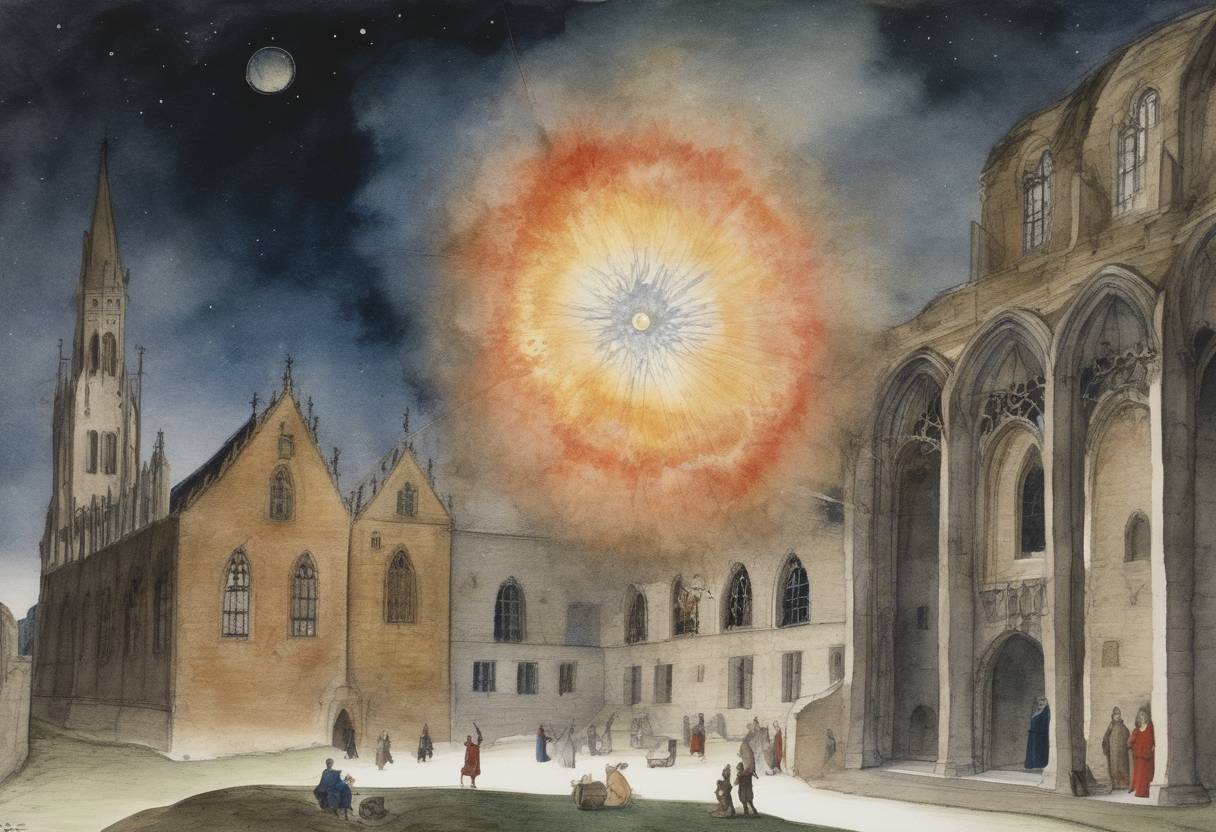
On November 11, 1572, the eminent Danish astronomer Tycho Brahe observed a new celestial phenomenon from Herrevad Abbey, in what is now modern-day Sweden. This event would come to be known as SN 1572, one of the most significant supernovae visible from Earth.
In the late 16th century, the prevailing Aristotelian cosmology posited a perfect and unchanging universe beyond the sphere of the Moon. However, this belief was challenged by Brahe’s observations. Using the technology of the time, Brahe meticulously documented the appearance of a bright new star in the constellation Cassiopeia, which gradually dulled over several months.
Brahe’s careful observations, conducted without the aid of a telescope (which had yet to be invented), provided precise measurements of the supernova’s position and apparent brightness. Importantly, Brahe noticed that the object did not exhibit parallax against the fixed stars, indicating its location far beyond the Moon, contrary to the Aristotelian view that such phenomena occurred only in the terrestrial realm.
The observation of SN 1572 had profound implications for astronomy and natural philosophy:
Challenging the Aristotelian Universe: The fact that such a change could occur in the celestial realm encouraged the reconsideration of the long-held Aristotelian doctrine.
Empirical Methods: Brahe’s work exemplified the shift towards empirical observation and data collection in astronomy, setting a precedent for future scientists.
Influence on Future Scientists: Brahe’s meticulous records greatly influenced his successors, including Johannes Kepler. Brahe’s data laid foundational groundwork that would eventually aid in Kepler’s formulation of the laws of planetary motion.
The supernova remained visible to the naked eye until early 1574. Brahe published his findings in the work De nova stella in 1573, solidifying his reputation as one of the most capable astronomers of his time. His observations advanced the Copernican Revolution by providing evidence that the heavens were not immutable, fueling further advancements in astronomical understanding.
SN 1572 is remembered not only as a key observational event but also as a moment that symbolized the dawning of a new scientific age, steering humanity away from ancient paradigms and towards a more empirical, evidence-based understanding of the cosmos.
Source: en.wikipedia.org