Battle of Abukir: July 20, 1799
1799 · Cairo, Egypt
On July 20, 1799, French forces under General Jean Baptiste Kléber defeated an Ottoman army near Cairo, Egypt, in the Battle of Abukir during the French campaign in Egypt.
September 24, 1800
The French army under General Jean Baptiste Kléber began the march to recapture Egypt's towns from Ottoman forces following Napoleon's departure.
Cairo, Egypt | French Army
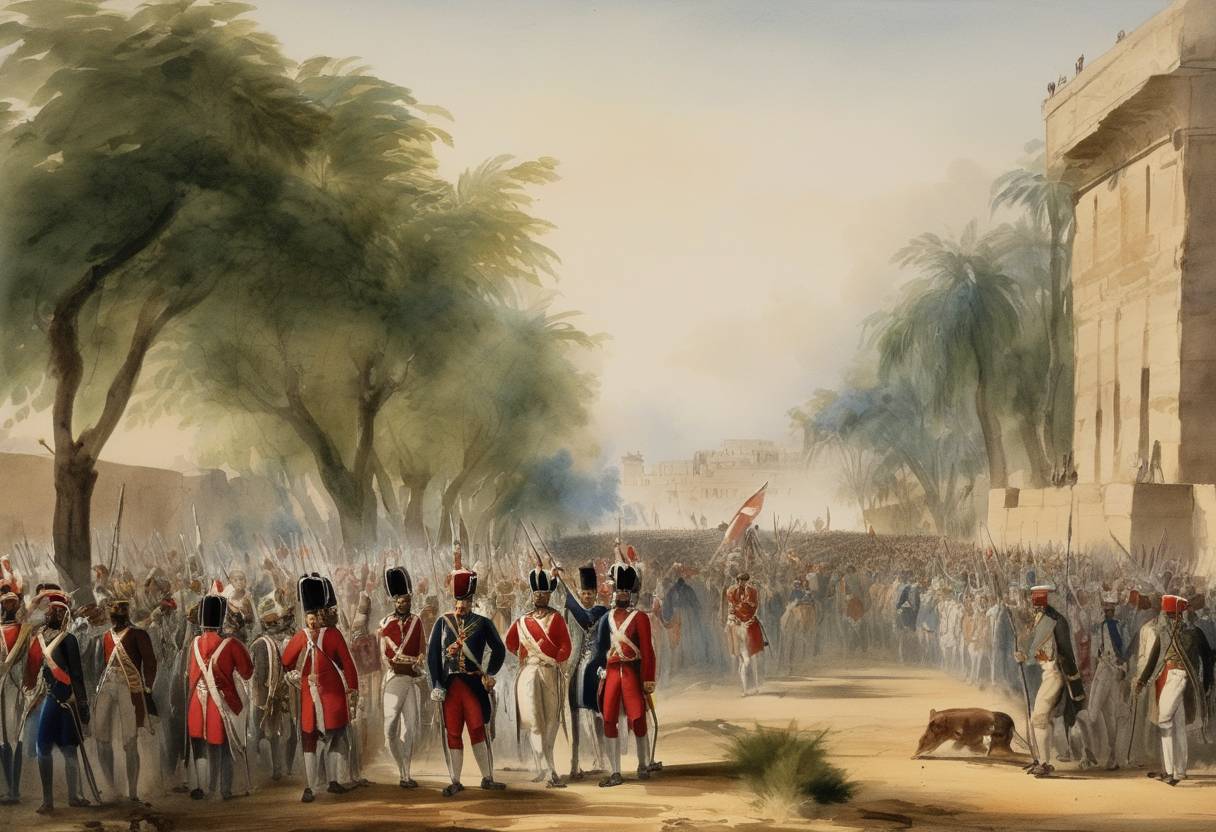
On September 24, 1800, the French army, led by General Jean Baptiste Kléber, began its march in an effort to reclaim Egyptian towns from Ottoman forces. This operation was part of the aftermath of Napoleon Bonaparte’s departure from Egypt, which had left the French expeditionary force in a precarious position.
The French had initially invaded Egypt in 1798, with Napoleon seeking to disrupt British trade routes and establish French dominance in the region. However, the campaign faced significant challenges from the British navy, local uprisings, and the formidable resistance mounted by the Ottoman Empire, which sought to re-establish its control over Egypt.
In August 1799, Napoleon left Egypt to return to France, leaving General Kléber in command of the French forces. Kléber inherited a difficult situation, with French troops spread thin and under constant threat from both Ottoman and British forces.
Prior to the September 24 march, the French had secured a temporary respite with the signing of the Convention of El-Arish in January 1800. This agreement with the Ottomans permitted the French army a safe passage out of Egypt. However, it was not ratified by the British, reigniting hostilities.
In response, Kléber decided to take decisive action. He focused on reorganizing and concentrating his forces, aiming to fortify French positions and recapture key Egyptian towns.
Under Kléber’s leadership, the French army embarked on the strategic march to secure their foothold in Egypt. Kléber’s strategies involved both military engagements and diplomatic maneuvers to weaken the resolve of the Ottomans and local opposition.
Although Kléber’s campaign showed initial promise, it soon faced significant challenges due to the harsh desert environment, supply constraints, and the persistent pressure from opposing forces. Despite his military acumen, Kléber knew that sustaining French control over Egypt would require more than just battlefield success.
Tragically, Kléber’s campaign was cut short by his assassination in Cairo in June 1800, which threw the French forces into further disarray. His death marked a turning point and began the final decline of the French expedition in Egypt. Eventually, the remaining French forces negotiated an evacuation in 1801, marking the end of the French campaign in the region.
The efforts of General Kléber were crucial in temporarily stabilizing the French presence in Egypt post-Napoleon, underscoring his role as a capable military leader during a tumultuous period in the Napoleonic Wars.
Source: www.britannica.com