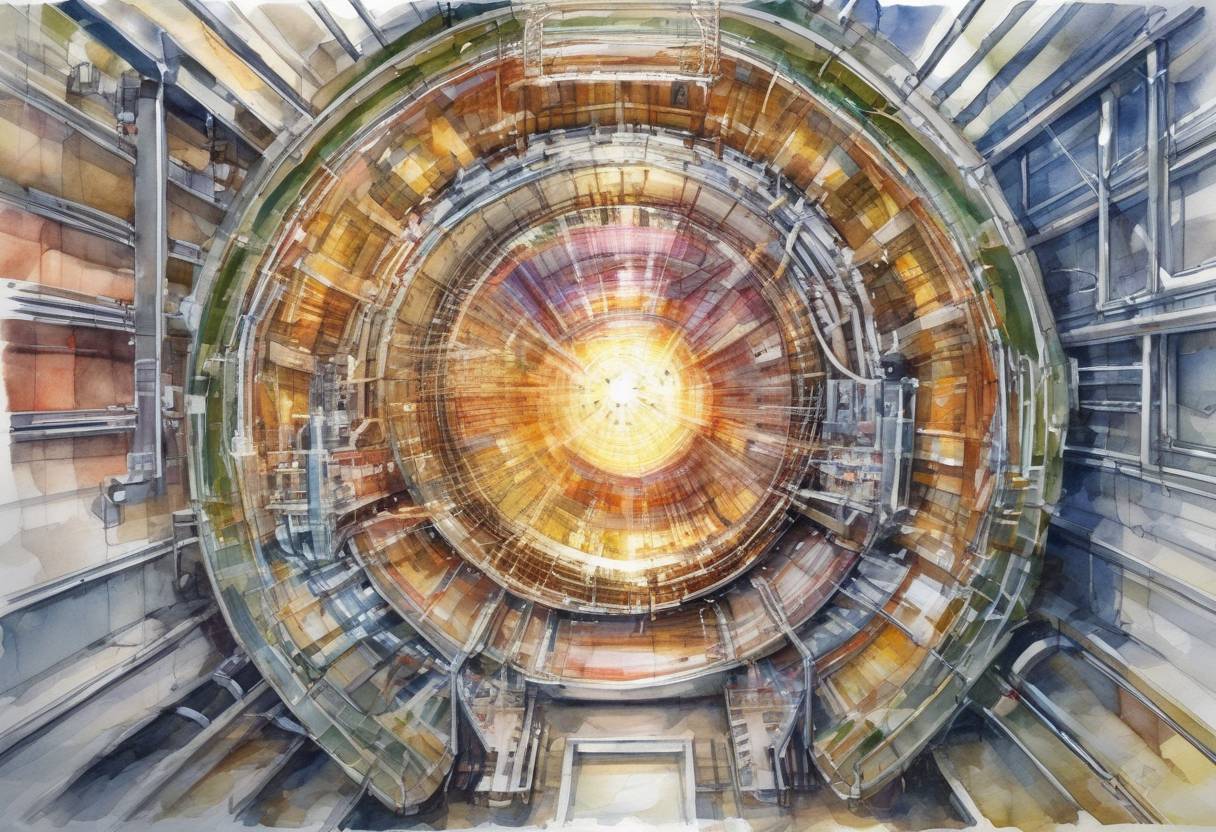
The Large Hadron Collider (LHC) First Powered Up: September 10, 2008
On September 10, 2008, the Large Hadron Collider (LHC) at CERN, the European Organization for Nuclear Research, was powered up for the first time. This event marked a significant milestone in the field of particle physics, as the LHC is the world’s largest and most powerful particle accelerator.
Background
- CERN: Founded in 1954, CERN is one of the world’s largest and most respected centers for scientific research in particle physics. It is located near Geneva, on the Franco-Swiss border.
- Purpose of the LHC: The LHC was designed to explore fundamental questions about the universe, including the origins of mass, the nature of dark matter, and the conditions of the early universe shortly after the Big Bang.
Key Features of the LHC
- Structure: The LHC consists of a 27-kilometer (about 17 miles) ring of superconducting magnets and a number of accelerating structures to boost the energy of the particles.
- Location: It is situated underground, straddling the border between Switzerland and France.
- Function: The LHC accelerates two high-energy particle beams in opposite directions and collides them at four interaction points. These collisions allow physicists to study the resulting particle interactions.
The First Power-Up
- Date: September 10, 2008
- Event: On this day, the LHC successfully circulated its first beams of protons, marking the beginning of its operational phase.
- Significance: This initial power-up was a crucial step in testing the LHC’s systems and ensuring that the accelerator could function as intended.
Scientific Goals and Achievements
- Higgs Boson: One of the primary goals of the LHC was to confirm the existence of the Higgs boson, a fundamental particle associated with the Higgs field, which gives mass to other particles. This was successfully achieved in 2012.
- Beyond the Standard Model: The LHC aims to explore physics beyond the Standard Model, including the search for supersymmetry and extra dimensions.
- Dark Matter: Experiments at the LHC also seek to shed light on dark matter, which makes up a significant portion of the universe’s mass but remains largely mysterious.
Broader Impact
- Technological Advancements: The development and operation of the LHC have led to advancements in technology, including improvements in superconducting magnets and data processing techniques.
- International Collaboration: The LHC is a testament to international scientific collaboration, involving thousands of scientists and engineers from around the world.
Conclusion
The powering up of the LHC on September 10, 2008, was a landmark event in the history of science, opening new frontiers in our understanding of the universe. Its successful operation has since led to groundbreaking discoveries and continues to be at the forefront of particle physics research.