Underground Nuclear Test 'Rainier'
1957 · Nevada, United States
The first underground nuclear test, code-named 'Rainier', is conducted at the Nevada Test Site in the United States.
January 27, 1951
The first nuclear detonation at the Nevada Test Site took place as Operation Ranger
Nevada, USA | United States Atomic Energy Commission
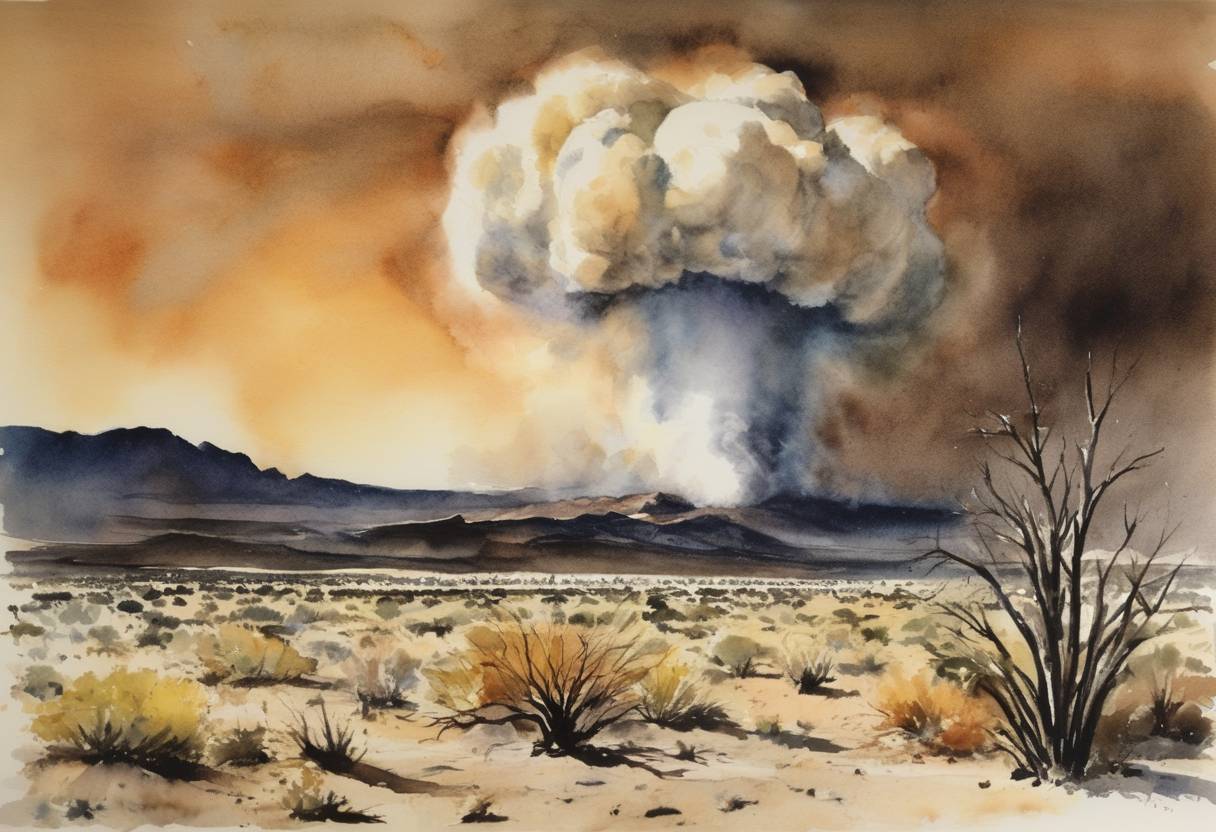
On January 27, 1951, the United States conducted the first nuclear detonation at the Nevada Test Site as part of Operation Ranger. This test, named “Able,” marked a significant moment in the history of nuclear testing, as it initiated a series of five atmospheric nuclear tests conducted by the United States at this new location.
The Nevada Test Site was selected as a primary location for nuclear tests due to its remote location and its proximity to the Los Alamos Laboratory, where the development of nuclear weapons was taking place. Before this, nuclear tests were mainly conducted at Bikini Atoll in the Pacific Ocean. The establishment of a continental test site aimed to facilitate the testing process, reduce logistical challenges, and safeguard against international scrutiny during the escalating tensions of the Cold War.
Operation Ranger consisted of a sequence of five nuclear tests between January 27 and February 6, 1951. Each test was named sequentially from “Able” to “Baker,” “Easy,” “Baker-2,” and “Fox.” The operation sought to improve the efficiency of nuclear weapon designs by experimenting with different core materials and detonation methods.
The initiation of bomb testing at the Nevada Test Site was a powerful demonstration of the United States’ commitment to maintaining its position at the forefront of nuclear technology during a period marked by geopolitical tensions and nuclear proliferation.
Source: www.ctbto.org