Jesse James' First Confirmed Bank Robbery: Gallatin, Missouri, December 7, 1869
1869 · Gallatin, United States
American outlaw Jesse James commits his first confirmed bank robbery in Gallatin, Missouri.
September 7, 1876
Infamous outlaw Jesse James and his gang attempt to rob the First National Bank of Northfield, Minnesota, but are stopped by armed citizens, resulting in the Northfield Raid.
Northfield, United States | James-Younger Gang
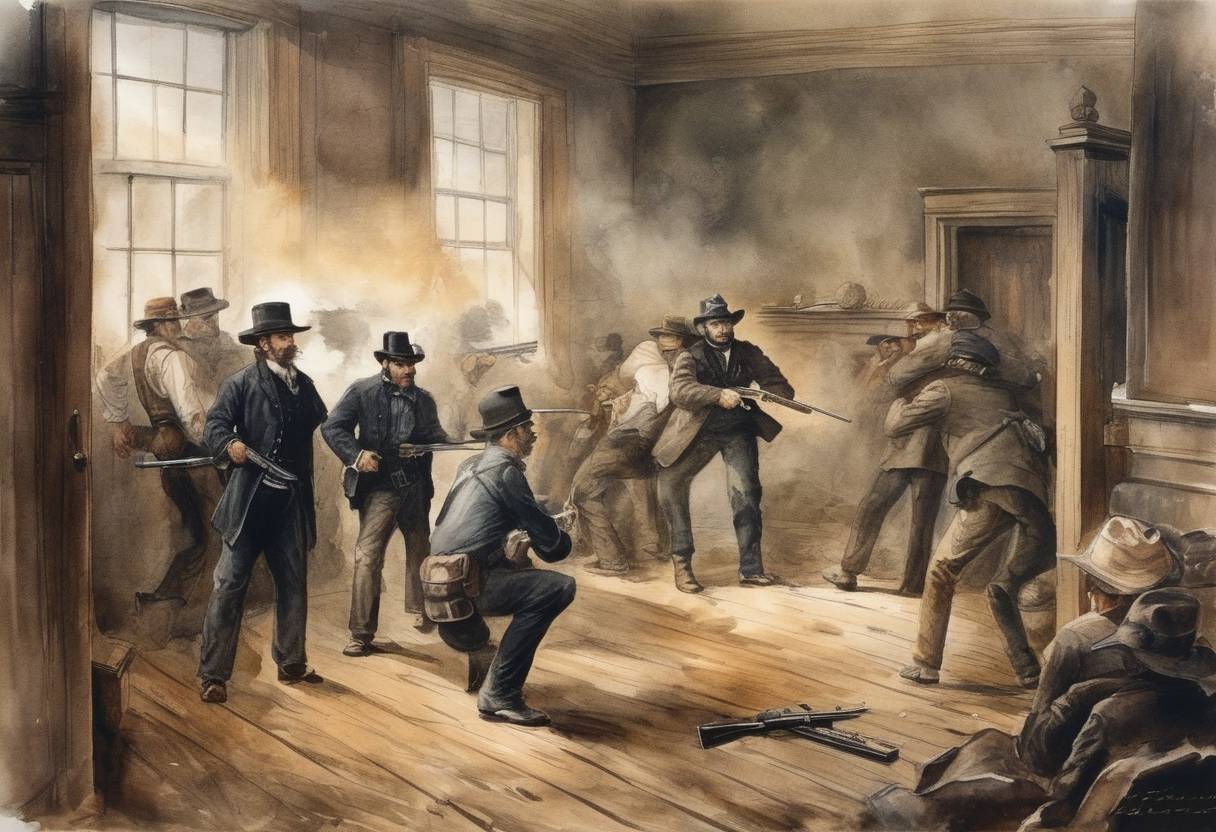
On September 7, 1876, the notorious outlaw Jesse James, along with his gang known as the James-Younger Gang, attempted what would become one of the most famous bank robbery attempts in American history. The target was the First National Bank located in Northfield, Minnesota.
The James-Younger Gang was already infamous for its series of successful robberies across Missouri and the surrounding states during the post-Civil War era. Comprising members like Jesse James and his brother Frank, along with the Younger brothers—Cole, Jim, and Bob—the gang sought to expand their criminal exploits into the Midwest.
On the morning of September 7, eight men rode into Northfield. The gang members split into two groups. Three members entered the bank where they demanded money from the vault. Meanwhile, other members stood guard outside, ready to dissuade any interference.
Contrary to the gang’s expectations, the citizens of Northfield quickly grasped the situation. When bank cashier Joseph Lee Heywood courageously refused to open the vault—claiming it had a time lock and protecting the bank’s assets—the situation escalated. The townspeople, sensing a robbery, began arming themselves. Local merchants and citizens opened fire on the gang from cover.
The armed resistance from Northfield’s citizens resulted in a chaotic and violent exchange. Two civilians, including Swedish immigrant Nicholas Gustafson, were killed during the shootout. Two gang members, Clell Miller and Bill Chadwell, were shot dead. Realizing the robbery had unquestionably failed, the remaining gang members fled the scene.
The failed raid at Northfield marked a turning point for the James-Younger Gang. Pursued by posses and law enforcement, the gang dissolved into smaller groups. The Younger brothers were eventually captured in Madelia, Minnesota, after a short but intense pursuit. They were tried and sentenced to life imprisonment. Jesse and Frank James, however, managed to evade capture and continued their criminal activities for a few more years.
This incident highlighted the growing resistance to outlaw gangs in the American West and the increasing effectiveness of organized law enforcement. It also marked the beginning of the end for many of the notorious outlaw gangs that had emerged from the post-Civil War era in the United States. The Northfield Raid thus remains a significant event in the folklore of the Old West, illustrating the unpredictable and often violent intersections between outlaws and ordinary citizens.
Source: www.britannica.com