André-Jacques Garnerin's First Recorded Parachute Jump
1797 · Paris, France
André-Jacques Garnerin makes the first recorded parachute jump from a hot air balloon over Paris.
September 20, 1819
The first successful parachute jump from a balloon is made by Jean-François Pilâtre de Rozier, landing safely after leaping from a height of 3,000 feet.
Paris, France | None
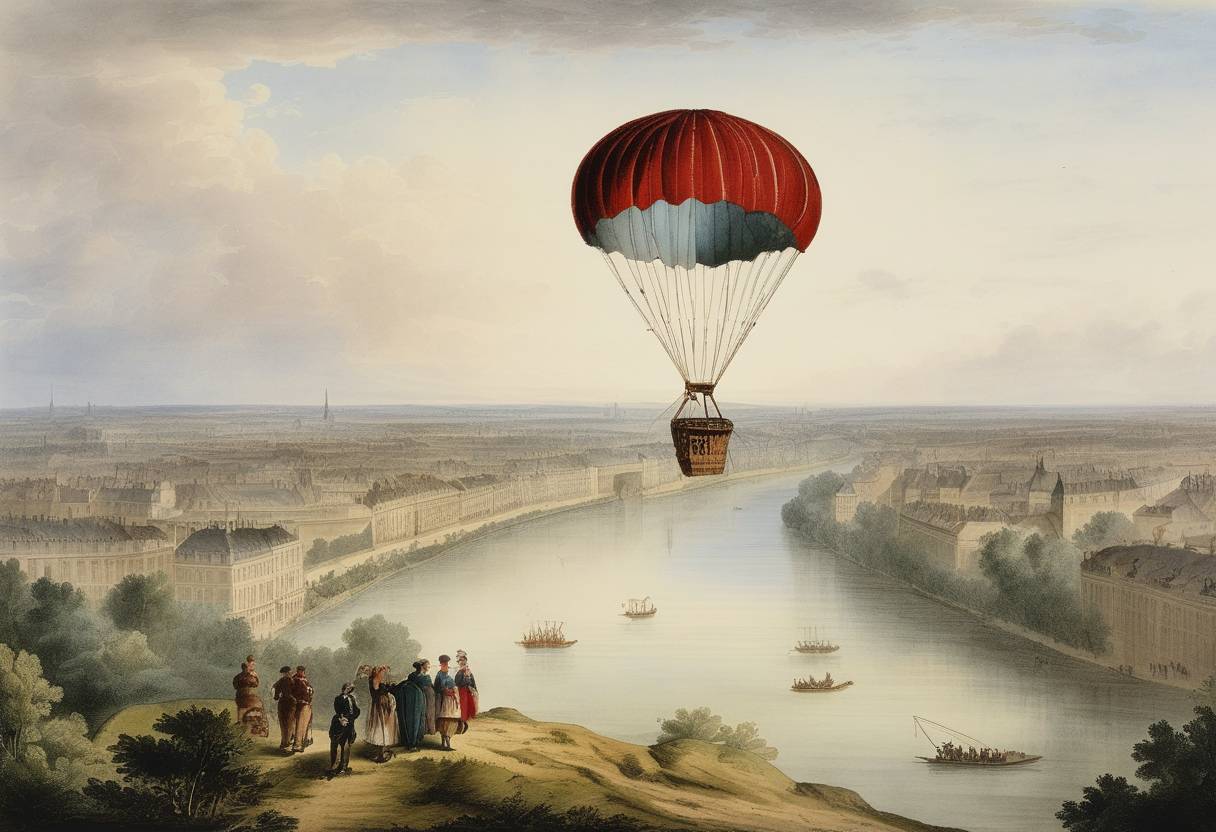
The first successful parachute jump is often attributed to André-Jacques Garnerin, not Jean-François Pilâtre de Rozier, and it took place on October 22, 1797. Jean-François Pilâtre de Rozier was indeed a pioneering balloonist but is not associated with the first parachute jump.
The development of the parachute concept dates back centuries, with various inventors and theorists proposing designs to slow descent from heights. However, it was the innovations of André-Jacques Garnerin in the late 18th century that brought the idea to fruition in a practical way.
On October 22, 1797, André-Jacques Garnerin achieved the first successful parachute jump from a balloon. The event took place at Parc Monceau in Paris, France. Garnerin ascended in a hydrogen balloon to an altitude of approximately 3,000 feet (about 900 meters). Once reaching this height, he cut the rope connecting his basket to the balloon and began his descent using a parachute of his own design.
Garnerin’s parachute consisted of a silk canopy with a diameter of about 23 feet (7 meters). Unlike modern parachutes, it lacked a vent, which caused it to swing wildly during the descent. Despite this instability, Garnerin landed safely, marking a significant achievement in the field of aeronautics.
Garnerin’s successful jump demonstrated the feasibility of using parachutes as a safety device for descending from heights. It paved the way for future advancements in parachute technology, leading to their eventual use in military and recreational contexts.
Following his groundbreaking jump, Garnerin continued to promote and refine parachute technology. He performed numerous demonstration jumps across Europe, which contributed to public interest and further innovations in the industry.
Garnerin’s work laid the groundwork for the development of safer and more reliable parachutes, which today are integral in various fields, including aviation safety, skydiving, and space exploration.
The first successful parachute jump by André-Jacques Garnerin was a landmark achievement in aeronautics. His innovative designs and daring spirit helped establish the parachute as a critical tool for ensuring safety during aerial activities, and his legacy endures through the continued use and development of parachuting technology.
Source: www.parisinfo.com