The Battle of Ayacucho: December 9, 1824
1824 · Ayacucho, Peru
The Battle of Ayacucho took place, leading to the defeat of Spanish royalist forces and securing the independence of Peru and the rest of South America from Spanish rule.
September 10, 1823
Simón Bolívar is named President of Peru, reinforcing his influence in South American liberation movements against Spanish control.
Lima, Peru | Republic of Peru
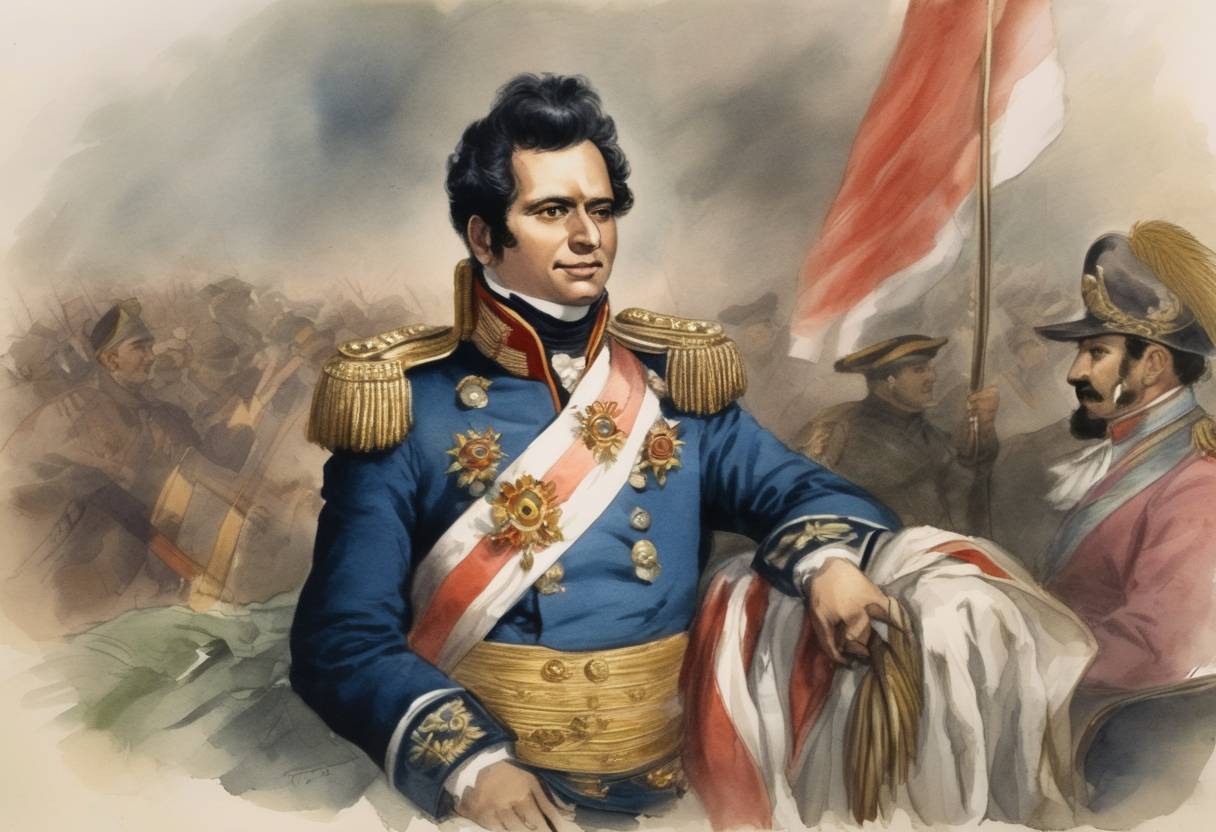
On September 10, 1823, Simón Bolívar, a key figure in the South American struggle for independence from Spanish colonial rule, was named President of Peru. This appointment significantly bolstered Bolívar’s influence in the liberation movements sweeping across the continent.
Simón Bolívar, known as “El Libertador,” was instrumental in the independence of several South American countries from Spanish rule. By 1823, Bolívar had already played pivotal roles in the liberation of Venezuela, Colombia, Ecuador, and Bolivia. His strategic military and political leadership was crucial in these movements.
The independence struggle in Peru had faced numerous challenges, including internal divisions and resistance from royalist forces. Prior to Bolívar’s involvement, José de San Martín had proclaimed Peruvian independence in 1821, but complete liberation was unattainable due to a strong royalist presence supported by General José de Canterac.
In early 1823, following the unsettled situation in Peru and the challenges faced by the provisional government, calls for Bolívar’s intervention grew stronger. The Peruvian Congress invited Bolívar to assist with the military efforts against the remaining Spanish forces. Bolívar arrived in Lima in September of that year.
Recognizing his leadership capabilities and the success he had achieved in other regions, the Republic of Peru’s interim government designated Bolívar as President. His appointment came with broad authority, allowing him to reorganize the military and devise strategies to defeat the remaining Spanish strongholds.
Under Bolívar’s command, the liberation forces gained momentum. Bolívar’s leadership galvanized the South American independence movement, providing the necessary strategic direction and morale to the cause. His presidency marked a turning point in the Peruvian war of independence.
The culmination of his efforts was the decisive Battle of Ayacucho in December 1824, led by his lieutenant, Antonio José de Sucre. This victory effectively ended Spanish rule in mainland South America, establishing Peru as a free republic.
Bolívar’s appointment as President of Peru underscored the significance of his role in the broader context of South American independence, consolidating his legacy as one of the most influential figures in the continent’s history.
Source: www.britannica.com