Stanford University Opens Its Doors
1891 · Stanford, United States
Stanford University officially opened its doors to students in Stanford, California.
October 15, 1880
The University of Southern California was founded, contributing to the higher education landscape of the United States.
Los Angeles, United States | University of Southern California
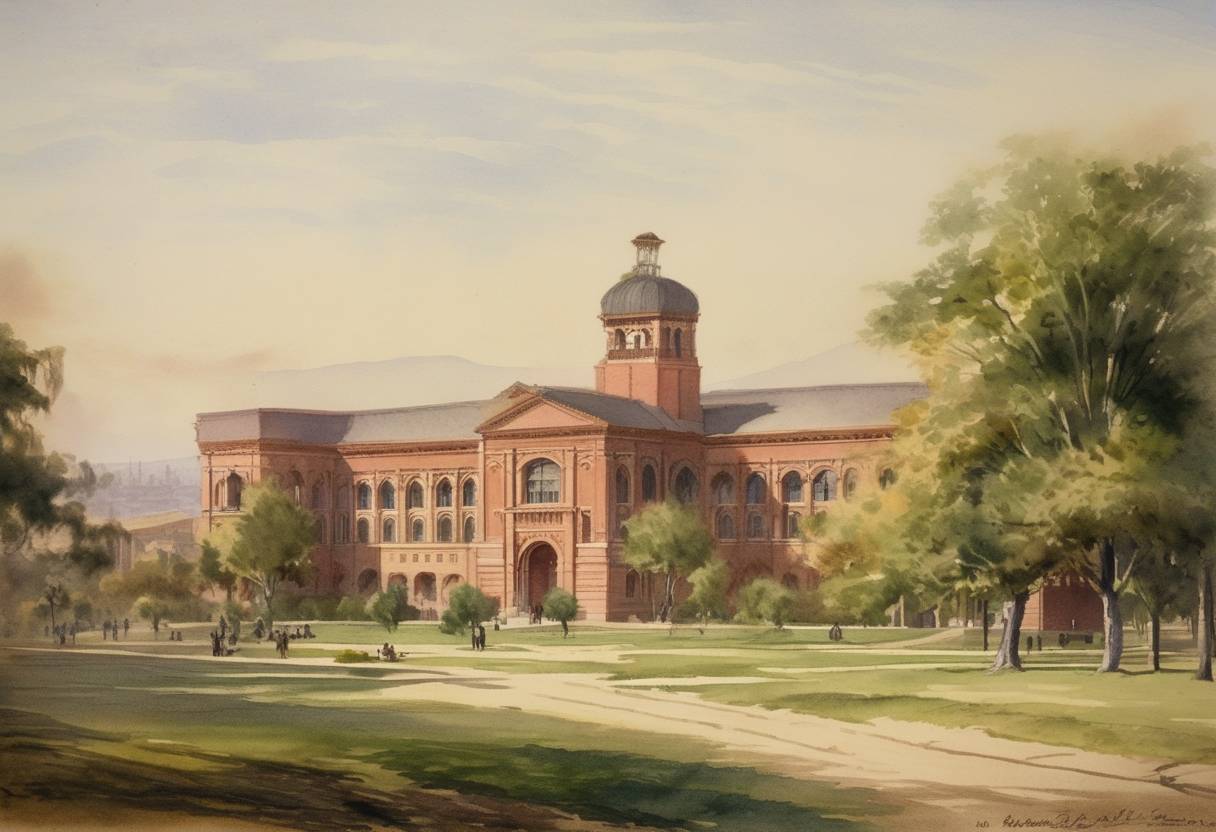
The University of Southern California (USC) was officially founded on October 15, 1880, marking a significant contribution to the higher education landscape in the United States. Located in Los Angeles, California, USC was established in response to the region’s growing need for educational institutions at a time when Southern California was beginning to expand and develop rapidly.
The initiative to establish USC germinated from the collaboration of three key figures: Judge Robert Maclay Widney, Ozro W. Childs, and John Gately Downey. Widney, a prominent lawyer and judge, was instrumental in envisioning and planning the university, while Childs, a Protestant nurseryman and philanthropist, along with Downey, a former Governor of California of Irish Catholic descent, provided essential financial support.
USC opened its doors on its founding day with just 53 students and 10 faculty members. The campus initially comprised a modest structure situated on a 308-acre plot donated by the founding partners. The institution was unique in its handling of student inclusivity from the outset, allowing students from various racial, religious, and gender backgrounds to enroll, which was relatively progressive for that era.
USC was also affiliated with the Methodist Church at its founding, which played a role in shaping its early educational ethos. Nevertheless, the university maintained a nonsectarian approach in its course offerings and student admissions, aligning with its founders’ vision of broad accessibility.
In the years following its founding, USC expanded quickly, evolving into a major research university. Its growth paralleled the exponential development of Los Angeles as a hub for the entertainment industry, technology, and innovation.
In its early decades, USC developed strong programs in business, law, engineering, and the arts, establishing itself as a pivotal institution in nurturing talent that would contribute significantly to various fields. The university’s resilience and adaptability allowed it to thrive through times of economic change and societal transformation.
As of today, USC stands as one of the leading private research universities, known for its diverse curriculum, a large number of undergraduate and graduate programs, and extensive international connections. Its establishment in 1880 set a foundational precedent for developing comprehensive higher education institutions in the western United States.
USC’s founding added to the burgeoning network of universities shaping America’s academic landscape at the turn of the 20th century. By situating itself strategically in Los Angeles, it contributed significantly not only to the educational sphere but also to the city’s cultural and economic life. USC’s impact continues to resonate as it fosters groundbreaking research, boasts a distinguished alumni network, and maintains a significant position in global higher education rankings.
Source: en.wikipedia.org