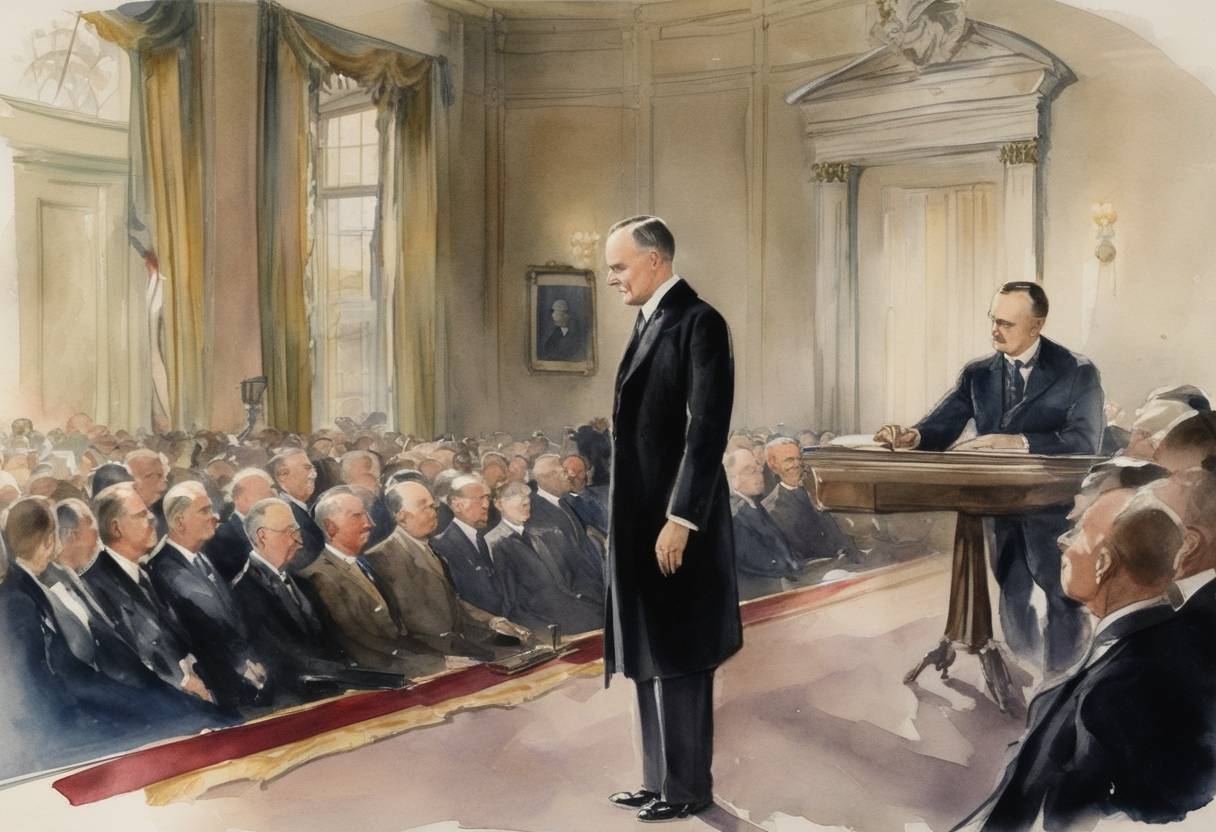
Calvin Coolidge Becomes the 30th President of the United States
On August 2, 1923, Calvin Coolidge was sworn in as the 30th President of the United States following the sudden death of President Warren G. Harding. President Harding passed away from a heart attack while on a speaking tour in San Francisco, California, marking an abrupt end to his tenure.
Background
Warren G. Harding, the 29th President, had embarked on a “Voyage of Understanding” tour across the western United States, intending to explain and promote his policies. However, his health had noticeably declined during the trip. On the night of August 2, 1923, Harding succumbed to heart failure, shocking the nation and leaving the presidency vacant.
Swearing-In of Calvin Coolidge
At the time of Harding’s death, Calvin Coolidge, then Vice President, was visiting his family’s homestead in Plymouth Notch, Vermont. He received the news from his father’s telephone, which was a rare modern amenity at the homestead. At approximately 2:30 AM, in a simple and solemn ceremony, Coolidge took the presidential oath of office administered by his father, John Calvin Coolidge Sr., who was a notary public. The event took place in the parlor of their family home, under the light of a kerosene lamp.
Significance
Coolidge’s swearing-in was unique due to its setting and simplicity, contrasting with the elaborate public ceremonies typical of presidential inaugurations. His assumption of the presidency marked a return to traditional values and a focus on stabilizing the country, following several scandals that had emerged during Harding’s administration.
Aftermath
Calvin Coolidge would go on to win the 1924 presidential election, serving until 1929. His presidency was marked by economic prosperity and a commitment to limited government. He became known for his quiet demeanor and strong advocacy of laissez-faire economics, which earned him a reputation for promoting business-friendly policies during the “Roaring Twenties.”
Harding’s sudden death and Coolidge’s subsequent rise to the presidency remains a poignant moment in U.S. history, underscoring the unpredictable nature of political leadership transitions.