The Opening of the First Underground New York City Subway Line
1904 · New York City, United States
The first underground New York City Subway line opened, running from City Hall to 145th Street.
February 26, 1870
The first New York City subway line was opened to the public, known as the Beach Pneumatic Transit, an experimental pneumatic subway line. However, it was not converted into a full-scale transit system.
New York City, United States | Beach Pneumatic Transit Company
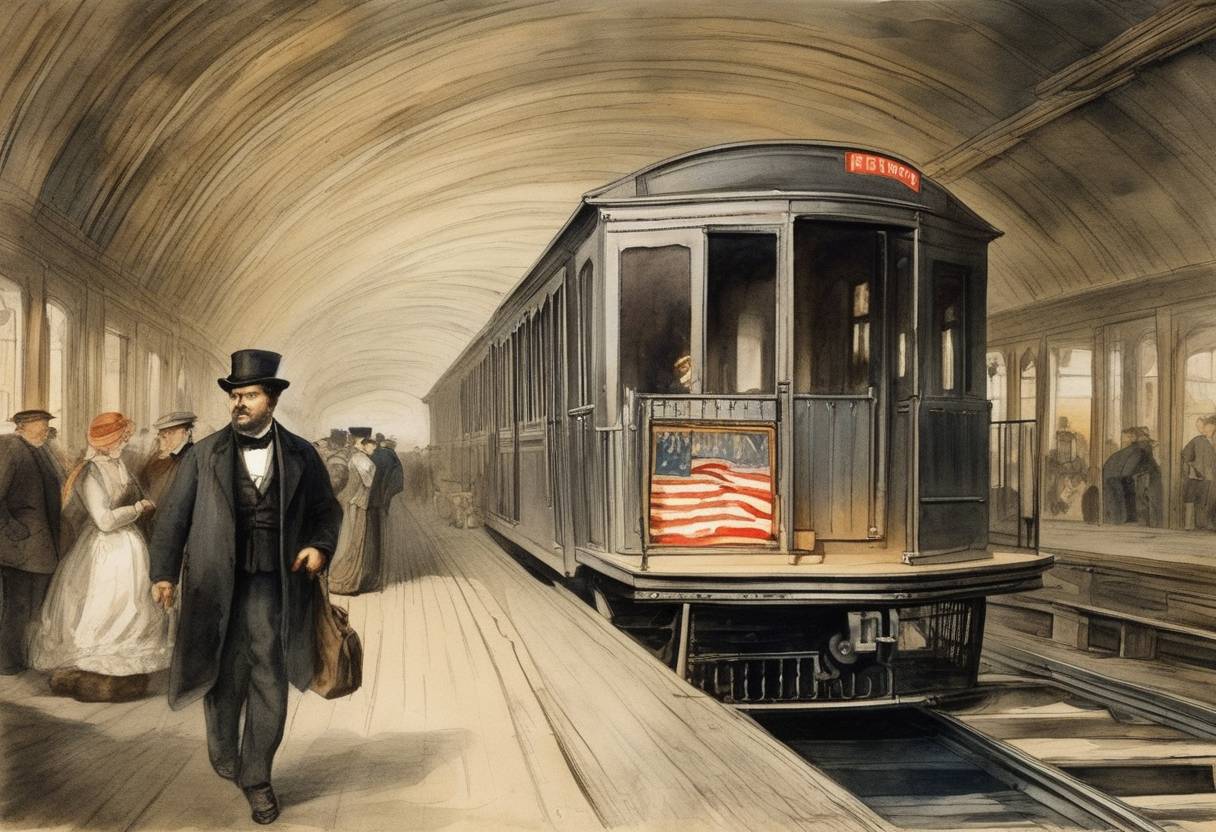
On February 26, 1870, the Beach Pneumatic Transit, an experimental subway line in New York City, opened to the public. This unique transportation system was designed by inventor and publisher Alfred Ely Beach. Unlike conventional railways, this prototype utilized pneumatic (air pressure) technology to propel a train car through an underground tunnel.
Alfred Ely Beach envisioned a solution to the severe street congestion in New York City during the mid-19th century. He proposed an underground transit system leveraging pneumatic propulsion, inspired by similar ideas and innovations experimented with in Europe.
The construction of the Beach Pneumatic Transit tunnel started secretly in 1869 to avoid public opposition and legal challenges. It was primarily built under Broadway, stretching from Warren Street to Murray Street, a distance of about 312 feet. Beach utilized a tunneling shield, a novel engineering technique that later became central to future subway projects.
The transit system featured a single car that could carry around 22 passengers at a time. It operated on the principle of a pneumatic tube, where a large fan powered by steam engines pushed the car back and forth in the tunnel.
The public response to the Beach Pneumatic Transit was overwhelmingly positive. Visitors were thrilled by the modern experience of underground travel, albeit on a small scale. Nevertheless, the project did not expand into a full-scale public transit system due to several factors including political opposition, funding challenges, and emerging competing technologies.
While the Beach Pneumatic Transit was a short-lived and isolated project, it is an important precursor to modern subway systems. It demonstrated the potential of underground transportation and set the stage for future developments in urban transit. Although it ceased operations in 1873, it remains a notable experiment in the history of public transportation, contributing to the eventual realization of New York City’s subway system inaugurated in 1904.
Source: www.nypl.org