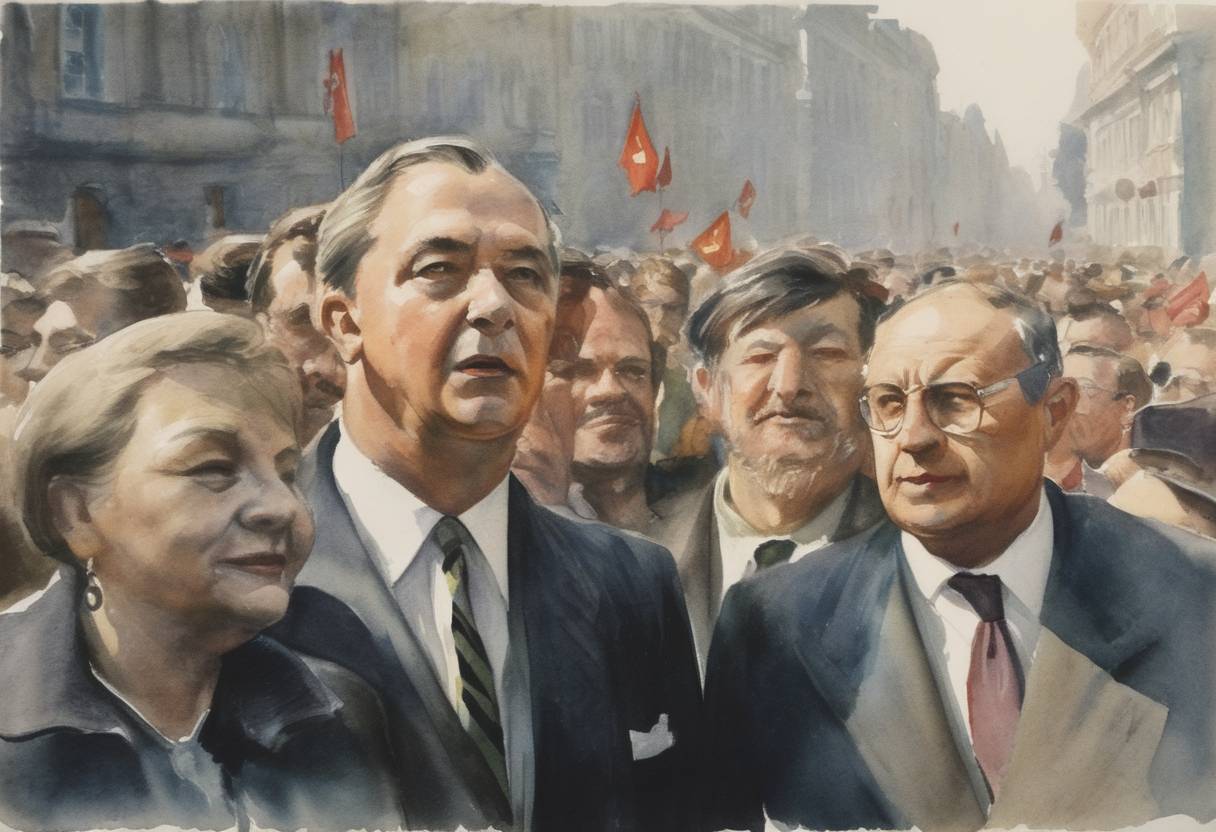
Alexander Dubček’s Election as First Secretary of the Communist Party of Czechoslovakia
On January 5, 1968, a pivotal change in Czechoslovakian politics unfolded with the election of Alexander Dubček as the First Secretary of the Communist Party of Czechoslovakia (KSČ). This event marked the beginning of what came to be known as the Prague Spring, a period of political liberalization and reform within the communist state that sought to create “socialism with a human face.”
Background
The mid-1960s in Czechoslovakia was a time of increasing public dissatisfaction with the stagnation under the static and repressive policies of Antonín Novotný, the then First Secretary. Economic problems and lack of political freedoms fueled the desire for change among the populace and segments within the Communist Party.
Election of Dubček
Dubček’s rise to power occurred as a direct response to this dissatisfaction. Antonín Novotný, who was both the President of Czechoslovakia and the First Secretary, faced mounting opposition. Internal conflicts within the KSČ saw reformist elements gain momentum, with Dubček emerging as a suitable candidate to lead the Party into a new era.
Significance of the Election
Dubček, who hailed from Slovakia, was perceived as a moderate communist leader willing to embrace reform. His election on January 5 represented a shift from hardline Stalinist policies towards a more liberal and open approach. The ensuing period, famously referred to as the Prague Spring, was characterized by attempts to implement political, economic, and cultural reforms.
Dubček’s administration promoted ideas like freedom of the press, freedom of speech, and the reduction of the secret police’s influence. This agenda resonated with the public’s aspirations for liberalization and greater autonomy from Soviet influence.
Aftermath
The reforms initiated under Dubček quickly attracted international attention and, crucially, the concern of the Soviet Union. As reforms expanded, they threatened to weaken Soviet control over the Eastern Bloc. This concern culminated in the Warsaw Pact invasion of Czechoslovakia in August 1968, which forcibly ended the Prague Spring and reinstated a conservative regime.
Although Dubček was later removed from power and the reforms largely reversed, the Prague Spring left a lasting legacy on Czech and Slovak political culture. It symbolized a courageous push for a more humane and liberal form of socialism and would inspire future generations, notably contributing to the Velvet Revolution of 1989.
Conclusion
The election of Alexander Dubček on January 5, 1968, was a transformative moment, setting the stage for short-lived but impactful reformative efforts in Czechoslovakia. It exemplified the tensions between liberalizing efforts within Soviet-affiliated states and the broader geopolitical interests of the Soviet Union during the Cold War.