The Death of Wat Tyler: The Peasants' Revolt of 1381
1381 · London, England
During the Peasants' Revolt in England, Wat Tyler, the leader of the revolt, was killed at Smithfield by officers loyal to King Richard II.
May 30, 1381
The English Peasants' Revolt began as tax collectors attempted to levy a poll tax in Brentwood, Essex, leading to extreme popular resistance.
Brentwood, England | English Crown
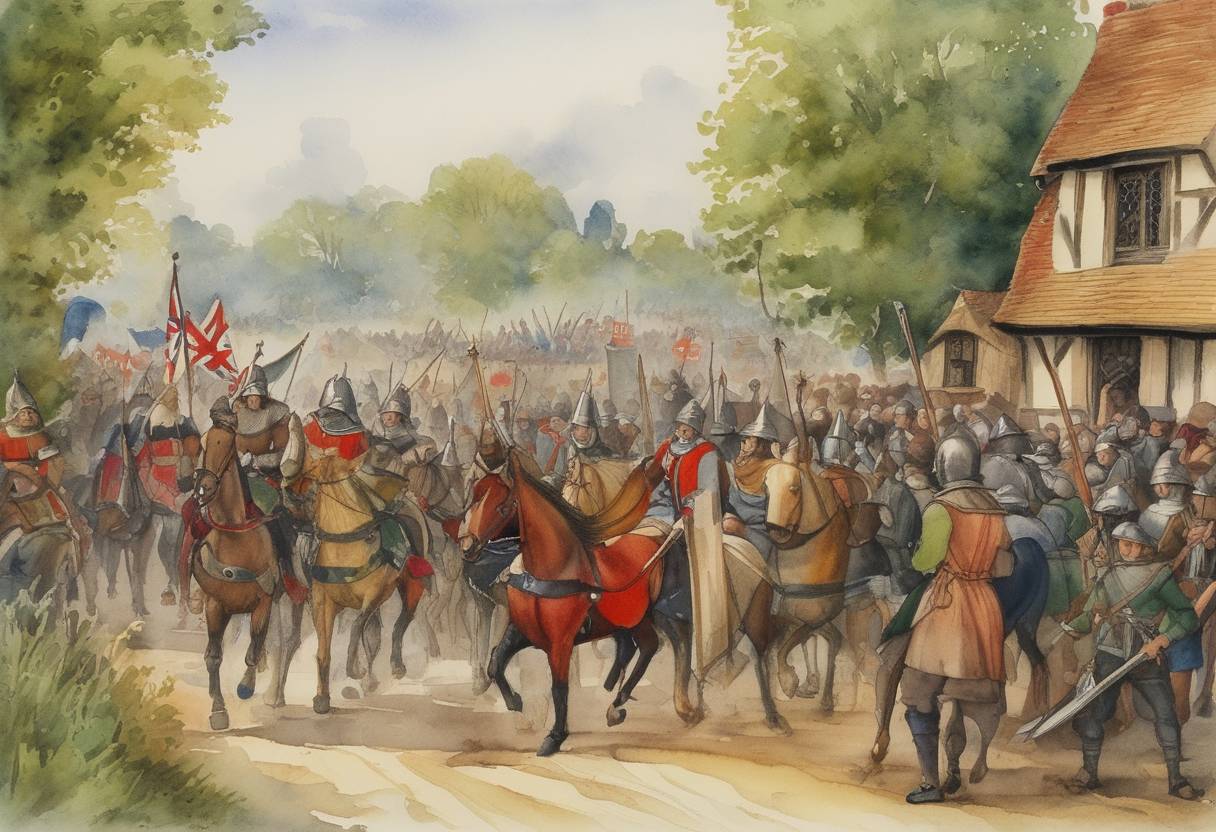
The English Peasants’ Revolt of 1381, a major uprising across large parts of England, was prompted by various socio-economic pressures, exacerbated by government-imposed poll taxes. On May 30, 1381, this discontent materialized violently in Brentwood, Essex, which is considered the catalyst for the revolt.
By the late 14th century, England faced several challenges: economic hardship due to the Black Death, which had significantly reduced the population and led to a severe labor shortage; social tensions stemming from feudal structures; and recurrent war with France that demanded funds. Successive governments attempted to address the fiscal strain through taxes, culminating in the controversial poll tax of 1381. This tax applied uniformly to all adults, disproportionally affecting the poorer domains of society.
The immediate trigger of the Peasants’ Revolt occurred on May 30, 1381, when royal tax collectors attempted to enforce the poll tax in Essex. The resistance in Brentwood was fierce. Villagers confronted the collectors, refusing to pay and assaulting the officials tasked with the tribute collection. This defiant action inspired other towns and villages across England to also resist the poll tax enforcements.
The confrontation in Brentwood marks a key moment in the Peasants’ Revolt. It set off a chain reaction, leading to a large-scale uprising that quickly spread to Kent and beyond. The rebels sought not only tax relief but broader socio-political reforms, challenging the feudal system and demanding an end to serfdom.
The revolt reached its peak as the rebels marched on London, where they famously captured the Tower of London and executed several royal officials. Although the revolt was ultimately quelled later that year and its leaders were executed, it marked a significant turning point in English history, highlighting the growing unrest among the lower classes and setting the stage for future social transformations.
Thus, the events of May 30, 1381, in Brentwood were instrumental in igniting a revolt that would challenge the traditional structures of medieval England and underscore the tensions within its society at the time.
Source: en.wikipedia.org