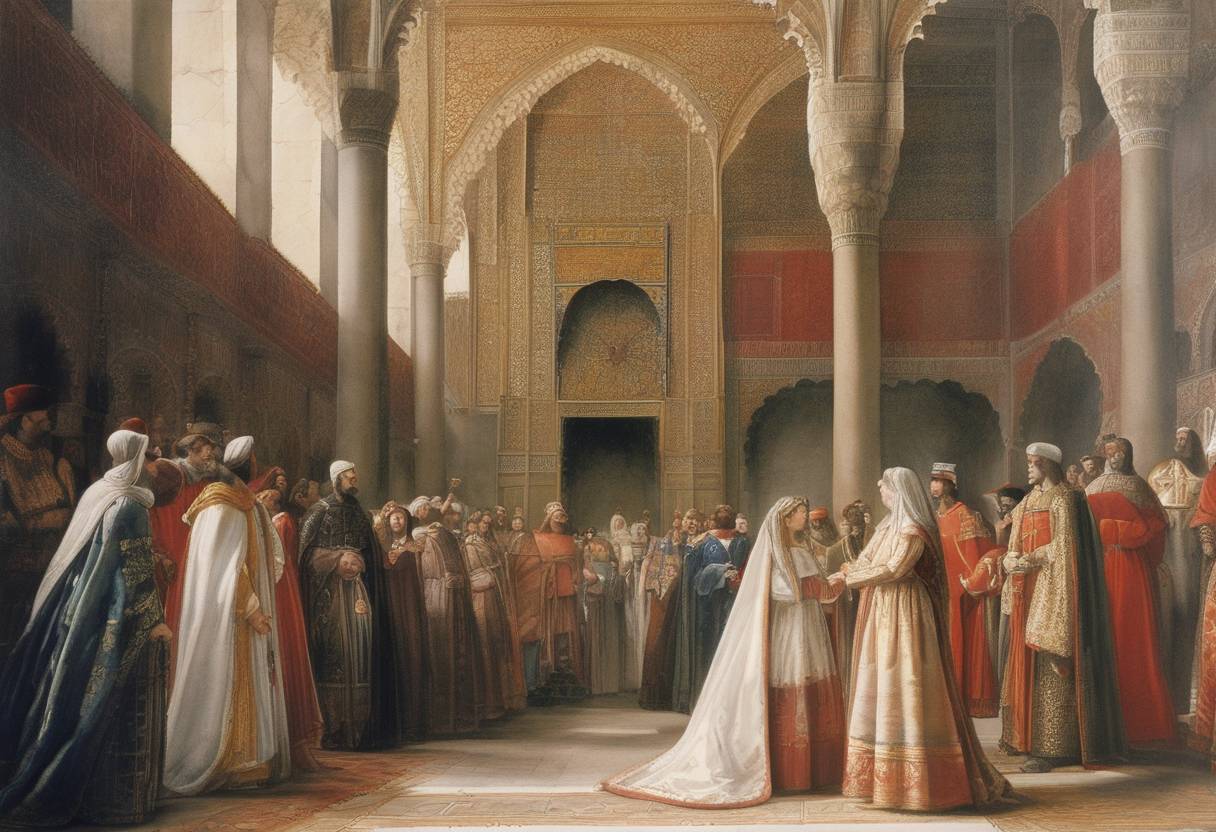
Alhambra Decree’s Final Stages: The January 20, 1502 Edict
On January 20, 1502, Queen Isabella I of Castile issued a critical edict in the aftermath of the Reconquista that targeted the remaining Muslim population in Spain. This order was a continuation of the broader efforts following the capture of Granada in 1492, which concluded centuries of Muslim rule on the Iberian Peninsula.
Context and Background
The fall of Granada in 1492 marked the end of Muslim sovereignty in Spain and was celebrated by the Catholic Monarchs, Isabella I of Castile and Ferdinand II of Aragon, as an achievement of their long-term strategy to consolidate Christian rule. In the decade following the conquest, the monarchs focused on religious homogeneity as a central policy for their newly unified kingdom.
The Alhambra Decree, initially issued in 1492, mandated the expulsion of practicing Jews from Spain to promote religious unification. The focus then shifted to Muslims, commonly referred to as Moors, particularly those who had chosen to stay after the conquest of Granada.
The January 20, 1502 Decree
The 1502 edict required that all remaining Moors in the Spanish kingdoms convert to Christianity or face expulsion. This decree was explicitly aimed at enforcing religious uniformity and ended the previous period of relative tolerance that had allowed Muslims to continue practicing their faith.
Conversion or Exile: Those who refused to convert were forced to leave the kingdom. Conversion was made under duress, and many Muslims outwardly adopted Christianity while secretly maintaining Islamic practices.
Economic and Social Implications: The expulsion and coerced conversions disrupted traditional Muslim communities and trades, wielding significant socioeconomic impacts on regions such as Granada that had been strongly influenced by Arab culture and economies.
Aftermath and Historical Significance
This edict, part of the overarching strategy of religious consolidation, significantly reduced the visible presence of Islam in Spain. While many historians note that this did not completely eliminate Islamic cultural influence or practices, it marked a decisive step in the Catholic Monarchs’ pursuit of a unified Christian state.
The policy laid the groundwork for continued religious persecution, leading to the establishment of the Spanish Inquisition’s systematic targeting of converts suspected of heresy.
Broader Legacy
The 1502 expulsion is seen as a historic turning point that pressured religious and cultural minorities in Spain, contributing to a larger pattern of intolerance and forced assimilation that would influence Spanish colonial policies in the Americas. The repercussions of these policies shaped Spain’s socio-religious landscape for centuries, lingering in the cultural memory and identity of the nation.