Bolivia's Declaration of Independence on August 6, 1825
1825 · Sucre, Bolivia
Bolivia declared independence from Spain with Simón Bolívar playing a significant role in its liberation.
June 21, 1824
The Battle of Ayacucho, part of the Peruvian War of Independence, occurred near La Paz, giving a decisive victory to the independentists under the lead of Antonio José de Sucre over the royalist forces.
Ayacucho, Peru | Independentist Forces
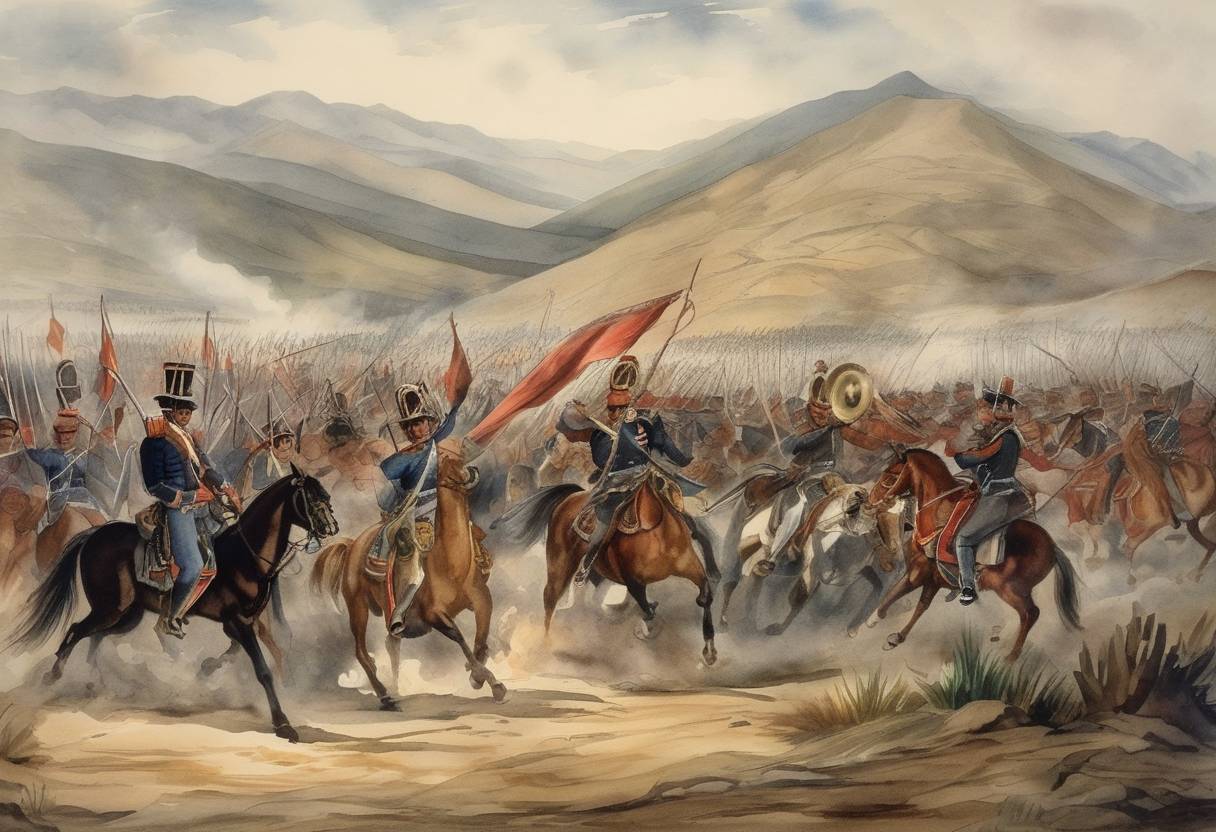
The Battle of Ayacucho took place on December 9, 1824, rather than June 21, 1824. It occurred near Quinua, in the Ayacucho region of present-day Peru, not near La Paz.
The Battle of Ayacucho was a pivotal conflict during the Peruvian War of Independence, which was part of the broader Spanish American wars of independence. By 1824, South America had become a hotbed of revolutionary activity as various regions sought independence from Spanish colonial rule. The campaign leading to Ayacucho was critical in securing the liberation of Peru and ultimately South America.
Antonio José de Sucre, a key figure and military leader of the independence movement, orchestrated a campaign to consolidate the gains made by earlier revolutionary leaders, including Simón Bolívar. As the commander of the Patriot forces, Sucre was tasked with defeating the last significant royalist army standing in defense of the Spanish Empire’s rule in Peru.
On December 9, 1824, Sucre faced off against a Spanish royalist army led by Viceroy José de la Serna. The decisive engagement occurred on the plains near Ayacucho. Sucre’s forces numbered around 6,000 men, consisting of a mix of liberated Peruvians, Colombians, Argentines, and other South Americans united in the cause of independence.
The battle commenced with strategic maneuvers and intense fighting. Sucre effectively capitalized on the rugged terrain and his troops’ superior morale, eventually outflanking and overwhelming the royalist forces. The combat was fierce, but Sucre’s leadership and tactical acumen proved decisive.
The victory at Ayacucho was conclusive, leading to the capture of Viceroy de la Serna and the capitulation of 9,000 Spanish soldiers. It marked the end of Spanish colonial rule in South America, as the defeat led to the acknowledgment of independence across the continent. This victory effectively sealed the liberation of Peru and paved the way for the independence of Bolivia, which was formerly known as Upper Peru.
The aftermath of the Battle of Ayacucho saw a shift in geopolitical power in South America, reducing European influence and setting the stage for the emergence of new nations. Sucre emerged as a key architect of this independence, and his role in Ayacucho elevated him to historical prominence as a liberator.
The Battle of Ayacucho is celebrated as one of the defining moments in the liberation of South America. It demonstrated the effectiveness of coordinated revolutionary movements across regions and symbolized the end of colonial domination. The independence achieved through this battle set a precedent for subsequent movements and transformations in the region throughout the 19th century.
Source: en.wikipedia.org