The Fall of Constantinople: May 29, 1453
1453 · Constantinople, Byzantine Empire (modern-day Turkey)
The Fall of Constantinople occurred, marking the end of the Byzantine Empire as the Ottoman Empire, led by Sultan Mehmed II, captured the city.
April 6, 1453
The Ottoman Empire under Sultan Mehmed II began the siege of Constantinople, marking the start of the battle that ended the Byzantine Empire.
Constantinople, Byzantine Empire | Ottoman Empire
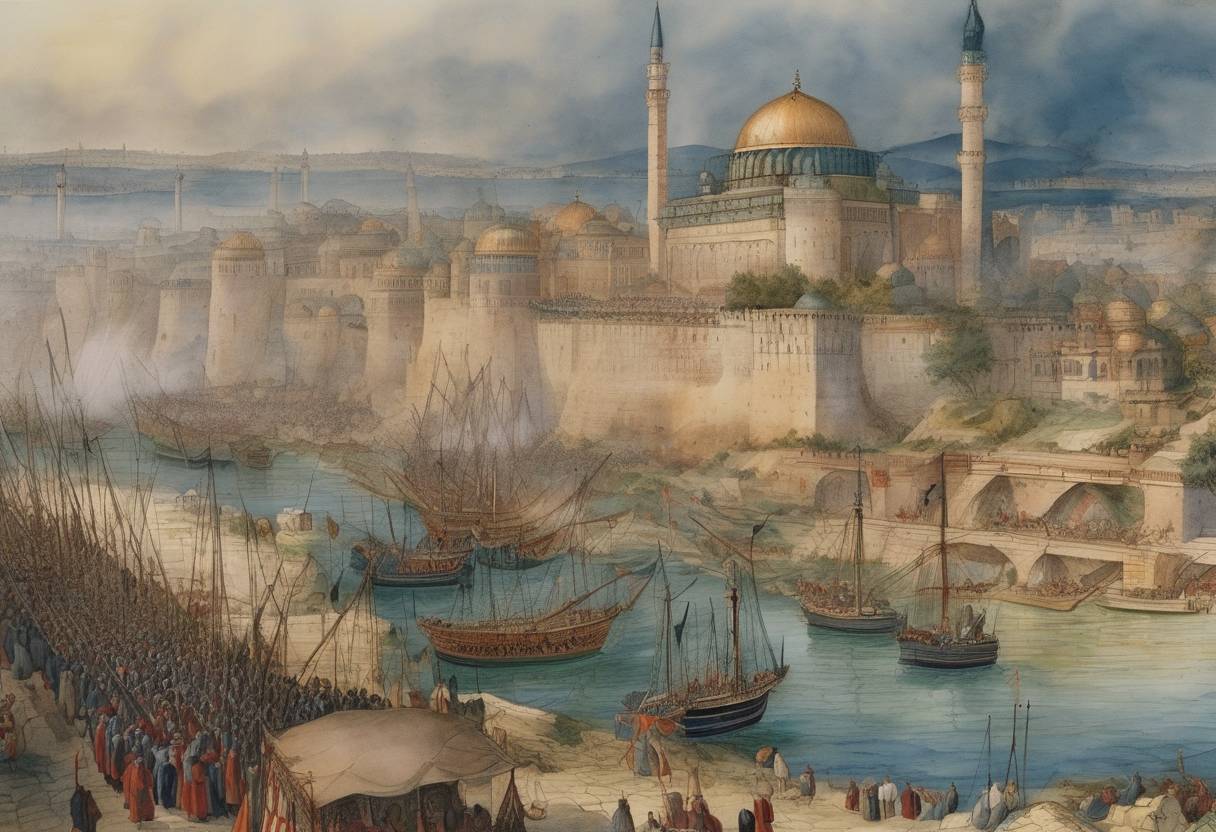
On April 6, 1453, Sultan Mehmed II, later known as Mehmed the Conqueror, initiated the siege of Constantinople, a pivotal moment that marked the beginning of the end for the Byzantine Empire. This siege was the culmination of a long-standing ambition by the Ottoman Empire to capture the esteemed city, which had been the center of Byzantine power and cultural influence for over a millennium.
Constantinople, strategically located at the crossroads between Europe and Asia, had been a vital stronghold due to its formidable defensive walls and control over key trade routes. However, by the mid-15th century, the Byzantine Empire had significantly weakened, both militarily and economically, rendering it vulnerable to external threats.
Sultan Mehmed II, who ascended to the Ottoman throne in 1451, was determined to expand his empire and saw the conquest of Constantinople as essential to his vision. He prepared meticulously for the siege, assembling a large and technologically advanced army, which included soldiers from various parts of the empire and a formidable artillery division equipped with massive cannons capable of breaching the city’s ancient walls.
The siege of Constantinople began on April 6, 1453, with the Ottoman forces surrounding the city both on land and at sea. Mehmed II’s strategy involved bombarding the city’s formidable fortifications while also blockading its harbor with a fleet of ships. The Ottomans employed massive cannons designed by the engineer Orban, which relentlessly pounded the city’s defenses, a key innovation that showcased the changing nature of warfare during this period.
Inside Constantinople, the Byzantine defenders, led by Emperor Constantine XI, were significantly outnumbered. Despite their resolute defense efforts, including repairing damaged sections of the walls and utilizing Greek fire against enemy ships, the city’s resources and morale were strained under the relentless Ottoman assault.
The siege extended for several weeks, with both sides enduring heavy casualties. Finally, on May 29, 1453, after a sustained and concentrated attack on a previously weakened section of the city’s walls, the Ottoman forces successfully breached Constantinople’s defenses. The city fell on that decisive day, marking the end of the Byzantine Empire.
The fall of Constantinople to the Ottomans was a turning point in world history. It signified the end of Eastern Roman (Byzantine) influence and established the Ottomans as a dominant power in southeastern Europe and the eastern Mediterranean. Mehmed II declared Constantinople the new capital of the Ottoman Empire, revitalizing it with an influx of diverse cultures and communities.
This conquest also had profound effects on Europe, prompting shifts in trade routes and encouraging exploration, ultimately contributing to the Age of Discovery. Additionally, the fall inspired Renaissance scholars as Greek scholars fled to Western Europe, carrying with them classical knowledge that enriched European intellectual life.
The siege and capture of Constantinople exemplified the transition from medieval to modern warfare, showcasing the critical role of gunpowder weaponry and strategic military leadership in shaping the course of history.
Source: en.wikipedia.org