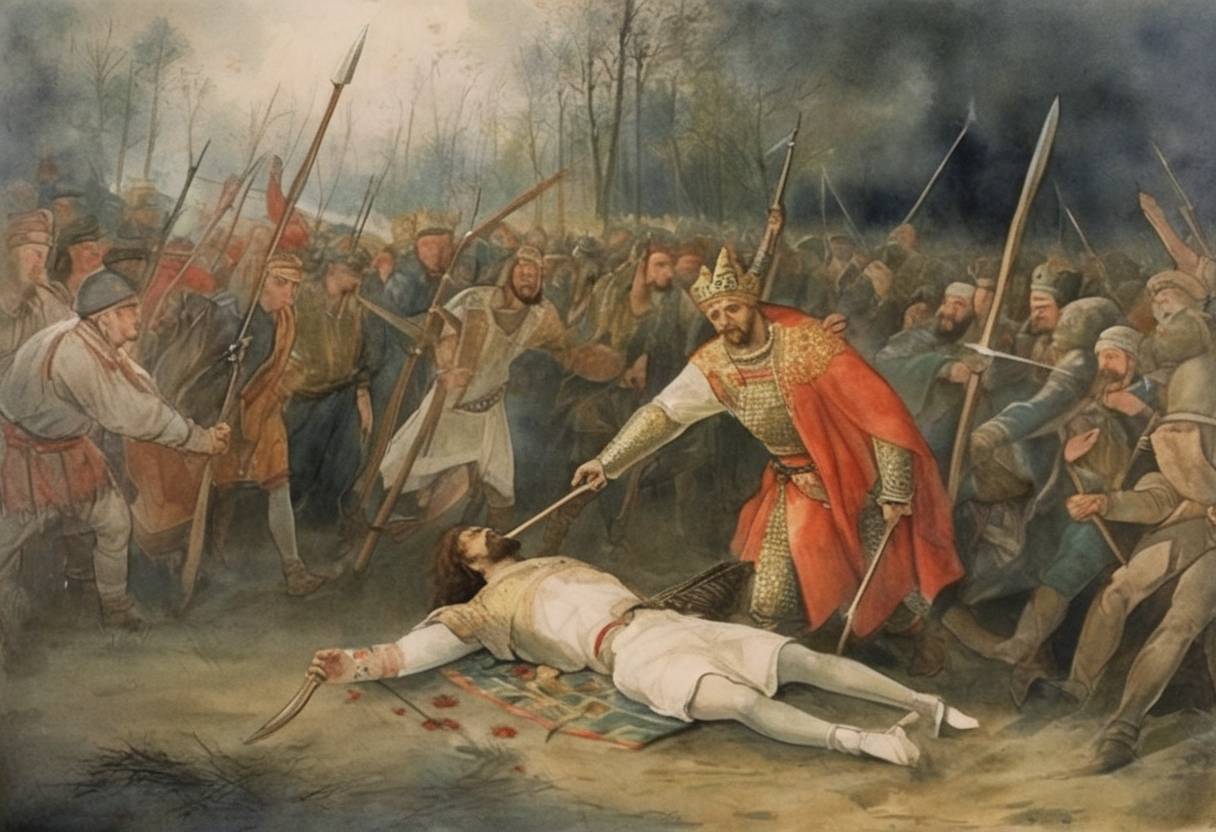
Martyrdom of Oleg, Prince of Chernigov
On October 31, 1017, Oleg, Prince of Chernigov, met his untimely death at the hands of Pecheneg tribesmen. His death marked a significant moment in the struggles between the Kievan Rus’ and the nomadic tribes of the Eurasian steppes. This event is a sobering reflection of the era’s pervasive tensions and the dangers faced by rulers in maintaining territorial integrity and power.
Historical Context
During the early 11th century, the Kievan Rus’ was a federation of Slavic and Finnic peoples, ruled by the Rurikid dynasty. The grand principality engaged in frequent conflicts with nomadic tribes such as the Pechenegs, who were known for their mobility and warfare tactics. These conflicts were often rooted in territorial disputes and competition over the lucrative trade routes that crisscrossed Eastern Europe and connected the Byzantium Empire with the Scandinavian countries.
Oleg’s Rule
Oleg, a member of the Rurikid family, was positioned as a prince within this complex political landscape. While information specific to his tenure as Prince of Chernigov remains sparse, it is understood that his rule and influence were marked by efforts to defend and expand his domains against external threats, particularly from the Pechenegs.
The Event
On October 31, 1017, Oleg embarked on a hunting expedition, an activity that was both a leisure pursuit and a demonstration of power and prowess among the nobility of his time. During this expedition, he encountered a group of Pecheneg tribesmen. The meeting quickly turned violent, resulting in Oleg’s death—an incident documented in the medieval chronicles of the time.
Consequences
Oleg’s death not only exemplified the constant perils leaders faced but also magnified the volatility of politics in the Kievan Rus’. It reinforced the threat of nomadic incursions that plagued the principalities and underscored the necessity for strong leadership and military strategy to counter these threats.
Historical Significance
This event is indicative of the broader geopolitical dynamics of Eastern Europe in the early medieval period. The Kievan Rus’, while a powerful entity, continually had to defend its borders from the encroaching nomads of the steppe. The martyrdom of Oleg, an individual from the ruling elite, symbolized the persistent danger these tribes posed and the vulnerabilities even high-ranking leaders could suffer.
Oleg’s death is also significant for its implications on local governance and regional stability, echoing the fragile nature of rule during a time when alliances were indispensable yet frequently unreliable. His demise may have served as a catalyst for shifts in regional power and adjustments in the strategic approaches of the Kievan Rus’ towards its nomadic adversaries.