Battle of Rio Salado - October 30, 1340
1340 · Tarifa, Spain
At the Battle of Rio Salado, English and Portuguese forces defeat the Marinid Muslim army in Iberia, effectively ending the last Muslim attempt to conquer the Iberian Peninsula.
February 15, 1214
Alfonso VIII of Castile and the forces of the Almohad Caliphate clash in the Battle of Alarcos. This battle establishes Almohad dominance in southern Iberia for a period.
Alarcos, Spain | undefined
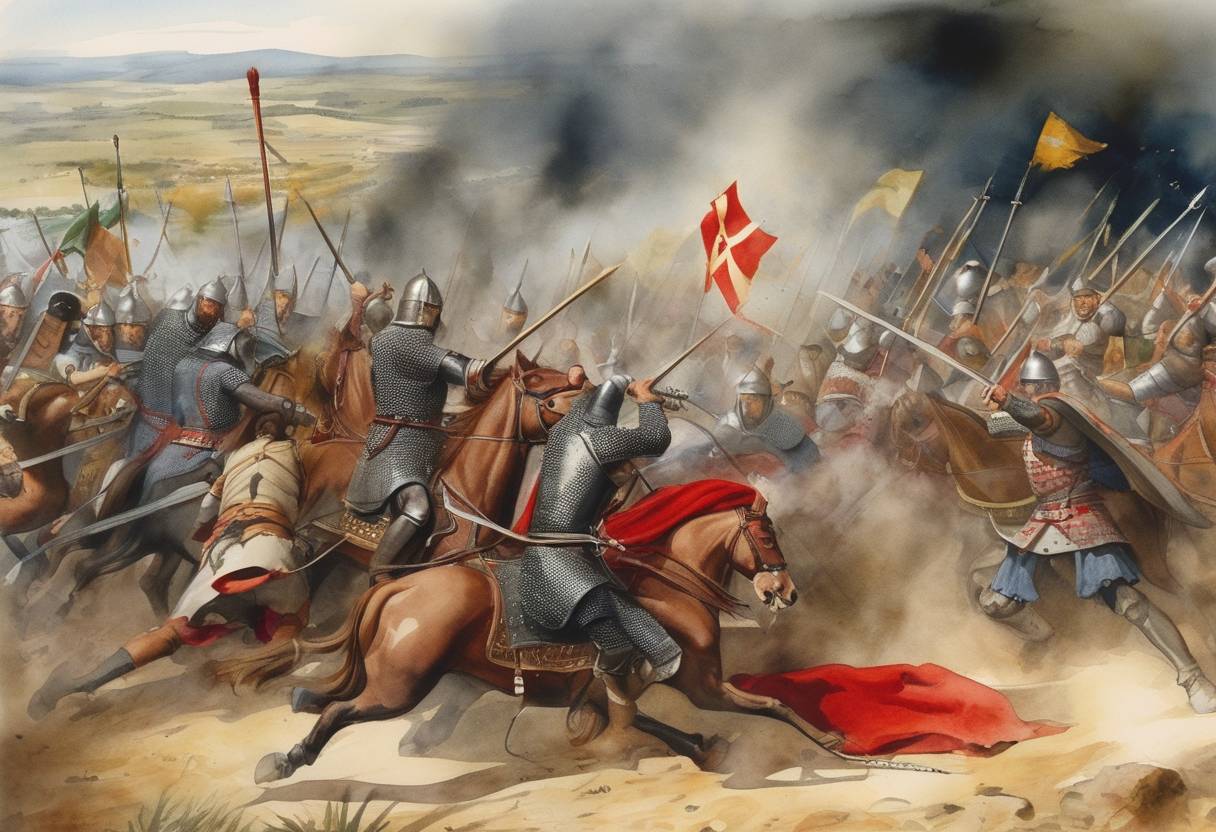
The Battle of Alarcos, a significant conflict in the history of the Iberian Peninsula, unfolded on July 19, 1195, rather than on February 15, 1214. This clash occurred near the castle of Alarcos, close to the city of Ciudad Real, and proved pivotal in shaping the power dynamics between the Christian kingdoms of northern Iberia and the Muslim Almohad Caliphate.
By the late 12th century, Spain was a patchwork of Christian and Muslim territories. The Almohad Caliphate, having taken control over the earlier Almoravid territories in the Iberian Peninsula, sought to consolidate its power. Alfonso VIII of Castile, eager to reclaim lands lost to Muslim dominion, pushed southward, threatening Almohad territories. This expansionist thrust set the stage for confrontation.
The confrontation at Alarcos was marked by the tactical and numerical superiority of the Almohad forces under the leadership of Caliph Abu Yusuf Yaqub al-Mansur. Alfonso VIII, on the other hand, commanded a strong but smaller coalition of Castilian knights and infantry.
As the battle progressed, the Almohads employed strategic maneuvers, utilizing their cavalry’s mobility to outflank the Castilian forces. The intense combat saw the Castilian lines break, overwhelmed by the coordinated assaults of the Almohad soldiers. Alfonso VIII was forced into a hasty retreat, leaving behind numerous casualties.
The outcome at Alarcos was a devastating blow to Alfonso VIII and the Christian kingdoms. It temporarily halted Christian expansion in the region and affirmed Almohad control over significant parts of southern Iberia, influencing the region’s political landscape. The defeat compelled Alfonso VIII to reinforce his armies and alliances, eventually culminating in the decisive confrontation at the Battle of Las Navas de Tolosa in 1212, which shifted the momentum back in favor of the Christians.
The Battle of Alarcos stands as a poignant reminder of the fluctuating fortunes during the Reconquista, illustrating the interplay of military strategy, leadership, and political machinations that defined the era’s conflicts.
Source: en.wikipedia.org