Construction of the Dome of Santa Maria del Fiore
1420 · Florence, Italy
Construction of the dome of Santa Maria del Fiore in Florence began, designed by Filippo Brunelleschi, marking a significant development in Renaissance architecture.
March 6, 1454
The Treaty of Lodi, also known as the Peace of Lodi, is signed in Lombardy, establishing a balance of power among the northern Italian states.
Lodi, Italy | Various Italian States
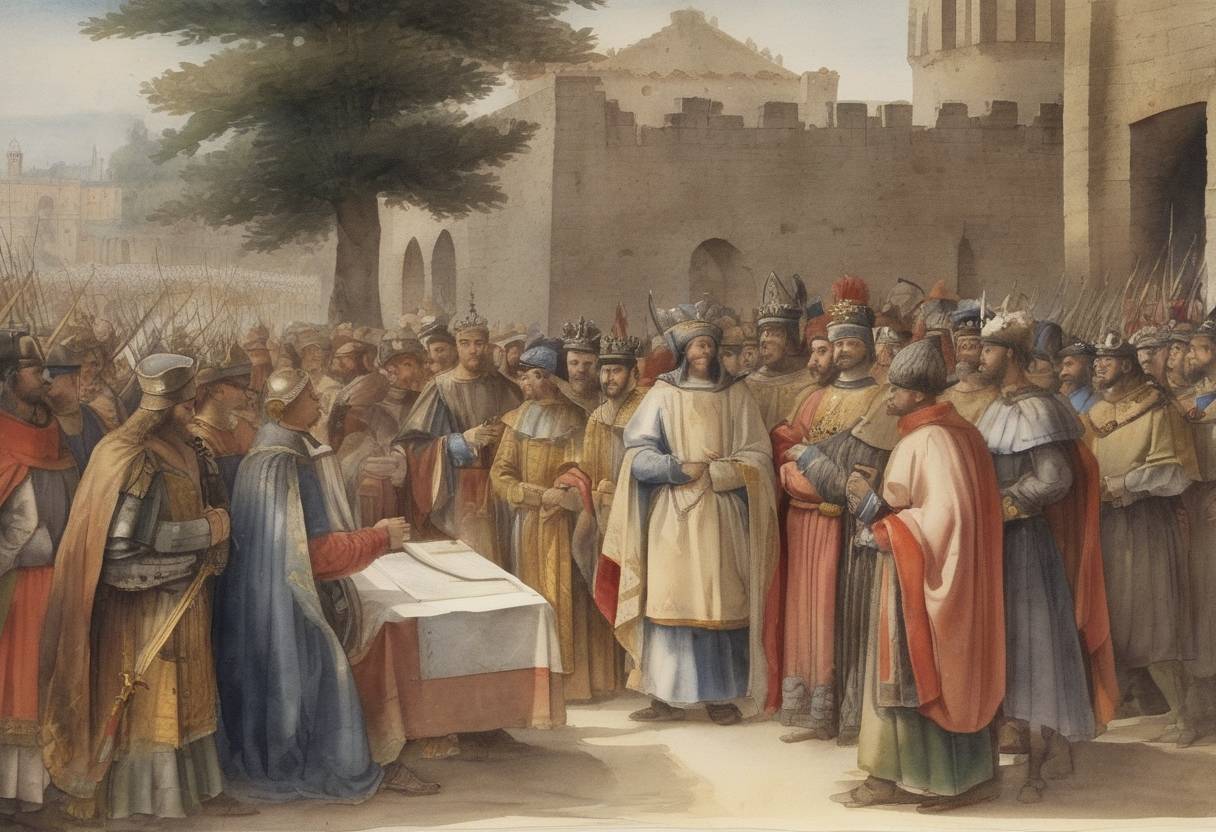
On April 9, 1454, in the Lombardy region of northern Italy, the Treaty of Lodi, also known as the Peace of Lodi, was signed. This significant treaty played a critical role in establishing a balance of power amongst the principal Italian states of the Renaissance period.
The signing of the Treaty came after three decades of intense warfare among the Italian city-states, notably involving Milan, Venice, and the Republic of Florence. As Venice and Milan were embroiled in the War of the Venetian Succession, the turbulence prompted a reconsideration of tactics, leading to peace negotiations.
Balance of Power: The treaty aimed to secure a stable distribution of power by acknowledging and respecting each state’s territorial gains. This balance was central to cooling tensions and preventing any one state from dominating northern Italy.
Mutual Defense Pact: It included commitments to mutual defense which implied that an attack on one of the signatories would be regarded as an attack on all, thereby deterring aggression from external powers as well.
Political Alliances: Milan and Venice agreed to recognize each other’s territorial integrity, setting aside their long-standing rivalries. This balance facilitated a political alliance that helped neutralize potential conflicts within northern Italy.
The Treaty was primarily signed by Francesco Sforza, Duke of Milan, and representatives of the Republic of Venice. Other Italian powers, such as Florence, the Papal States, and the Kingdom of Naples, endorsed the treaty either directly or indirectly, contributing to its reach and impact.
The Treaty of Lodi held for approximately four decades, facilitating a period of relative peace and economic prosperity during the High Renaissance. This equilibrium allowed cultural and artistic developments to flourish by focusing on cooperative and diplomatic relations rather than conflict.
Moreover, the Treaty paved the way for the Italian League, established in 1455, which further solidified alliances and mutual cooperation against foreign invasions, notably those by the French and the Holy Roman Empire.
Historically, the Treaty of Lodi is recognized for its innovative approach to diplomacy and conflict resolution, embodying early principles of collective security that influenced European political thought. By preventing any single state from becoming overly dominant, it remained a prototype for diplomatic structuring in a fragmented political landscape and highlighted the Renaissance focus on balance and proportion, not just in art, but also in politics.
Source: en.wikipedia.org