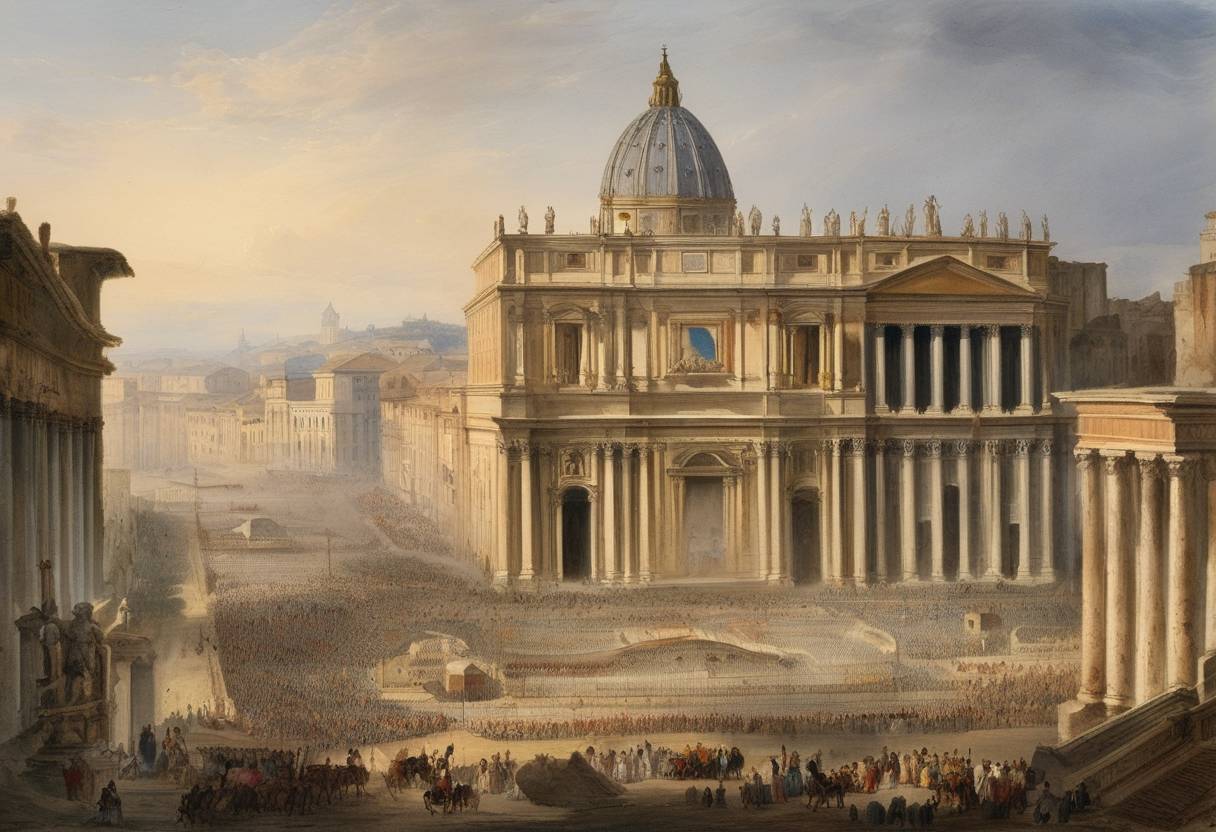
The Proclamation of the Roman Republic on February 9, 1849
On February 9, 1849, the Roman Republic was proclaimed in the city of Rome, marking a significant but brief chapter in the Revolutionary Year of 1848—a period marked by numerous liberal uprisings across Europe. This political transformation followed a popular uprising against Pope Pius IX, who, despite initially appearing as a reformer, became a symbol of reactionary forces.
Context and Background
The mid-19th century was a time of political volatility in Europe. The Revolutions of 1848, also known as the Springtime of Nations, were a series of interconnected republican revolts against monarchical rule, aiming to establish more democratic governments and national self-determination. Within this larger movement, Italy was a mosaic of states and kingdoms, with many advocates pushing for unification and liberation from foreign and papal rule.
In this atmosphere, opposition to the Papal States’ autocratic governance was growing. Pope Pius IX, initially liberal in policy, had sparked hopes for reform but ultimately rejected progressive changes when faced with increasing pressure, leading to widespread dissatisfaction.
Establishment of the Republic
On November 1848, after popular demonstrations and violence, including the assassination of the liberal minister Pellegrino Rossi, Pope Pius IX fled Rome to Gaeta in the Kingdom of the Two Sicilies. This left a power vacuum in the papal territories. Using this opportunity, Roman revolutionaries declared a republic on February 9, 1849.
The declaration of the Roman Republic was a radical measure aiming to abolish papal governance and instate a democratic regime. The new political entity was guided by a triumvirate consisting of Carlo Armellini, Giuseppe Mazzini, and Aurelio Saffi, with Mazzini being a central figure in Italy’s broader unification and republican movements.
The Republic’s Policies and Challenges
The Roman Republic enacted several progressive reforms, including abolishing tax on grinding grain and land redistributions. It sought to dismantle the feudal systems and proclaimed religious freedom, therefore aiming to separate church and state—a radical departure from traditional Papal policies.
However, the new republic faced internal challenges and external threats. The utopian vision of the Roman Republic was undermined by its inability to secure widespread support across different social classes and regions within the Papal States. Meanwhile, the broader conservative reaction across Europe, backed by powers fearful of revolutionary contagion, posed imminent threats.
Collapse and Aftermath
A formidable threat to the republic came from the intervention of the French Second Republic, which had its interests in restoring the pope to power to maintain influence in the region. In April 1849, French troops began military operations to reinstate papal rule. After a protracted siege of Rome, the republic capitulated in early July 1849. By July 3, French forces had entered Rome, and by early September, papal rule was fully restored.
The Roman Republic’s brief existence was emblematic of the wider revolutionary fervor that spread through Europe during this period, which often saw reactionary forces eventually prevailing over revolutionary changes. Despite its short lifespan, the Roman Republic remains an important milestone in Italy’s path to unification and the broader European liberal movements. The ideals espoused during this time echoed into subsequent Italian and European nationalistic and democratic endeavors.