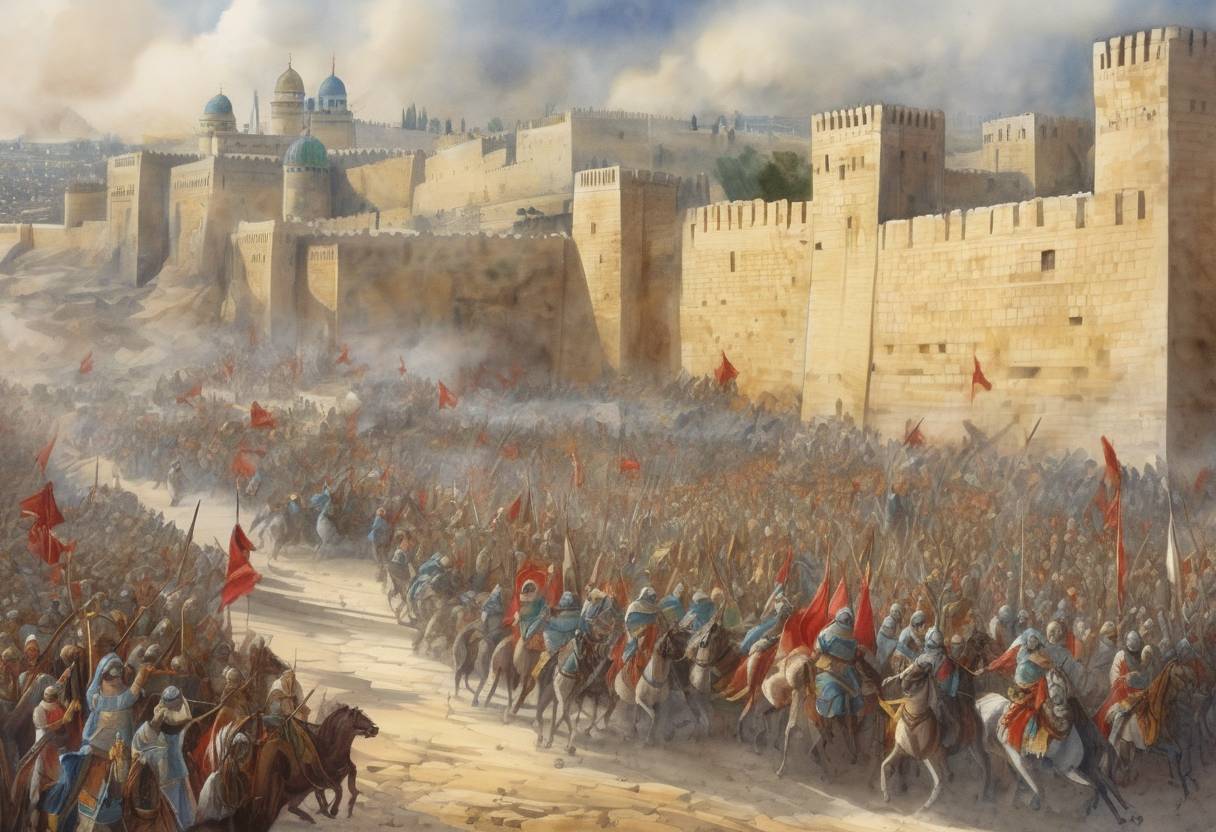
The Siege of Jerusalem: October 2, 1187
The Siege of Jerusalem, culminating on October 2, 1187, marked a pivotal moment in the history of the Crusades. This event saw the city of Jerusalem captured by Saladin, the Sultan of Egypt and Syria, and had profound implications for the Christian and Muslim worlds.
Background
The capture of Jerusalem by Saladin was part of a larger conflict known as the Crusades, a series of religious wars initiated by European Christians to reclaim the Holy Land from Muslim control. The First Crusade had successfully captured Jerusalem in 1099, establishing several Crusader states in the region. However, over the following decades, Muslim forces gradually regained strength and territory.
Saladin, a Kurdish leader who rose to power in the late 12th century, unified Muslim territories in Egypt and Syria. His leadership and military prowess posed a significant threat to the Crusader states. In 1187, Saladin launched a campaign to reclaim Jerusalem, which had been under Christian control for nearly 88 years.
The Siege
The siege began in September 1187, following Saladin’s decisive victory at the Battle of Hattin on July 4, 1187. This battle effectively crippled the Crusader forces, leaving Jerusalem vulnerable. Saladin’s army surrounded the city, cutting off supplies and weakening the defenders.
The defenders of Jerusalem, led by Balian of Ibelin, faced a dire situation. With limited resources and manpower, they were unable to withstand a prolonged siege. Balian negotiated with Saladin, seeking terms for surrender to avoid a massacre of the city’s inhabitants.
The Surrender
On October 2, 1187, Jerusalem surrendered to Saladin. Unlike the brutal sack of the city by the Crusaders in 1099, Saladin’s capture of Jerusalem was marked by relative mercy. He allowed for the peaceful evacuation of Christians, who were required to pay a ransom for their freedom. Those who could not afford the ransom were often freed through the charity of others, including Saladin himself.
Aftermath and Significance
The fall of Jerusalem was a significant blow to the Christian world and led to the call for the Third Crusade, which sought to recapture the Holy City. The loss of Jerusalem galvanized European leaders, including Richard the Lionheart of England, Philip II of France, and Frederick I Barbarossa of the Holy Roman Empire, to launch a new military campaign.
Saladin’s capture of Jerusalem is remembered for its strategic brilliance and the relative clemency shown to the city’s inhabitants. It solidified his reputation as a chivalrous and honorable leader, respected by both his allies and adversaries.
The event also highlighted the shifting power dynamics in the region and underscored the enduring religious and cultural significance of Jerusalem. The city’s capture by Saladin remains a key moment in the history of the Crusades, illustrating the complex interplay of faith, politics, and warfare in the medieval world.