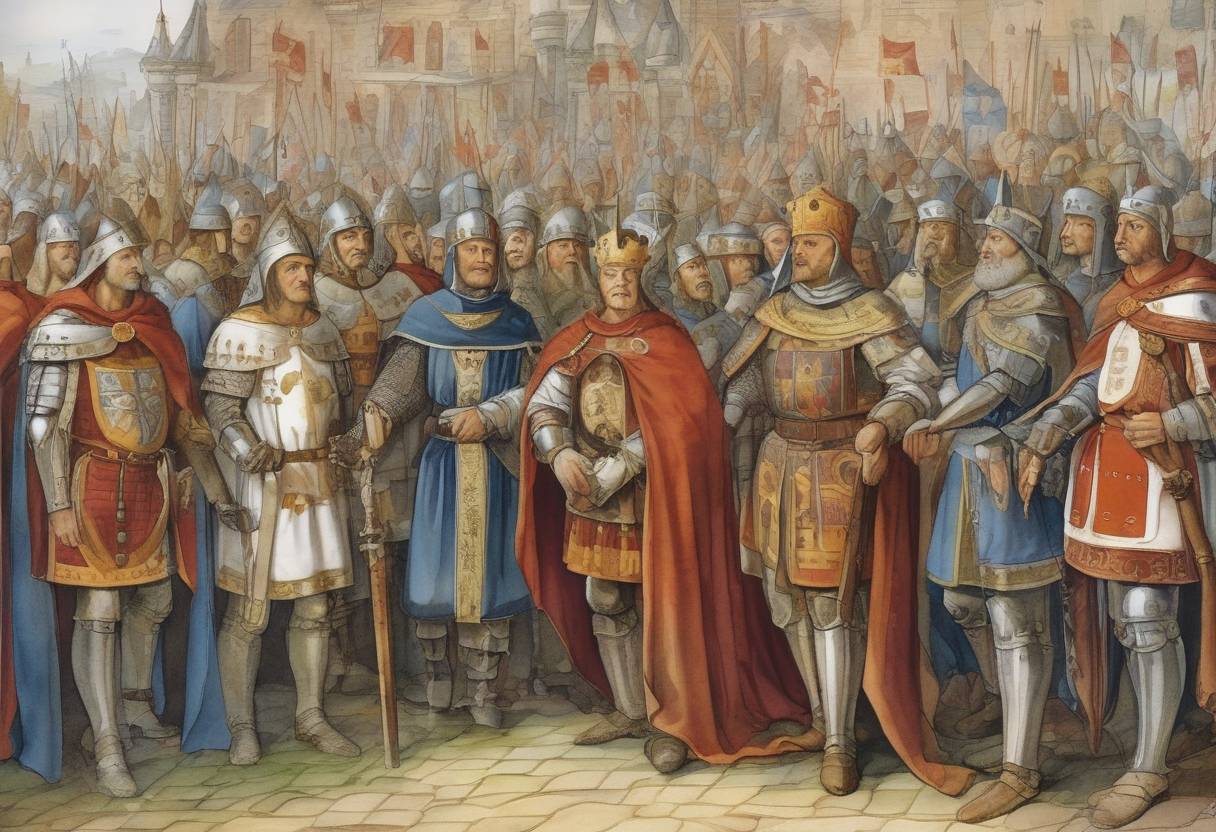
The Treaty of Meerssen, signed on August 6, 870, was a significant event in the history of the Carolingian Empire, marking another step in the fragmentation of the empire established by Charlemagne. This treaty was an agreement between the sons of Louis the German and Charles the Bald, two grandsons of Charlemagne, which further divided the territories of the once-unified Carolingian Empire.
Historical Context
- Charlemagne’s Empire: Charlemagne, also known as Charles the Great, was crowned Emperor of the Romans in 800 AD. His empire, often referred to as the Carolingian Empire, covered much of Western and Central Europe.
- Treaty of Verdun (843): After Charlemagne’s death in 814, his empire was inherited by his son Louis the Pious. Upon Louis’s death in 840, his sons fought over the empire, leading to the Treaty of Verdun in 843, which divided the empire into three parts among his sons: Lothair I, Louis the German, and Charles the Bald.
- Background: The Treaty of Meerssen was necessitated by the death of Lothair II, the son of Lothair I, in 869. Lothair II died without legitimate heirs, leading to a dispute over his kingdom, Lotharingia.
- Signatories: The treaty was signed by Louis the German, King of East Francia, and Charles the Bald, King of West Francia. Both were grandsons of Charlemagne and sons of Louis the Pious.
- Terms of the Treaty: The Treaty of Meerssen divided Lotharingia between Louis the German and Charles the Bald. This division was meant to settle disputes over the inheritance of Lothair II’s lands and to prevent further conflict between the two rulers.
Consequences
- Further Fragmentation: The Treaty of Meerssen further fragmented the Carolingian Empire, which had already been divided by the Treaty of Verdun. This fragmentation weakened the central authority and contributed to the eventual dissolution of the empire.
- Impact on Lotharingia: The division of Lotharingia between East and West Francia set the stage for future territorial disputes and influenced the political landscape of medieval Europe.
- Legacy: The treaty exemplified the challenges of maintaining a large empire in the face of internal divisions and external pressures. It highlighted the difficulties of succession and governance that plagued the Carolingian dynasty.
The Treaty of Meerssen is a pivotal moment in medieval European history, illustrating the complex dynamics of power, inheritance, and territorial control that shaped the continent during the early Middle Ages.