Shahrbaraz Crowned as King of the Sasanian Empire on April 27, 629
629 · Ctesiphon, Sasanian Empire
Shahrbaraz is crowned as king of the Sasanian Empire, marking a brief period of instability and rapid succession in the empire.
April 17, 0628
Khosrow II, the last great king of the Sasanian Empire, is overthrown by his son Kavadh II, leading to a significant shift in Persian power dynamics.
Ctesiphon, Sasanian Empire | Sasanian royal family
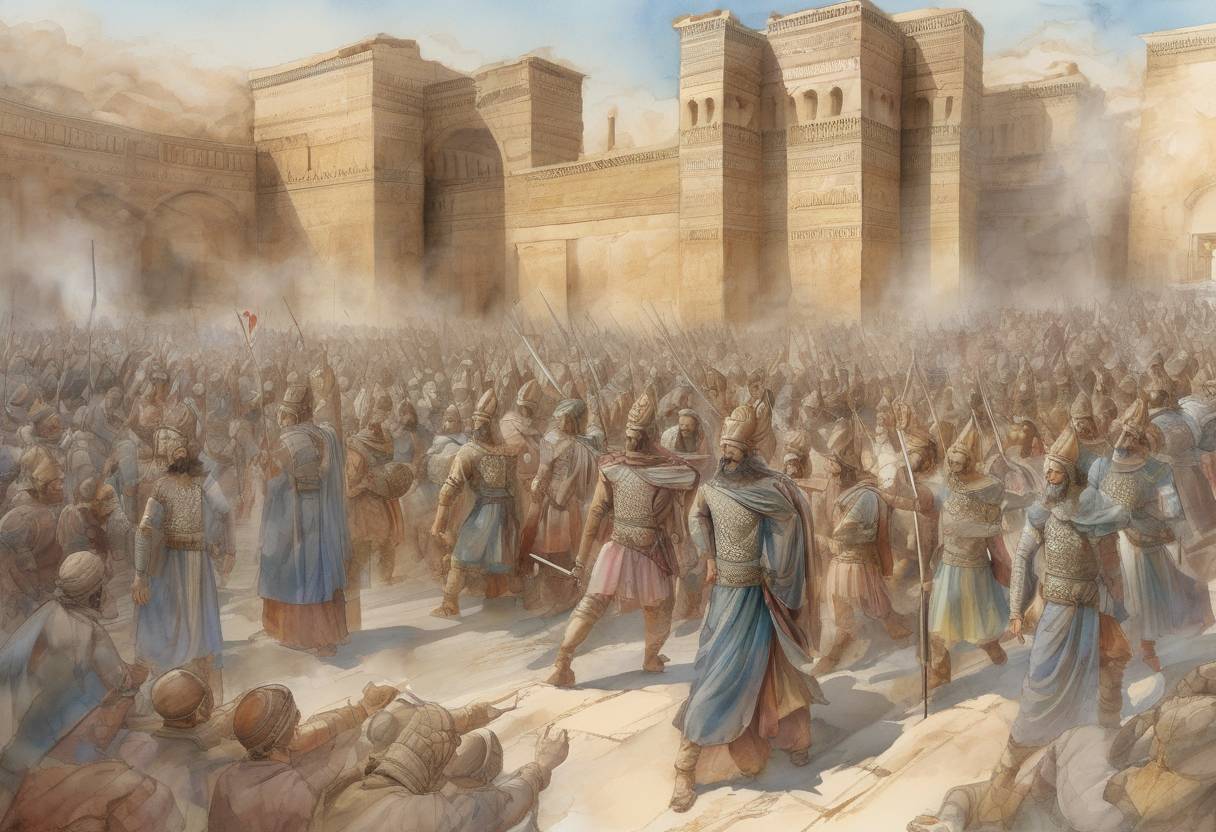
On April 17, 628, a pivotal event unfolded in the history of the Sasanian Empire: the overthrow of Khosrow II by his son, Kavadh II. This marked a significant shift in Persian power dynamics and heralded the decline of one of the most powerful empires of the ancient world.
Khosrow II, also known as Khosrow Parviz, ascended to the throne in 590 CE. His reign was initially marked by territorial expansion and prosperity. However, his later years were characterized by military overreach and internal strife. The protracted and costly Byzantine-Sasanian War (602–628 CE) severely strained the empire’s resources and weakened its military and economic stability.
Military Failures: The war with the Byzantine Empire, particularly the campaigns led by the Byzantine Emperor Heraclius, resulted in significant losses for the Sasanians. Heraclius’s successful counter-offensives, including the sacking of the Sasanian capital, Ctesiphon, exposed the vulnerabilities of Khosrow’s rule.
Economic Strain: The prolonged conflict drained the empire’s treasury, leading to economic hardship and discontent among the populace and the nobility.
Internal Dissent: Khosrow’s authoritarian rule and the heavy taxation imposed to fund the war efforts led to widespread dissatisfaction. This unrest provided fertile ground for political conspiracies.
Family Betrayal: Amidst this turmoil, Khosrow’s son, Kavadh II, also known as Shiroye, capitalized on the growing discontent. With the support of disgruntled nobles and military leaders, he orchestrated a coup against his father.
On April 17, 628, Kavadh II successfully deposed Khosrow II. Khosrow was imprisoned and later executed, marking a brutal end to his reign. Kavadh II’s ascension to the throne was initially seen as a potential stabilizing force, but his reign was short-lived.
Brief Reign of Kavadh II: Kavadh II’s rule lasted only a few months, as he died in September 628, possibly due to illness or poisoning. His brief reign did little to stabilize the empire.
Succession Crisis: Kavadh’s death plunged the Sasanian Empire into a period of chaos and rapid succession of rulers, further weakening the state.
Decline of the Sasanian Empire: The internal instability and weakened military left the empire vulnerable to external threats. This culminated in the Islamic conquests of Persia in the mid-7th century, which led to the eventual fall of the Sasanian Empire.
Historical Significance: The overthrow of Khosrow II and the subsequent decline of the Sasanian Empire marked the end of a significant era in Persian history. It paved the way for the rise of Islamic power in the region, fundamentally altering the cultural and political landscape of the Middle East.
In summary, the overthrow of Khosrow II by Kavadh II on April 17, 628, was a turning point that not only ended the reign of the last great Sasanian king but also set the stage for the empire’s eventual collapse and the transformative changes that followed in the region.
Source: en.wikipedia.org