Thomas Edison's Patent for the Two-Way Telegraph on August 9, 1892
1892 · West Orange, United States
Thomas Edison received a patent for his two-way telegraph, further advancing communication technology during the late 19th century.
November 29, 1877
Thomas Edison demonstrated his phonograph for the first time.
West Orange, United States | Edison Laboratory
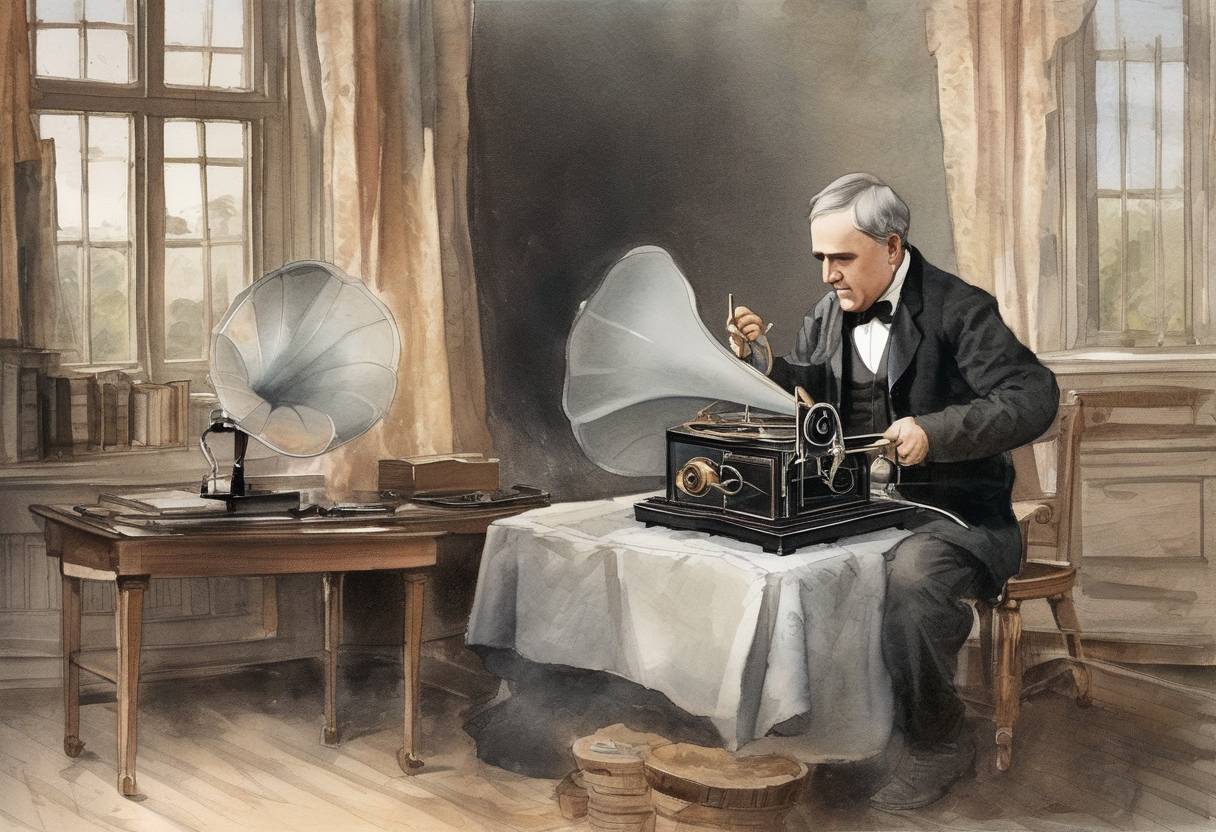
On November 29, 1877, Thomas Edison, one of the most prolific inventors in American history, demonstrated his latest invention, the phonograph, for the first time. This groundbreaking event took place at Edison’s laboratory in Menlo Park, New Jersey, marking a significant milestone in the history of sound recording and playback technology.
Thomas Edison had already established himself as a formidable inventor by the 1870s, with inventions such as the electric light bulb and the telegraph under his belt. The phonograph emerged from Edison’s work on improving the telegraph and telephone. His initial goal was to create a machine that could transcribe telegraphic messages onto paper tape, which could then be sent over long distances.
The phonograph was a novel device capable of recording and reproducing sound. It consisted of a cylinder wrapped in tinfoil, which was rotated by a hand crank. Sound vibrations were captured by a diaphragm and a stylus, which etched the sound waves onto the tinfoil as grooves. When the process was reversed, the stylus would trace the grooves, and the diaphragm would reproduce the original sound.
During the demonstration on November 29, 1877, Edison famously recited the nursery rhyme “Mary Had a Little Lamb” into the phonograph. To the astonishment of those present, the machine played back his voice, making it the first successful recording and playback of sound. This demonstration showcased the phonograph’s potential and captured the public’s imagination.
The phonograph was a revolutionary invention that laid the foundation for the modern music and recording industry. It opened up new possibilities for entertainment, communication, and the preservation of sound. Edison’s phonograph was the precursor to later developments in audio technology, including the gramophone and the vinyl record.
The invention also had a profound impact on Edison’s career, further solidifying his reputation as a leading innovator of his time. The phonograph’s success led to the establishment of the Edison Speaking Phonograph Company in 1878, which aimed to commercialize the technology.
Thomas Edison’s demonstration of the phonograph on November 29, 1877, was a pivotal moment in technological history. It not only showcased Edison’s ingenuity but also marked the beginning of a new era in sound recording and playback, influencing countless aspects of modern life and culture.
Source: en.wikipedia.org