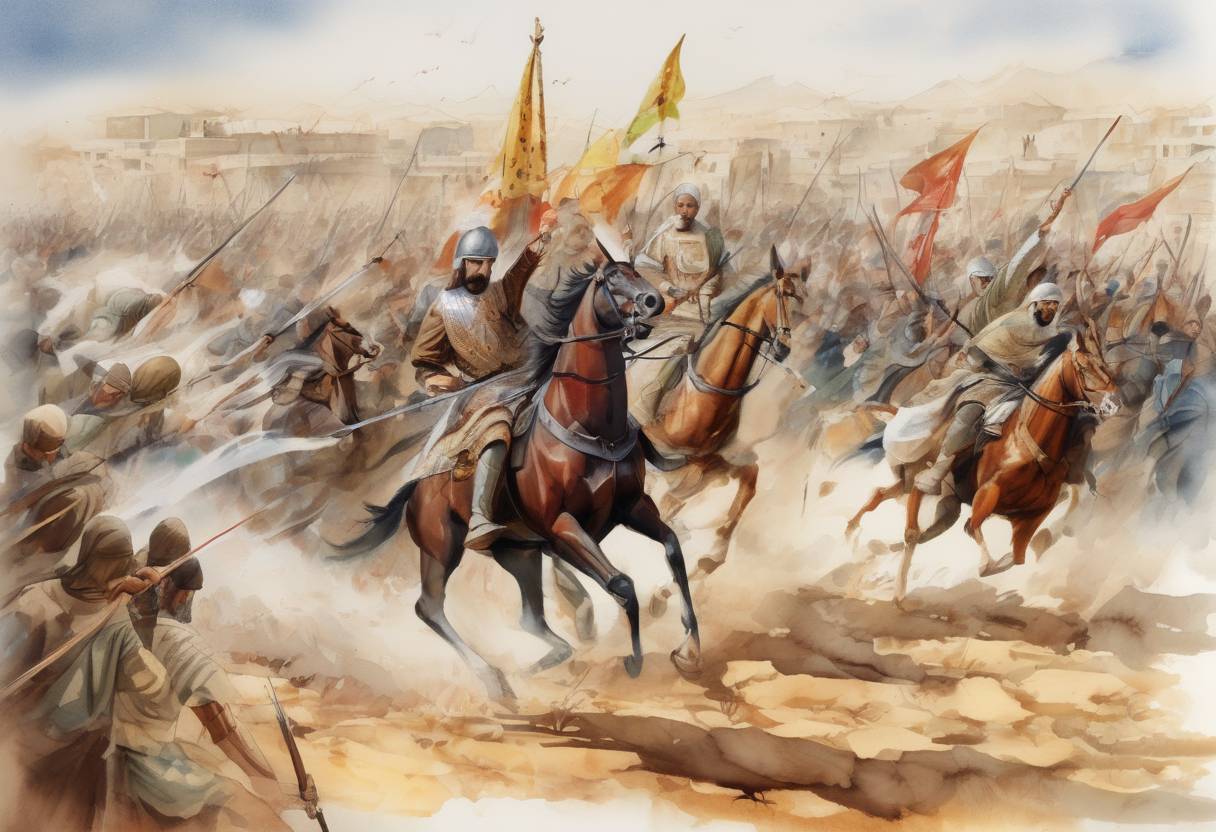
The Battle of Ajnadayn: A Decisive Clash
Date and Context
The Battle of Ajnadayn occurred on July 30, 634, not August 23, as sometimes mistakenly cited. This significant battle was fought between the forces of the Rashidun Caliphate and the Byzantine Empire. It marked a pivotal moment in the early Muslim conquests, showcasing the military prowess of the nascent Islamic state under the leadership of the Rashidun Caliphate.
Background
The early 7th century was a period of significant upheaval and transformation in the Middle East. The Byzantine Empire, though powerful, was weakened by decades of warfare with the Sassanian Empire. Meanwhile, the Rashidun Caliphate, under the leadership of Caliph Abu Bakr, sought to expand its territory and influence beyond the Arabian Peninsula.
The Muslim forces, led by generals Khalid ibn al-Walid and Amr ibn al-As, aimed to capitalize on the Byzantine vulnerabilities. The battle was part of a broader campaign to secure control over the Levant, a region of strategic and economic importance.
The Battle
The exact location of Ajnadayn is debated, but it is generally believed to have been in the region of modern-day Israel or Palestine. The battle saw the Muslim forces, estimated to be around 20,000 strong, face a Byzantine army of similar or slightly larger size.
Khalid ibn al-Walid, known for his tactical genius, employed strategies that maximized the mobility and cohesion of his forces. The Muslim army was well-organized and motivated, with a strong emphasis on discipline and unity.
The Byzantines, led by commanders such as Theodore Trithyrius, faced challenges in coordinating their diverse and multi-ethnic forces. Despite their numerical strength and experience, they struggled to adapt to the dynamic tactics of the Muslim army.
Outcome and Significance
The Battle of Ajnadayn resulted in a decisive victory for the Rashidun Caliphate. The Byzantine forces suffered heavy casualties, and their defeat marked a significant setback in their efforts to maintain control over the Levant.
This victory was crucial for the Rashidun Caliphate, as it paved the way for further Muslim advances into Byzantine territories. It demonstrated the effectiveness of the Muslim military strategies and the leadership of commanders like Khalid ibn al-Walid.
The battle also had broader implications for the region, contributing to the eventual decline of Byzantine influence in the Middle East and the rise of Islamic power. It set the stage for subsequent battles and conquests that would shape the political and cultural landscape of the region for centuries to come.
Aftermath
Following the victory at Ajnadayn, the Rashidun Caliphate continued its campaigns, eventually capturing key cities such as Damascus and Jerusalem. The success of these early conquests laid the foundation for the rapid expansion of the Islamic empire across the Middle East and beyond.
The Battle of Ajnadayn remains a significant historical event, illustrating the dynamic shifts in power during this transformative period in history.