Thomas Edison Files Patent for Optical Phonograph - October 17, 1888
1888 · West Orange, United States
Thomas Edison filed a patent for the Optical Phonograph (the first patented movies).
November 21, 1877
Thomas Edison announced his invention of the phonograph, a device for recording and replaying sound.
West Orange, United States | Edison Laboratories
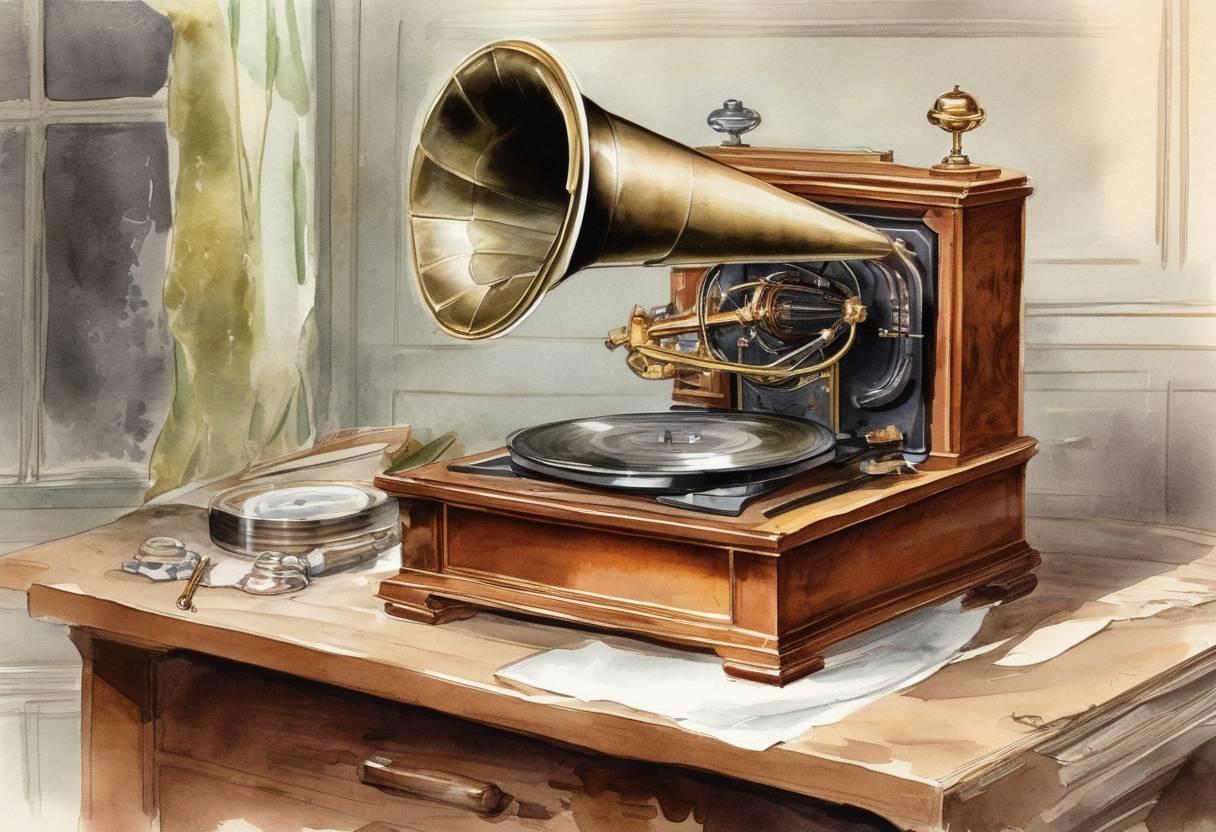
On November 21, 1877, Thomas Edison announced his invention of the phonograph, a groundbreaking device that could record and reproduce sound. This invention marked a significant milestone in the history of audio technology and had profound implications for the future of music, communication, and entertainment.
Thomas Edison, already renowned for his work on the telegraph and the electric light bulb, began experimenting with sound recording in the mid-1870s. His initial goal was to improve the efficiency of telegraphy and telephony. During these experiments, Edison conceived the idea of a device that could capture and replay sound.
The phonograph’s development was based on Edison’s understanding of sound waves and their ability to create impressions on a physical medium. The original phonograph used a tinfoil-covered cylinder and a stylus to record sound vibrations. When someone spoke into the mouthpiece, the sound waves caused the stylus to etch grooves into the tinfoil. By reversing the process, the phonograph could reproduce the original sounds.
Edison’s announcement of the phonograph took place on November 21, 1877, and quickly captured the public’s imagination. The device was demonstrated to the editors of “Scientific American” and other notable figures, who were astounded by its ability to play back recorded sound. The phonograph was dubbed the “talking machine,” and Edison was hailed as a wizard of invention.
The phonograph’s invention had far-reaching effects:
Cultural Impact: It revolutionized the way people experienced music and entertainment. For the first time, music could be recorded and played back, allowing for the mass distribution of audio content.
Technological Advancements: The phonograph laid the groundwork for future developments in audio recording and playback technology, influencing the creation of records, tapes, and eventually digital audio formats.
Commercial Success: Edison’s invention opened new markets and industries, including the music recording industry, which would grow exponentially in the following decades.
Following the announcement, Edison continued to refine the phonograph. By the 1880s, improvements in recording media and playback mechanisms made the phonograph more practical and commercially viable. The invention spurred competition and innovation, leading to the development of the gramophone and other audio technologies.
In summary, Thomas Edison’s announcement of the phonograph on November 21, 1877, was a pivotal moment in technological history. It not only showcased Edison’s ingenuity but also set the stage for the modern audio industry, transforming how people interact with sound and music.
Source: en.wikipedia.org